The first thing I notice when I watch Pixels (PIXEL) on-chain isn’t raw transaction volumeit’s the rhythm of activity. It comes in waves not a steady flow. You’ll see bursts of microtransactions tied to ingame actionsharvesting, crafting, tradingfollowed by quieter periods where wallets sit idle. That stop-start cadence tells me immediately this isn’t purely financial capital rotating; it’s behavioral capital tied to user engagement loops.
Most chains driven by speculation show sharp spikes around price volatility. Pixels behaves differently. The activity clusters around gameplay cycles. When new features drop or reward structures shift, wallets light upnot necessarily with large capital inflows, but with dense, repetitive interactions. That’s a different kind of signal. It’s closer to what I’ve seen in early playtoearn ecosystems, but with less brute-force farming and more nuanced participation.
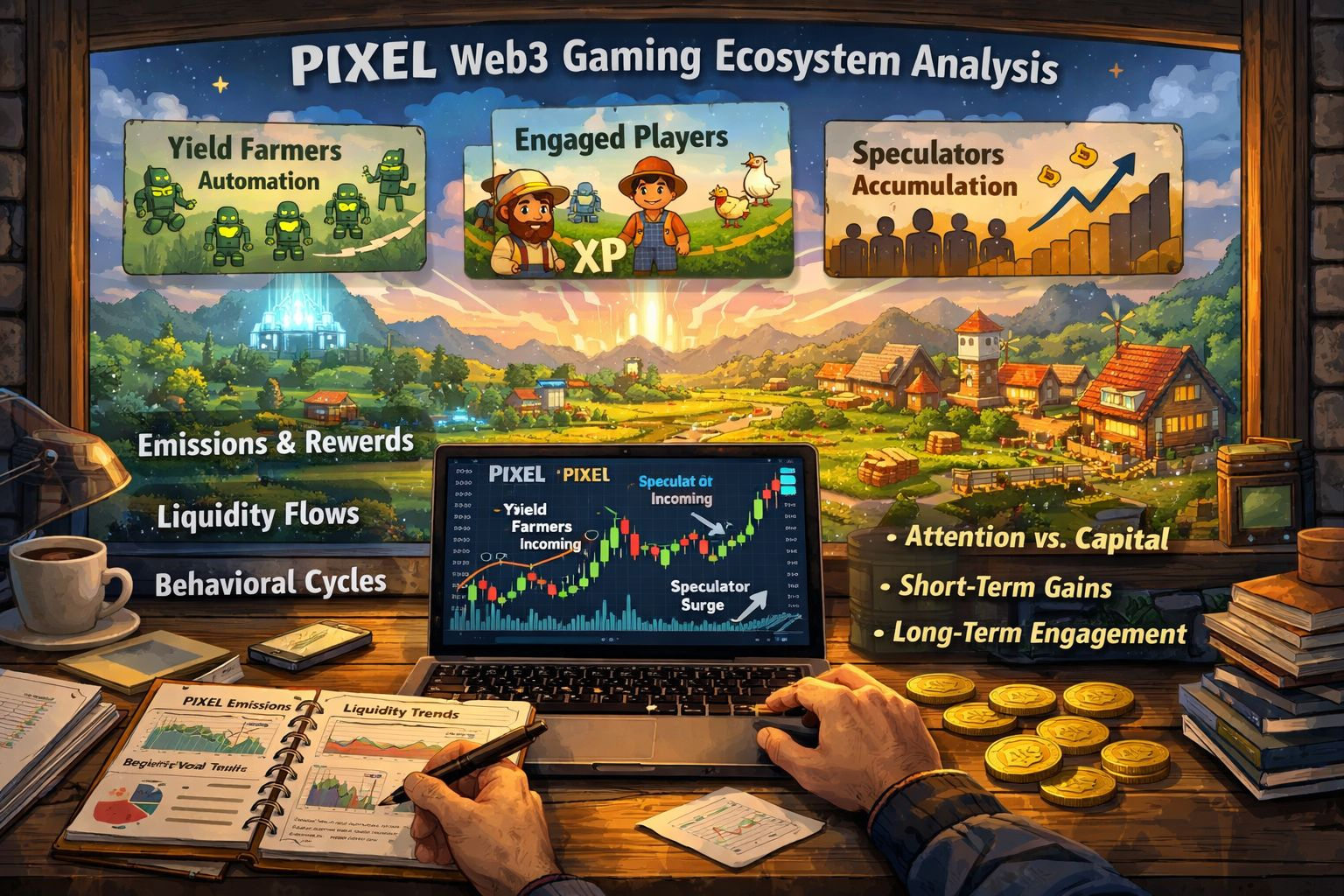
When I break down wallet behavior, I see three distinct participant classes forming. First, there are the extractive farmersaccounts that optimize for token output, cycling through tasks with mechanical efficiency. They’re not here for the game; they’re here for yield. You can spot them by their consistency and scale, often interacting across multiple accounts or synchronized time windows.
Then there’s a second layerengaged participants who actually play. Their transaction patterns are irregular, more human. They trade less frequently, hold assets longer, and interact with a broader set of in-game mechanics. This group is smaller, but structurally more important. They introduce friction into the system, which ironically stabilizes it.
Finally, there are the speculators. These are the ones bridging the in-game economy with external liquidity venues. They accumulate during low attention phases and distribute into hype cyclesoften front-running emissions or anticipated updates. Their presence is what connects PIXEL to the broader market cycle.
What’s interesting is how these three groups interact. The farmers generate supply pressure. The players absorb some of it through utility. The speculators arbitrage the imbalance. That triangle defines the economic structure more than any whitepaper ever could.
From an incentive design perspective, PIXEL sits in a delicate position. The system clearly leans on emissions to bootstrap activity, but the way those emissions are distributed matters more than their size. Instead of purely rewarding passive staking or capital lockups, rewards are tied to active participationtime, effort, and in-game decision-making.
That shifts the cost structure. You’re not just allocating capital; you’re allocating attention.
This is where I start to think about capital durability. Pure yield systems tend to attract mercenary liquidityfast in, fast out. But when rewards require behavioral input, you introduce switching costs. It’s no longer trivial to rotate capital because you lose accumulated progress, positioning, and familiarity.
That said, the barrier isn’t high enough yet to fully eliminate mercenary flows. You can still see wallets ramping up activity during high-reward periods and tapering off when yields compress. The stickiness is there, but it’s conditional.
Liquidity pacing is another subtle but important dynamic. PIXEL emissions don’t hit the market uniformly. They’re released through gameplay loops, which creates a kind of drip liquidity rather than sudden unlock events. On the surface, that looks healthierit avoids large supply shocks. But in practice, it creates constant low-level sell pressure.
You can see this in how price reacts. Instead of sharp drawdowns, you get slow bleed phases unless external demand steps in. This is typical of systems where rewards are continuously realized rather than periodically unlocked.
Where things get more interesting is around event-driven liquidity. Whenever the game introduces new mechanics, land expansions, or reward adjustments, you see a temporary tightening of supply. Players hold instead of selling, anticipating higher future utility. Speculators front-run this behavior, creating short-term demand spikes.
These are the windows where liquidity becomes asymmetric.
I’ve seen similar patterns in earlier cyclesAxie during its growth phase, certain DeFi protocols during liquidity mining expansionsbut PIXEL’s twist is that the trigger isn’t purely financial. It’s experiential. That makes the timing less predictable, but the reactions more organic.
From a microstructure standpoint, this creates fragmented liquidity conditions. On some days, the market behaves like a thinly traded altcoinhigh slippage, reactive moves. On others, it tightens up as ingame demand temporarily absorbs circulating supply.
That inconsistency is where experienced traders find edge. You’re not trading just priceyou’re trading behavioral cycles.
Long term, the question I keep coming back to is whether PIXEL can transition from an emission-driven economy to a self-sustaining one. Right now, incentives are doing most of the heavy lifting. They’re effective, but they’re also expensive.
If emissions compressand they will, either by design or necessitywhat happens to activity?
If the player base is genuinely engaged, you’ll see a partial retention. Transaction volume will drop, but not collapse. If, however, the majority of activity is still yield-motivated, the system will experience a sharp contraction. Wallets will go dormant, liquidity will thin out, and price discovery will become more volatile.
The early signals suggest a hybrid outcome. There is real engagement here, but it’s still intertwined with financial incentivesThe separation hasn’t fully happened yet
What I think the market underestimates is how important behavioral inertia can become in systems like this. Once users build routinesdaily tasks, social interactions, asset positioningthey don’t immediately disappear when yields drop. They decay slowly.
That decay curve is where long-term value either stabilizes or unravels.
PIXEL isn’t just competing with other tokens; it’s competing with user attention. And attention, once captured and structured correctly, can outlast capital flowsat least for a while.
The real test isn’t during expansion phases. It’s during compression.
That’s when you find out whether you’re looking at a game with a token, or a token with a game wrapped around it.