
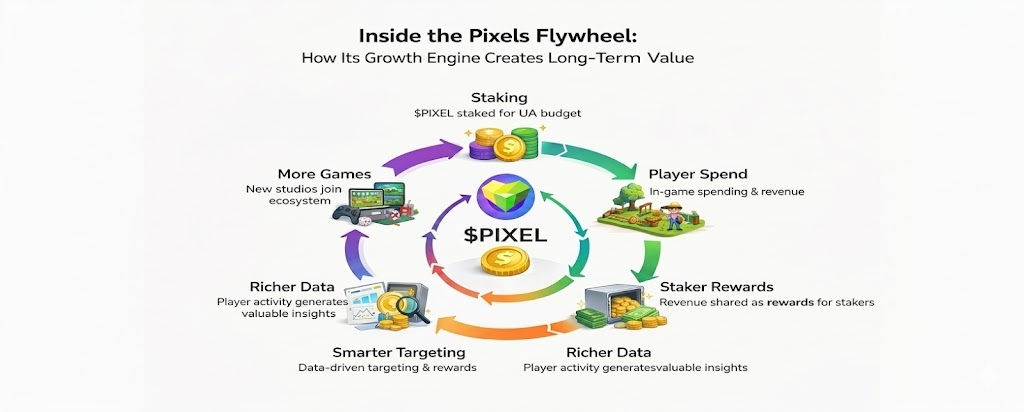
When I look at Pixels, I do not see it as only a game token trying to survive on price action. I see a project trying to build a full loop where players, capital, rewards, and data keep feeding back into each other. That is what makes the Pixels flywheel interesting to me. A lot of Web3 gaming projects talk about growth, but here the idea is explained in a more structured way. The system is meant to be circular, not one-directional. In simple terms, Pixels wants each dollar worth of $PIXEL entering the system to move through a closed loop again and again until the return becomes stronger than the reward cost. For me, that is the real long-term story here. It is not only about whether the token goes up or down in one week. It is about whether this engine can keep turning in a way that creates stronger value over time instead of leaking it away.
The flywheel starts with staking, and I think this is one of the smartest parts of the model. In the Pixels ecosystem, players can deposit $PIXEL or 1:1-backed $vPIXEL into the validator of their choice, which in this case is a game rather than a node. That stake then turns into an on-chain user acquisition budget, or UA budget, that the game studio can use for targeted in-game rewards instead of spending that money on outside ad platforms. I like this because it changes the role of staking. It is not just sitting idle for passive yield. It becomes part of a live growth engine. In other words, staked value is turned into a tool for attracting or re-engaging players inside the ecosystem itself. For me, that already feels more useful than many basic token systems, because the capital is being pushed directly into the growth side of the game economy instead of being separated from it.
The next part is where the loop becomes more real. Those UA credits are used to bring in new players and bring older players back into the game. Then, when those players actually spend inside the game, the gross revenue is recorded on-chain in the same contract that created the UA credits in the first place. That part matters a lot because it creates a visible link between subsidy and result. It is not just rewards going out with no structure behind them. The system is trying to measure how those rewards turn into actual spending and activity. From my point of view, that makes the model much stronger than random reward distribution. Then the flywheel keeps moving, because that revenue can support staker rewards. Each game decides its own reward structure for stakers, and the stronger the game becomes, the more competitive it can potentially be. So now the loop is already doing three jobs at once: stake becomes growth fuel, growth fuel brings player activity, and player activity feeds back into value for stakers.
What makes the Pixels flywheel even more interesting to me is the data layer behind it. Every purchase, quest, trade, or withdrawal is logged through the Pixels Events API, and that creates a growing first-party dataset across all games. The system is not only watching basic activity. It is collecting information around LTV curves, fraud scores, session depth, and churn vectors. I think this is where the project starts looking much bigger than a normal farming game. Data in this model is not just a report card. It becomes another output of the economy. After staking, spending, and rewards, the next thing produced by the flywheel is insight. And that insight matters because it helps the system understand which players are valuable, which behaviors support retention, and where rewards are being wasted. For me, that is a very important difference. Instead of rewarding everyone blindly, Pixels is building a loop where every interaction becomes part of a smarter decision-making process for the next cycle.
That leads directly into the next stage: smarter targeting. According to the model, the reward system retrains nightly, and budgets are adjusted toward the cohorts and moments in the funnel that create the strongest lift in retention, ARPDAU, and ultimately RORS. In easy words, the goal is to reduce wasted rewards and send better incentives to real players instead of extractors. I think this is one of the most valuable parts of the whole design. In many Web3 projects, rewards leak out because people farm them without adding long-term value. Pixels is trying to tighten that gap by using its data loop to improve the quality of distribution. Then from there, the flywheel moves into growth again, because better UA efficiency becomes visible on-chain. That means new studios can look at the model and estimate acquisition efficiency before they even fully launch. Each new game then expands the audience, adds fresh behavior data, and restarts the loop from a stronger base. For me, this is why it is called a flywheel and not a treadmill. It is supposed to compound, not just burn energy in place.
When I connect this model with the current market data, the story becomes even more interesting. PIXEL is trading around $0.00828–$0.00830, with a 24-hour high of $0.00861 and a 24-hour low of $0.00745. The token is showing about +7.25% to +7.51% on the day, and the performance data also shows +20.17% over 7 days. At the same time, the longer time frames are still weak, with -29.41% over 30 days, -13.93% over 90 days, -54.41% over 180 days, and -68.06% over 1 year. For me, that says the short-term momentum has improved, but the broader recovery story is still unfinished. The wider token metrics also matter here. The market cap is around $27.94M, the fully diluted market cap is $41.3M, and the 24-hour volume is $27.8M. The Vol/Market Cap ratio is 99.48%, which tells me market activity is very high relative to the token’s size. The circulating supply is 3.38B PIXEL, while the total and max supply are both 5B PIXEL. So even though the token is still far below its all-time high of $1.0224, it is clearly not inactive.
The trading and money flow data add another layer to that picture. On the order book screen, the market shows about 71.11% bid against 28.89% ask, which suggests stronger buy-side interest at that moment. The 24-hour trading volume is shown as 551.11M PIXEL and 4.44M USDT, so attention is definitely there. On the money flow side, total buy volume is 551.81M PIXEL compared with total sell volume of 550.35M PIXEL, leaving a net inflow of 1.46M PIXEL. The medium orders show a positive inflow of 20.28M, while large orders show -8.36M and small orders show -10.46M. Then on the 5 x 24 hours large inflow section, the total large inflow over 5 days is -38.72M, with daily values including -17.33M, -11.72M, +3.89M, -5.45M, and another negative day in the last 24 hours. For me, this says the market is active and buyers are present, but larger flows still look mixed. So I would not call this a full confidence return yet. I would call it a market that is paying attention again while still waiting for stronger proof.
That is why I think the Pixels flywheel matters so much in the long run. Price can move for many reasons, and short-term trading can always change quickly. But a real long-term value engine has to do more than create temporary excitement. It has to keep recycling capital, player activity, and data in a way that gets stronger over time. That is exactly what Pixels is trying to build through staking, UA credits, player spend, revenue share, staker rewards, data collection, smarter targeting, and more games entering the ecosystem. For me, the beauty of this model is that the same unit of $PIXEL can play multiple roles inside the loop instead of being used once and forgotten. It can start as stake, return as reward, show up as revenue share, and then become a data point that improves the next round of distribution. That does not guarantee success, but it does give Pixels a more serious long-term framework than many projects in this space. And honestly, that is why I still think the flywheel is one of the strongest reasons to keep watching Pixels closely.
