
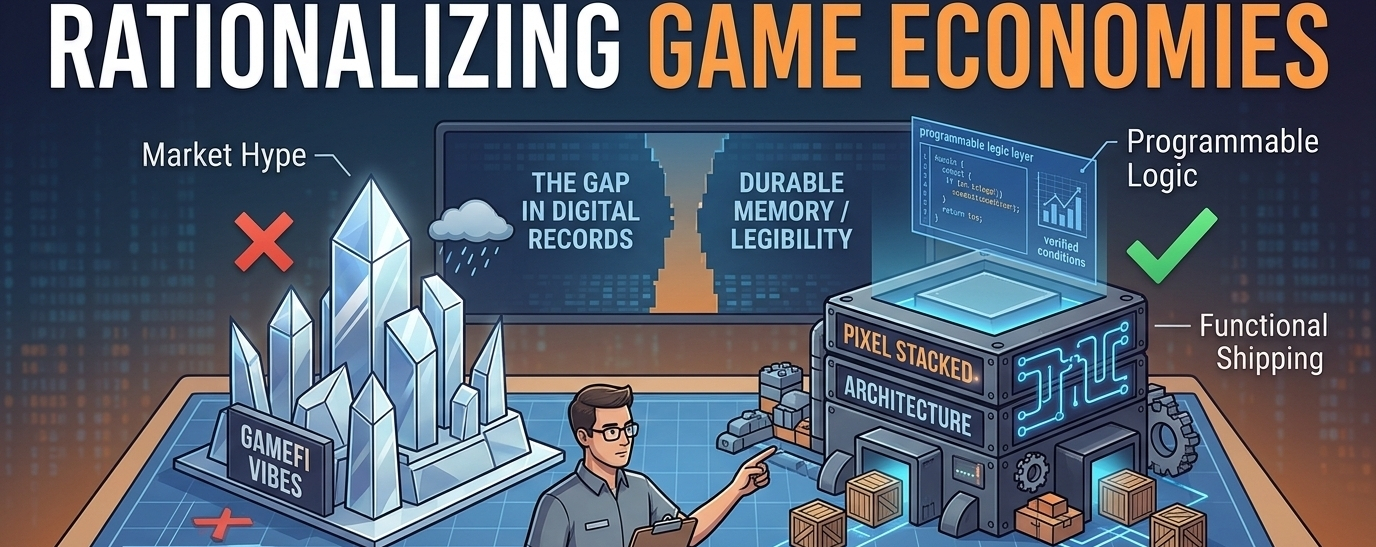
I keep noticing a fundamental shift in how we treat the concept of a game economy. For years, these systems were static, hardcoded loops that broke the moment they met a live audience.
Pixels has spent the last four years moving toward a programmable layer of coordination called Stacked. The transition is subtle but the implications are massive. It is no longer about a fixed set of rules inside a single game like Pixels. Instead, it is a rewarded LiveOps engine that treats player behavior as a verifiable input for an automated economic layer!
By shifting the logic away from the game client and into a centralized coordination layer, they have created a system that reacts to verified conditions in real time. That is the difference between a game that has a token and an ecosystem that functions as a programmable economy.
The industry is currently drowning in vibes and speculative whitepapers about the future of play to earn. I am more interested in the functional shipping of tools that survive adversarial usage. Stacked was not born in a deck, it was reverse engineered from the failures of early GameFi.
Most reward systems are half baked ideas that attract bots and drain liquidity. Stacked rejects this by focusing on the unsexy mechanics of fraud prevention and behavioral data at scale. The difference is visible in the receipts. This infrastructure already powers millions of players across Pixels and Pixel Dungeons, contributing to over 25M in revenue!
It is a battle tested engine designed to ship actual rewards, cash, crypto, or gift cards to players who show up. The shipping reality here is that the team spent years building a moat against bots and economic leakage. They are now offering that same infrastructure to external studios as a B2B service. That gap between a concept and a functional, auditible ROI is larger than it looks.
We often treat digital records as temporary, but data is useless unless it preserves its proof over time. In the Pixels ecosystem, $PIXEL is evolving from a single game currency into a cross-ecosystem attestation of value.
The memory gap in gaming is usually the loss of player history when moving between titles. Stacked uses an AI game economist to bridge this, creating a durable record of how a player interacts with different mechanics. This AI layer does not just look at current spend, it analyzes cohorts to understand why a whale drops off or what a loyal user does before day 30.
By anchoring these rewards and behaviors in a system that tracks continuity, the team ensures that meaning is preserved across different systems. It is not just about giving a reward, it is about the legibility of that player’s value to the entire ecosystem over the long term. this continuity is what makes a digital economy durable rather than disposable!
The redirect of billions in ad spend directly to verified players is how we finally scale sustainable digital coordination.