
I didn’t notice it at first, but I kept coming back to the same kind of game.
Not because it had the best graphics or the deepest mechanics, but because it was easy to return to. I could log in, do a few things, make a bit of progress, and leave without feeling lost the next time I opened it. There was a rhythm to it. Small actions, repeated over time, quietly stacking into something that felt like mine.
And that’s where the difference started to show.
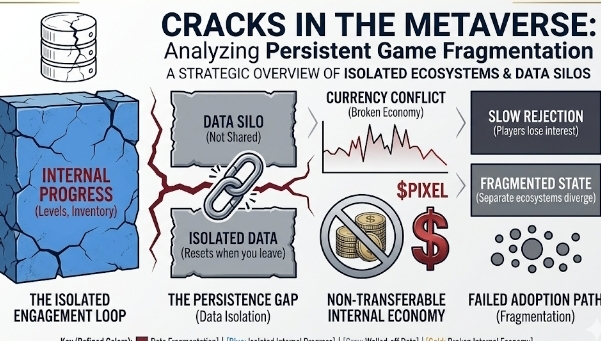
Most games are good at capturing attention, but not as good at holding continuity. You play, you progress, but everything is contained. Your time stays inside that system. The moment you leave, it’s paused, isolated, almost invisible to anything outside it.
At that moment, I realized the issue wasn’t engagement—it was persistence in a broader sense. Not just saving progress, but making that progress exist somewhere that isn’t tied completely to one environment.
That’s when something like @PIXEL started to make more sense to me. Not as a game itself, but as something sitting slightly underneath the experience.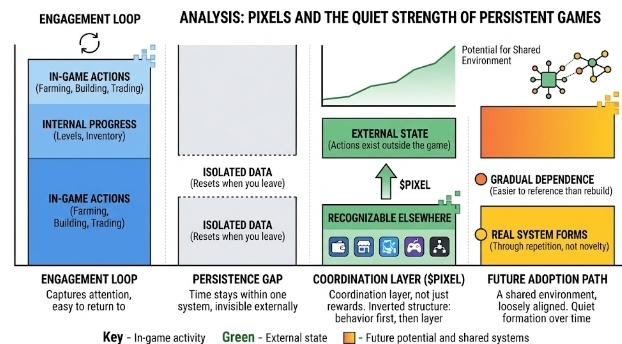
Initially, I thought it was unnecessary. If a game is already enjoyable, why add another layer? Why introduce tokens, external tracking, or shared state when players are already satisfied just playing?
It felt like adding structure to something that was working fine without it.
But then I started looking at it differently.
The role of $PIXEL isn’t just about rewards or in-game currency. It acts more like a coordination layer. A way to represent actions, ownership, and participation in a format that isn’t locked inside the game itself.
So instead of progress being meaningful only within one system, it becomes something that can be recognized elsewhere. Not automatically everywhere, but potentially anywhere that chooses to read from that same source.
That changes the shape of the experience, even if the player doesn’t fully notice it.
A simple action—farming, building, trading can carry weight beyond the immediate loop. Not because the game tells you it matters, but because the state exists outside the game’s boundaries. It can be verified, referenced, or extended.
What I find interesting is that the strength here isn’t coming from complexity. It’s coming from the fact that the game is actually enjoyable on its own.That part feels easy to overlook.
A lot of systems try to build external layers first, hoping engagement will follow. Here, it seems inverted. The activity already exists. People are already playing. The layer forms around behavior, not the other way around.
But I don’t think this guarantees anything, at least not yet.
There’s still a real question of whether players care about that external state. If the game works without it, the added layer has to justify itself quietly. It can’t interrupt the experience or demand attention. It has to prove usefulness over time.
And then there’s the broader ecosystem problem.
For something like $PIXEL to matter beyond a single game, other systems need to recognize it. That means coordination, shared standards, and a willingness to rely on something external. Most platforms aren’t designed that way. They prefer to stay closed, to control their own data and logic.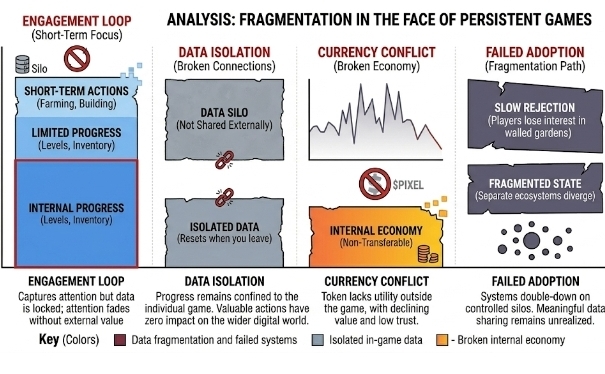
So even if the foundation is there, expansion isn’t automatic.Upon reflection, though, the more realistic path isn’t sudden adoption. It’s gradual dependence.
If players keep showing up, keep interacting, and their actions consistently map to something persistent, then over time, other systems might start to reference that. Not because they have to, but because it’s easier than rebuilding the same context from scratch.That’s where it starts to feel like more than just a game.
You begin to see the outline of a shared environment, where different experiences can connect through a common layer of truth. Not tightly integrated, but loosely aligned. Each system doing its own thing, but still able to recognize what happened elsewhere.I’m still somewhere in the middle with it.
I hold a small amount of $PIXEL, mostly to stay close to how things evolve. I’m not fully convinced the external layer becomes essential, but I can see the conditions where it might.The signal, for me, is simple.
If players continue to engage even when the novelty fades, and if their actions start to matter outside the immediate game loop—if other systems begin referencing that activity without forcing it—then something real is forming.Not loudly, not all at once, but through repetition.
A game people actually enjoy, quietly producing a layer other systems might eventually rely on.