
I’ve been around Web3 gaming long enough to recognize the usual cycle.
New game launches → hype builds → rewards look attractive → players rush in → tokens start getting farmed → value leaks out → attention fades.
It’s predictable at this point.
That’s exactly why I didn’t expect much when I first came across @Pixels
At a glance, it looked like another casual farming game with a token attached. Bright visuals, simple mechanics, familiar loops. The kind of setup we’ve seen many times before.
But the more time I spent actually observing how the system works, the more it started to feel… different.
Not because it’s doing something flashy.
But because it’s quietly solving problems most GameFi projects ignore.
The Real Problem With GameFi Isn’t Gameplay. It’s the Economy
Most Web3 games don’t fail because they’re boring.
They fail because their economies don’t hold.
You can build a visually great game, add quests, rewards, NFTs, tokens… but if the underlying system rewards extraction more than participation, it eventually collapses.
Players don’t stay where value disappears.
And that’s where $PIXEL starts to stand out.
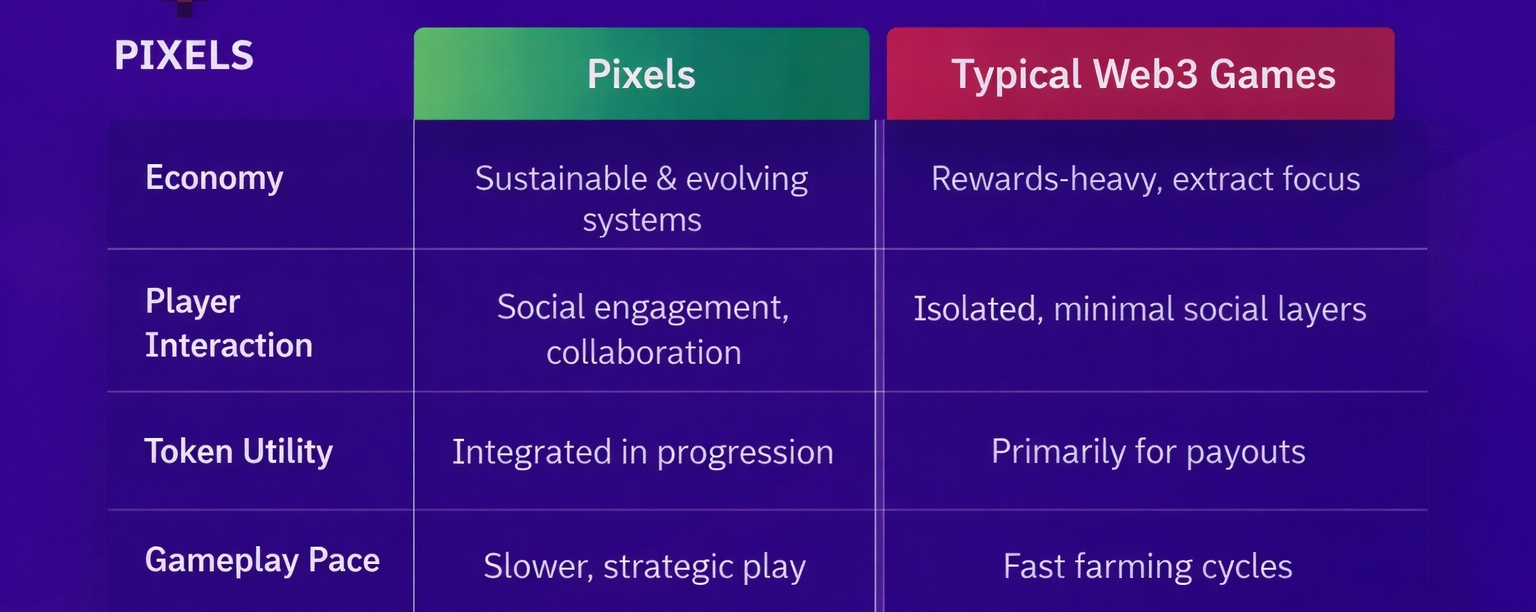
Instead of designing around short term reward distribution, the focus feels more aligned with sustained player activity. The loops aren’t built just to pay players, they’re built to keep them engaged in a system that evolves over time.
That’s a very different foundation.
From “Play to Earn” to “Play and Participate”
There’s a subtle but important shift happening inside @Pixels.
It’s not just about earning tokens anymore.
It’s about participating in a living economy.
When you farm, craft, trade, or upgrade skills, you’re not just grinding for rewards. You’re interacting with a system where your decisions start to matter more over time.
Skill progression becomes important.
Resource management matters.
Timing matters.
And most importantly, your approach to the game affects your outcome.
That’s something traditional GameFi models rarely achieve. They usually reduce gameplay to repetitive actions with predictable returns.
Here, it feels less linear.
More open.
The Social Layer Isn’t an Add On. It’s the Core
One thing that surprised me was how naturally social interaction fits into the experience.
In many Web3 games, “community” is something that exists outside the game. Discord servers, Twitter threads, separate marketplaces.
Inside the game, you’re usually alone.
Pixels flips that.
You see players around you.
You interact, trade, coordinate.
Land usage, shared spaces, and in game economies create natural points of connection.
That changes everything.
Because once players feel part of something, not just a system to extract value from, retention starts to shift.
People don’t just log in for rewards.
They log in because they’re part of the environment.
Why $PIXEL Is More Than Just an In Game Token
A lot of gaming tokens struggle because their only purpose is reward distribution.
Once rewards slow down, demand disappears.
That’s where $PIXEL is evolving differently.
Its role is gradually expanding beyond just being a payout mechanism.
It connects multiple layers of the ecosystem.
It ties into progression.
It influences participation.
It reflects activity rather than just emission.
And as the ecosystem grows, especially with more features, integrations, and potential expansion into multiple game experiences, the utility surface naturally expands.
That’s how a token survives long term.
Not through hype, but through relevance.
Pacing Might Be the Most Underrated Advantage
One thing that stands out when you spend time in @Pixels is the pacing.
It’s slower compared to most Web3 games.
At first, that might feel like a downside.
But it’s actually one of its biggest strengths.
Fast reward cycles attract attention, but they also attract short term behavior.
Slower systems encourage planning.
They push players to think instead of just grind.
They create space for progression instead of instant extraction.
And over time, that leads to a healthier economy.
Because not everyone is rushing to farm and exit at the same time.
The Risk Still Exists. Let’s Be Real
No GameFi project is risk free.
And pixels isn’t an exception.
Retention is still the biggest challenge.
It’s easy to attract users when rewards are strong.
The real test is what happens when those rewards stabilize.
Do players stay?
Do they still find value in the experience itself?
That’s where most projects fail.
And that’s the part pixels still has to prove over time.
But Here’s What Feels Different
Even with that uncertainty, there’s something worth paying attention to.
The design choices feel intentional.
The system doesn’t scream for attention.
It builds quietly.
It focuses on behavior, not just incentives.
It leans into interaction instead of isolation.
And it tries to create an environment where players actually want to spend time, not just extract value.
That combination is rare.
Where This Could Go
If pixels continues in this direction, it has the potential to move beyond being “just another Web3 game.”
It could become a framework for how sustainable game economies are built.
A place where:
Players contribute instead of just farm
Economies evolve instead of inflate
Tokens represent activity instead of just emissions
Communities form inside the experience, not outside it
That’s a much bigger vision than most projects aim for.
Final Thoughts
I’m not here to say this is the next guaranteed success.
That’s not how this space works.
But I am saying this…
Pixels is one of the few projects that doesn’t feel like it’s built for a quick cycle.
It feels like it’s trying to last.
And in Web3 gaming, that alone is worth paying attention to.
Because the real winners won’t be the ones that attract the most players at launch…
They’ll be the ones that still have players showing up months later, even when the easy rewards are gone.
That’s the real test.
And that’s exactly what I’m watching with pixel