
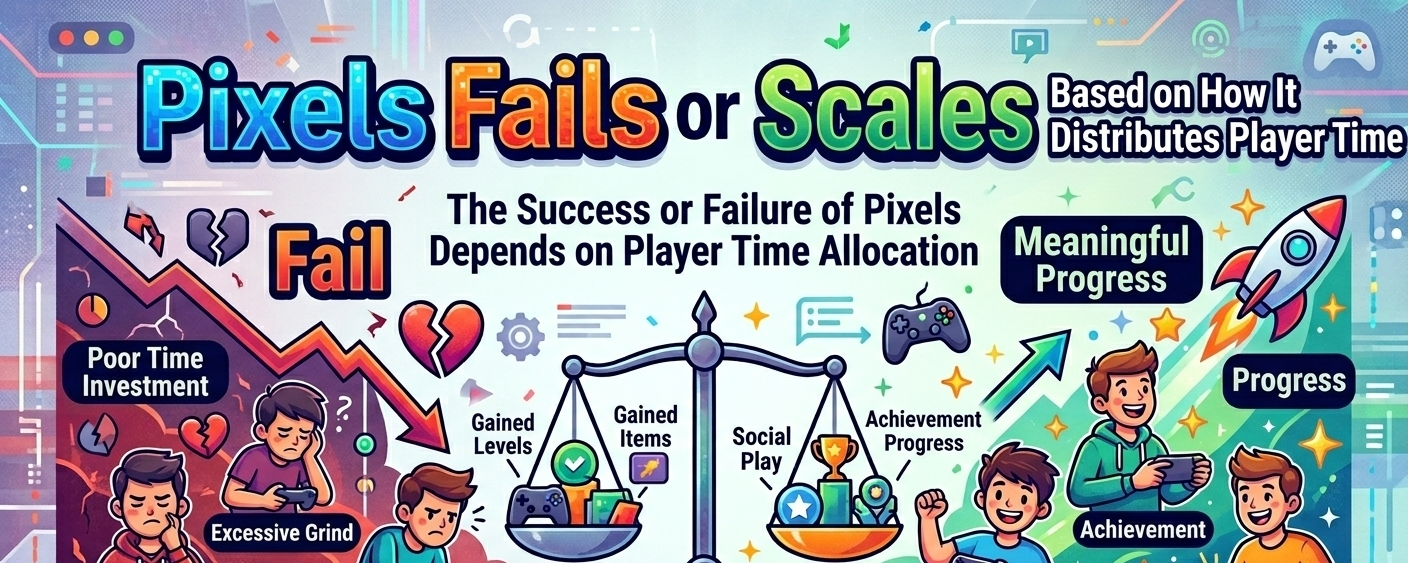
Pixels functions as a time allocation system where farming, exploration, and creation compete under different return profiles. Farming provides consistent, quantifiable output per action, exploration introduces variable outcomes tied to discovery, and creation converts accumulated inputs into persistent, visible artifacts. The system forces trade-offs because time spent in one layer directly delays progress in the others, making player choice the core driver of progression rather than content consumption.
The competition between these layers is enforced through output structure. Farming scales linearly with time, making it predictable and easy to optimize. Exploration breaks that linearity by offering uneven rewards that depend on movement and discovery, which cannot be perfectly planned. Creation sits behind both, requiring prior inputs and additional time, but produces non-linear returns through persistence and visibility. This creates a decision surface where players must continuously choose between short-term efficiency and long-term identity.
The imbalance risk emerges because players naturally drift toward the highest return per unit of time. If farming output remains the most reliable path to progress, time allocation compresses into repetitive cycles, reducing exploration to a supporting role and standardizing creation outputs. This is not a content failure but a structural one, where the system unintentionally rewards optimization over variation.
Pixels attempts to counter this by making creation outputs visible across the shared environment, turning them into signals that influence how other players navigate and interact. This introduces indirect returns, where time spent on creation affects social positioning and recognition rather than immediate resource gain. The system relies on this layer to pull time away from pure efficiency loops and redistribute it into expressive behavior.
Ronin enables this structure by minimizing execution friction, allowing frequent transitions between activities without cost buildup. This is necessary because time allocation decisions only matter if switching between actions is seamless. However, infrastructure cannot rebalance incentives. If one layer consistently outperforms others in measurable output, player behavior will converge regardless of how smooth the system feels.
The failure mode is convergence of behavior into a single dominant loop. When most players allocate time similarly, farming patterns become uniform, exploration paths narrow into predictable routes, and creation outputs lose differentiation. At that point, identity weakens because it no longer reflects unique choices, and retention shifts toward obligation-driven repetition. The system stops distributing time and starts dictating it, breaking the condition required for long-term engagement.
