
Web3 games have spent years selling the same dream in different wrappers. Own your assets. Earn rewards. Join the future of gaming. The language changes, the branding gets better, and the token names rotate, but the core problem often stays the same. Too many of these games feel like economies searching for a world, not worlds worth living in.
Pixels stands out because it understood that problem early, whether by instinct or by design. It did not try to win people over with ownership alone. It built something softer, stickier, and in many ways smarter: a social farming world that people could actually settle into. That is a very different ambition from simply launching a blockchain game. It means creating not just activity, but routine. Not just rewards, but attachment. Not just mechanics, but a place people want to return to.
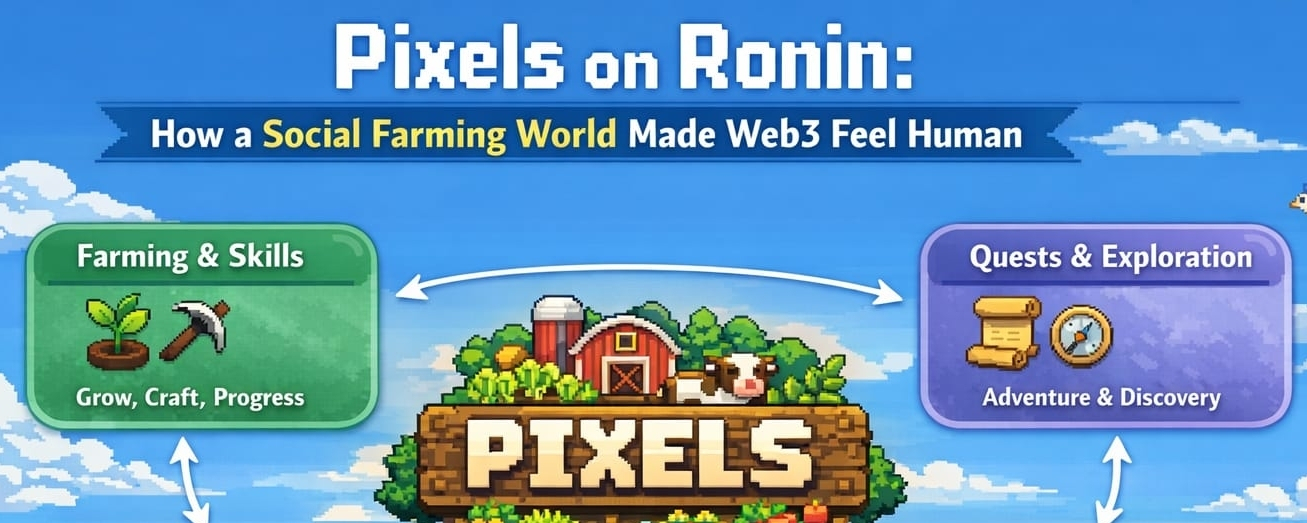
At first glance, Pixels seems simple. A pixel-art farming game. Crops, animals, quests, skills, gathering, crafting, and a bright, inviting world. But that surface simplicity hides the real reason it works. The game is not built around one single promise. It is built around overlap. Farming connects to skills. Skills connect to progression. Progression connects to quests. Quests connect to movement across the world. The world connects people. And then blockchain ownership sits underneath all of it, not always shouting for attention, but quietly shaping how value, identity, and persistence feel inside the experience.
That is what makes Pixels more interesting than the average Web3 project. It does not feel like a game that had crypto pasted on top of it at the last minute. It feels like a game trying to answer a more difficult question: how do you make blockchain ownership feel natural inside a world people genuinely enjoy inhabiting?
The answer, in Pixels, starts with farming. That may sound too modest for a space obsessed with scale, innovation, and disruption, but farming is exactly the kind of mechanic that can hold a world together. Good farming games are never only about crops. They are about rhythm. They are about returning. They are about learning a place well enough that it starts to feel familiar. You plant, harvest, improve, adjust, repeat. In weaker games, repetition becomes boredom. In better ones, repetition becomes intimacy.
Pixels leans into that second possibility.
The farming loop gives players something grounded to do, but it also gives the world a pulse. Instead of being pushed through a narrow path, players develop their own patterns. Some focus on efficiency. Some care more about quests. Some become absorbed in skills and optimization. Some are drawn to the social side, the guilds, the friendships, the feeling of existing in a shared environment rather than simply clicking through isolated tasks. Others are interested in the asset layer, the ownership side, the idea that what they build or collect can have a lasting form beyond a closed in-game database.
What is impressive is that these motivations do not always clash. In many Web3 games, the economy dominates everything else. Players stop feeling like participants in a world and start feeling like workers inside a reward machine. Pixels avoids the worst version of that by making the world itself matter. It gives players enough different ways to engage that no single motivation completely swallows the experience. That balance is delicate, and probably never perfect, but it is one of the game’s strongest achievements.
Its move to Ronin helped sharpen that identity.
That migration was not important just because it happened on a popular gaming-focused blockchain. It mattered because Ronin was a natural home for the kind of experience Pixels was trying to become. A social farming world cannot afford too much friction. It lives or dies on repetition. Players need to move easily between playing, trading, owning, and progressing without feeling like they are constantly stepping outside the game to deal with the machinery underneath it. When blockchain becomes too visible, too clunky, or too ceremonial, it breaks immersion. The player stops feeling present in the world and starts feeling like a user performing transactions.
Pixels needed infrastructure that could support the illusion of continuity.
Ronin gave it that support, or at least gave it a much better chance of achieving it. And that matters more than people sometimes admit. In game design, convenience is not a side issue. It is emotional architecture. The smoother a system feels, the easier it becomes for a player to believe in the world surrounding it. If the ownership layer is painful, then ownership stops feeling empowering and starts feeling like admin. If it flows smoothly, then it becomes part of the fabric of play.
That is where Pixels made a smart move. It did not just join an ecosystem. It found a chain that was aligned with the daily life of the game it wanted to run.
Still, infrastructure alone does not create loyalty. Systems do.
One of the reasons Pixels has staying power is that it gives players several overlapping reasons to return. Quests are a big part of that. Open-ended games are exciting in theory, but total openness can easily become drift. People need orientation, especially early on. Quests solve that problem without suffocating freedom. They provide short-term clarity inside a long-term sandbox. They give players direction while still leaving room for self-defined play.
That matters because Pixels is not trying to be a tightly scripted experience. It is trying to be a world. Worlds need structure, but they also need looseness. Too much structure and the place starts to feel mechanical. Too little, and it loses shape. Pixels sits in that middle zone by using quests as a guide rather than a cage.
Then there are the skills, which are more important than they may first appear.
Skills change the emotional meaning of repetition. A player is not simply harvesting again, crafting again, or gathering again. They are becoming better at something. That shift is subtle, but powerful. It turns action into identity. In almost every successful long-term game, progression works best when it does more than increase numbers. It needs to make the player feel distinct, more capable, more rooted in the world than they were before. Skills help create that feeling. They tell the player that time spent here is not just time passed. It is time that has accumulated into competence.
And once competence appears, attachment usually follows.
Pixels also understands that relationships should not be treated like decoration. This may be one of the clearest reasons it feels alive. Many games say they are social, but what they really mean is that players can stand near each other, chat, or join a guild that provides minor convenience. The actual game still happens elsewhere. The social layer is there, but it is thin.
Pixels does something more interesting. It makes relationships structurally useful. Guild access, collaboration, community spaces, and social coordination are not just aesthetic additions around the edges. They are part of how players actually move through the world. That changes the atmosphere completely. It means another player is not merely background noise. They can matter to your progress, your access, your plans, even your sense of belonging.
That is a much stronger kind of social design.
It also points to something bigger about Web3 gaming as a whole. The industry often talks as if ownership is the defining innovation, but that is only partly true. Ownership matters, yes. Scarcity matters. Trade matters. But relationships are what make those things meaningful. People value digital assets because communities form around them. Economies function because trust, attention, and social belief hold them up. Retention improves not because players hold tokens in a wallet, but because they build habits, identities, and friendships around a shared environment.
Pixels seems to understand this in practice. Its world works because it is not only about what you can own. It is about where you fit.
That is exactly why the ownership layer feels more grounded here than in many other blockchain games. In a lot of projects, ownership is abstract. You are told that an item matters because it is on-chain. You are told that land matters because it is scarce. You are told that assets matter because they are yours. But the emotional bridge between technical ownership and lived experience is often weak. Players possess things, yet do not always feel why that possession should matter beyond speculation or resale.
Pixels closes that gap more effectively.
Ownership in this world has a practical and social texture. It is connected to labor, contribution, and place. The idea is not simply that you have an asset. It is that what you put into the world can remain tied to you. That distinction changes everything. Suddenly ownership is not only about value in the market. It is about memory inside the game. It is about effort leaving a trace. It is about the world recognizing that someone built something, placed something, shaped something, and that this contribution is not instantly dissolved into the background.
That kind of persistence feels more human than most blockchain marketing language ever does.
It taps into a very old desire. People want the places they invest in to remember them. That is true in cities, communities, games, and even online platforms. When a system preserves some link between contribution and identity, players begin to trust it more. The world feels less disposable. Their actions feel less temporary. And once that happens, ownership stops being a gimmick and starts becoming part of the emotional logic of the place.
Land plays into this too, but Pixels handles it with more restraint than many projects in the space. Land matters, but the game does not make ownership the only path to relevance. That is important. If every valuable experience is locked behind asset ownership, the world shrinks fast. It becomes hostile to curiosity, hostile to newcomers, and eventually hostile even to its own long-term growth. Pixels avoids that trap by letting non-owners still participate meaningfully. People can play, progress, join guilds, and become part of the ecosystem without needing to buy their way into it first.
That balance is one of the smartest things about the game.
Ownership remains significant, but non-ownership does not feel like exclusion from the real game. Instead, it feels like another position within the world. That keeps the social fabric broader, and broad social fabric is what gives ownership lasting value in the first place. Scarcity without a living community becomes sterile very quickly.
There is also something quietly important about the aesthetic choice Pixels made. The game does not present itself like a high-intensity spectacle. It is not trying to overwhelm players with realism, cinematic scale, or hyper-competitive aggression. It invites rather than intimidates. That tone is doing more work than it might seem. In Web3, where so many projects carry an atmosphere of urgency, extraction, or financial tension, a softer environment can actually be a strategic advantage.
It lowers the barrier to entry. It gives people room to explore. It encourages slower attachment.
And slow attachment may be exactly what the space needs more of.
The irony is that a farming world may be better suited to blockchain than many of the genres that originally dominated the conversation. Farming is already about persistence, ownership, production, land, routine, accumulation, and long-term care. Those themes fit naturally with on-chain systems when they are handled well. They do not need to be forced. The best use of blockchain in games is not when it tries to reinvent human motivation from scratch. It is when it quietly reinforces motivations that are already there.
Pixels does that better than most.
Of course, none of this means the model is free from tension. In fact, some of the most important questions around Pixels come from the very thing that makes it compelling. The moment a game includes real ownership, scarce assets, and visible economic outcomes, player behavior begins to shift. Efficiency culture shows up. Optimization intensifies. Some players stop seeing a world and start seeing a machine to be solved. That can drain softness from the experience if it goes too far.
This is not a flaw unique to Pixels. It is one of the central problems of all games with economies, whether on-chain or not. But in Web3 the pressure tends to be stronger because financial framing sits closer to the surface. The challenge is preserving the social and emotional texture of the world while still allowing enough economic seriousness for ownership to mean something. Too much emphasis on extraction and the game loses its soul. Too little, and the ownership layer risks becoming cosmetic.
Pixels walks that line in a way that is more thoughtful than most, but the line is still there.
There is also the issue of access and hierarchy. Even in a game that keeps free-to-play participation open, different levels of ownership and organization will create unequal opportunities. Some players will have more land, better positioning, stronger social networks, or more efficient routes through progression. That is natural in any living system, but it can become a problem if the gap grows too wide or too visible. A world feels generous when players believe there is still room to matter. It starts to feel closed when they suspect all meaningful leverage has already been claimed.
The long-term health of Pixels depends on how well it continues to manage that tension.
But that is precisely why the project is interesting. It is not merely running a game loop. It is trying to sustain a world. Worlds are harder. They contain friction, inequality, cooperation, ambition, community, and conflicting incentives all at once. They are messy because people are messy. A clean system can be elegant, but it rarely feels alive. Pixels has chosen the harder route, and that choice gives it far more depth than the average tokenized game experience.
In the end, what Pixels really built on Ronin is not just a farming game with blockchain features. It built a place where multiple kinds of value can coexist. Time has value there. Skill has value there. Social trust has value there. Ownership has value there. Routine has value there. Contribution has value there. That layered structure is what makes the game feel more durable than the usual Web3 release cycle, where attention spikes quickly and disappears just as fast.
Pixels feels more patient than that. More lived-in. More aware that staying matters as much as arriving.
And that may be its most important lesson for the future of Web3 gaming. The next generation of blockchain games will probably not win by talking louder about decentralization, rewards, or digital assets. They will win by making people care about a place first. They will understand that ownership is powerful only when it sits inside a world that already has emotional weight. They will treat the economy as support, not as the entire point.
Pixels comes closer to that vision than most projects in the space.
It does not feel important because it attached assets to gameplay. Plenty of games have tried that. It feels important because it connected ownership to care, progression to identity, and social systems to the everyday life of the world. That is a much more mature idea. It suggests a version of Web3 gaming that is less obsessed with proving its technology and more focused on building environments people genuinely want to inhabit.
That is a harder thing to do. It is also the only thing that really lasts.
When people remember Pixels, they probably will not remember it simply as a Ronin game or a farming MMO or a Web3 success story. They will remember that it managed to make blockchain feel less like a sales pitch and more like part of a living world. In a space full of promises, that is rare.
And in a space full of noise, rare is usually where the real signal begins.
