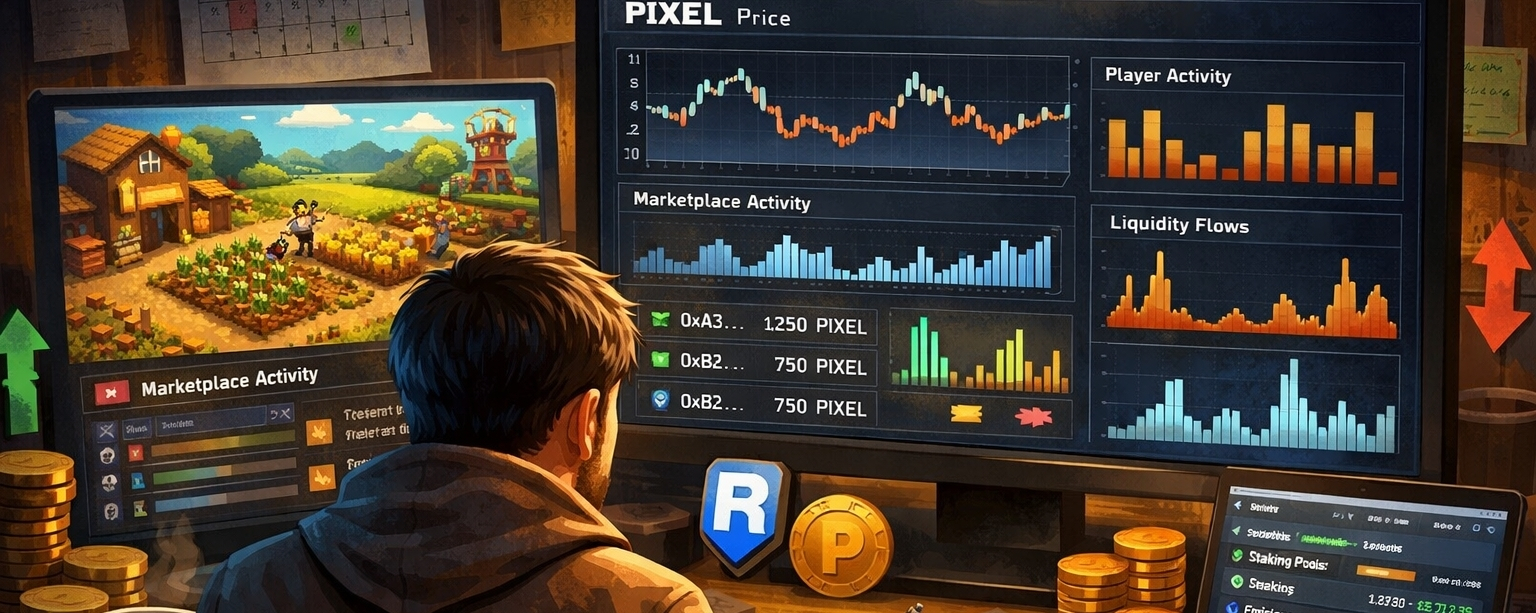
The first thing that stands out to me when I track activity around Pixels on the Ronin Network isn’t volume in the traditional DeFi senseit’s behavioral rhythm. The chain doesn’t move like a financial system first; it moves like a game economy with financial consequences layered on top. You see bursts of micro-transactions clustered around gameplay loopsharvesting, crafting, land interactionrather than the clean, discrete capital rotations you’d expect from yield farms or liquidity mining programs.
Wallet behavior reflects this immediately. Instead of large wallets cycling capital between pools, you’re looking at a wide distribution of smaller wallets engaging repeatedly. It feels closer to behavioral stickiness than capital stickiness. Players log in, perform actions, and transact in small increments. That matters because it shifts how we think about liquidity durability. This isn’t capital parked for yieldit’s capital in motion, tied to attention.
When I map participant behavior, I see three clear cohorts forming. First, the grindersplayers who treat the ecosystem like a time-to-earn environment, optimizing farming loops and extracting value from in-game mechanics. Second, the speculatorsthese are the familiar faces, rotating into $PIXEL during hype cycles, often clustering around listing events or narrative spikes. Third, a smaller but more interesting group: infrastructure-aligned participants. These are landowners, guild operators, and long-term holders who are less sensitive to short-term emissions and more focused on ecosystem positioning.
What’s interesting is how these groups interact. The grinders generate consistent transactional flow. Speculators inject volatility and liquidity bursts. But the infrastructure cohort anchors the system. Without them, the economy would feel hollowpure emission extraction. With them, there’s at least a framework for persistence.
This brings me to incentive design, which is where most GameFi systems either stabilize or collapse. Pixels doesn’t rely purely on passive yieldit ties rewards to activity. That’s a critical distinction. Emissions are earned through participation, not just capital allocation. On paper, this reduces mercenary behavior. In practice, it just transforms it. Instead of capital rotating, attention rotates.
Liquidity pacing here is tied to engagement cycles. When new content drops or when in-game rewards shift, you see immediate spikes in activity. Capital follows attention. This creates short-term bursts of liquidity that aren’t necessarily predictable in a DeFi sense, but become predictable if you track player behavior instead of TVL.
Capital durability is mixed. The speculator layer is as transient as everno surprises there. But the player base introduces a different kind of stickiness. These participants aren’t optimizing APY; they’re optimizing gameplay efficiency That creates a baseline level of economic activity that persists even when token incentives compress.
The real question is whether that baseline is enough to sustain the system once emissions decline.
From a cost perspective, the Ronin infrastructure helps significantly. Low transaction fees enable high-frequency interaction, which is essential for this type of economy. If execution costs were higher, the entire behavioral model would break down. In that sense, the chain isn’t just a scaling solutionit’s a prerequisite for the economic design.
When I look at market microstructure, I don’t see the typical liquidity cliffs around unlocks or governance events. Instead, liquidity clusters around gameplay milestones. New features, seasonal updates, or reward adjustments act as catalysts. You get short bursts of volume, followed by normalization. It’s less like trading a token and more like trading engagement cycles.
That said, there are still familiar patterns. When $PIXEL liquidity deepensespecially after exchange listingsyou see the usual speculative flows. Price volatility increases, and short-term traders step in. But these phases tend to be decoupled from the underlying gameplay activity. In other words, the financial layer and the game layer move on partially independent timelines.
That separation is both a strength and a risk.
It’s a strength because it reduces reflexivity. The game doesn’t immediately collapse when the token pulls back. But it’s a risk because it means speculation can outrun utility. When that happens, you get inflated expectations that the underlying economy may not be able to support.
Comparing this to earlier GameFi cycles, the difference is subtle but important. Previous systems leaned heavily on emissions to bootstrap activity. Pixels leans more on engagement. But engagement itself is being incentivized, which means it’s still, at its core, an emissions-driven systemjust one layer removed.
The long-term question is whether the system can transition from incentivized engagement to organic engagement.
If emissions compress, what happens to the grinders? Do they stay because the game is compelling, or do they rotate out like yield farmers? My instinct, based on wallet behavior, is that a portion will staybut not all. The drop-off won’t be binary, but it will be noticeable.
The infrastructure cohort is more resilient. Landowners and ecosystem participants have embedded exposure. Their incentives are aligned with long-term growth. But they rely on a steady influx of active players to sustain value. Without that, their position weakens.
So structurally, Pixels sits in an interesting middle ground. It’s not purely financial, and it’s not purely entertainment. It’s an economic layer built on top of a game loop, where attention is the primary input and tokens are the output.
What I think the market may be underestimating is how fragile that balance can be. Not in a catastrophic sense, but in a gradual one. If engagement slows, liquidity doesn’t disappear overnightit just thins out. Spreads widen, activity declines, and the system becomes less efficient.
At the same time, I think there’s a tendency to underestimate the value of behavioral stickiness. A user who logs in daily to farm, craft, and interact is fundamentally different from a liquidity provider chasing yield. That kind of participation, even if partially incentivized, creates a more stable foundation than pure capital flows.
The real signal to watch isn’t priceit’s activity consistency. If transaction frequency and player engagement remain stable through lower emission phases, then the system has something most GameFi projects never achieved: a baseline economy that isn’t entirely dependent on incentives.
Until then, I treat Pixels the same way I treat any emerging on-chain economyI watch the flows, track the behavior, and assume that incentives, not narratives, will ultimately determine what stays and what fades.