
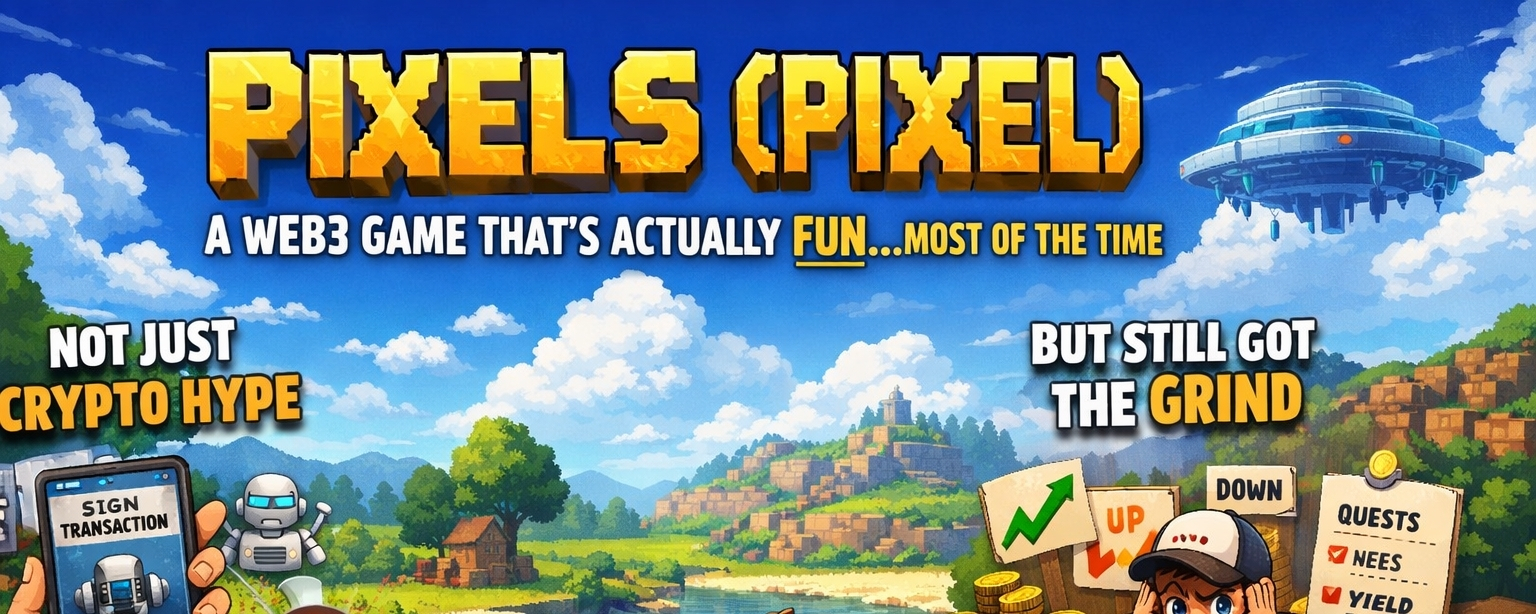
Most Web3 games don’t work. Not in the way normal games work. You click around, things break, menus lag, and half the time you’re not even sure what you’re supposed to be doing. It feels like everything is built backwards. Tokens first. Gameplay later. If ever. You log in and instead of playing, you’re connecting wallets, signing stuff, checking prices, worrying about fees. It’s tiring. It kills the mood before it even starts.
That’s the space Pixels comes from. Same crowd. Same expectations. So yeah, I didn’t expect much.
And to be fair, it still has problems. Let’s not pretend it doesn’t.
There’s still that background noise of “this matters because it has value.” You can feel it. Even if the game doesn’t shout it at you, it’s there. People grinding like crazy. People optimizing every little thing. Treating it like a job. Running farms like factories. And once you see that, it’s hard to ignore. It changes how the whole thing feels.
But here’s the thing. Pixels doesn’t immediately throw all that in your face.
You log in, and it’s just a simple farming game. You move around. You plant crops. You water them. You wait. You harvest. That’s it. No pressure at the start. No wall of crypto nonsense hitting you right away. And honestly, that alone already puts it ahead of a lot of other Web3 games.
It reminds me of those old browser games. The ones you’d play without thinking too much. Just click, wait, repeat. There’s something calm about it. You fall into a rhythm. Plant, harvest, sell, explore. It loops nicely. Nothing fancy. But it works.
The world itself is pretty basic. Pixel art. Simple animations. Not trying to be realistic or flashy. And that’s fine. It doesn’t need to be. It feels light. Easy to run. Easy to understand. You don’t need a tutorial just to move around. You just… play.
And there are other players around too. Not in an annoying way. You just see them passing by. Doing their own thing. Farming their land. Running around collecting stuff. It makes the world feel alive without turning it into chaos. You’re not alone, but you’re also not forced into constant interaction. It’s a good balance.
Now, the Ronin Network part. That’s actually one of the better things here. Transactions are fast. Cheap. You don’t get stuck waiting or paying stupid fees just to do basic stuff. It works quietly in the background. And that’s how it should be. You shouldn’t have to think about the tech every five minutes.
But even with all that, the cracks show up.
You start noticing how the game isn’t really equal for everyone. Some players have more land. Better setups. More resources. And yeah, part of that is just time and effort. But part of it is also how deep they go into the system. The more you treat it like an economy, the more you get out of it.
And that’s where things get weird.
Because now you’re not just playing a game. You’re thinking about efficiency. About output. About how to get more from your time. And suddenly that chill farming loop starts feeling like work. Not fun work. Just repetitive tasks with a goal attached.
You log in to relax. But then you start thinking, “Am I doing this the right way?” And once that thought shows up, it kind of ruins the whole vibe.
That’s the big issue with games like this. They try to mix two worlds that don’t always fit together. A cozy, slow-paced game and a system where everything has value. One pushes you to relax. The other pushes you to optimize. And those don’t always get along.
Pixels handles it better than most. It doesn’t force you into the economy right away. You can ignore it for a while. Just farm. Explore. Craft. Do your own thing. And for a time, it actually works. You forget about the bigger system.
But you can’t ignore it forever.
At some point, you start asking questions. What’s the point of this item? Can I trade it? Should I save it? Is this worth something outside the game? And just like that, you’re pulled back into the Web3 mindset.
And honestly, that part is exhausting.
Not because it’s complicated. But because it’s always there. Always sitting in the background, waiting for you to care.
Still, I keep coming back to Pixels. Which is weird.
Because I’ve tried a lot of these games. Most of them I drop within an hour. Either they’re too confusing, too broken, or just straight-up boring. Pixels isn’t like that. It actually holds your attention. Not because it’s doing something revolutionary. But because it does the basics right.
Movement feels fine. Actions are simple. The loop makes sense. You always have something small to do. And sometimes, that’s enough.
You log in. You water crops. You harvest. Maybe you explore a bit. Talk to someone. Craft something. Then log out. No stress. No big decisions. Just small progress.
And yeah, maybe that’s the real reason it works.
It doesn’t try too hard.
It’s not screaming about being the future. It’s not pushing big promises every second. It just exists as a game first, and everything else second. That alone makes it stand out in a space full of overhyped projects.
But I’m still cautious.
Because I’ve seen how this goes. Things start simple. Then systems get added. Economies get bigger. More pressure. More competition. More focus on “value.” And slowly, the game part gets buried under all of it.
I don’t know if Pixels will go that way. Maybe it won’t. Maybe it’ll keep things balanced. Keep it simple. Keep it playable.
I hope so.
Because right now, it’s one of the few Web3 games that doesn’t immediately make me regret logging in. It actually feels like something you can play without thinking too much. Something that doesn’t demand your full attention or turn into a second job.
And honestly, that shouldn’t be rare.
But it is.
So yeah, Pixels isn’t perfect. It still carries all the baggage of the space it comes from. The grind. The economy. The constant question of whether you should care more than you do.
But under all that, there’s a real game. A simple one. A decent one.
And for once, that’s enough to keep me around.