
Honestly....I went into Pixels with the usual doubt I now carry into almost every Web3 game.
I have seen too many projects confuse activity with value, and too many token systems mistake short-term extraction for real adoption.
A lot of games can manufacture busy dashboards, noisy communities, and temporary user spikes.
That part is easy.
What is hard is building a game people actually want to return to, then attaching incentives that do not slowly poison the reason they came in the first place.
That is the part that made me look more carefully at @pixels.
The more time I spent with the official Pixels litepaper, the less I saw a team trying to sell me a simple play-to-earn loop, and the more I saw a team openly admitting that reward design can go wrong if it attracts the wrong behavior.
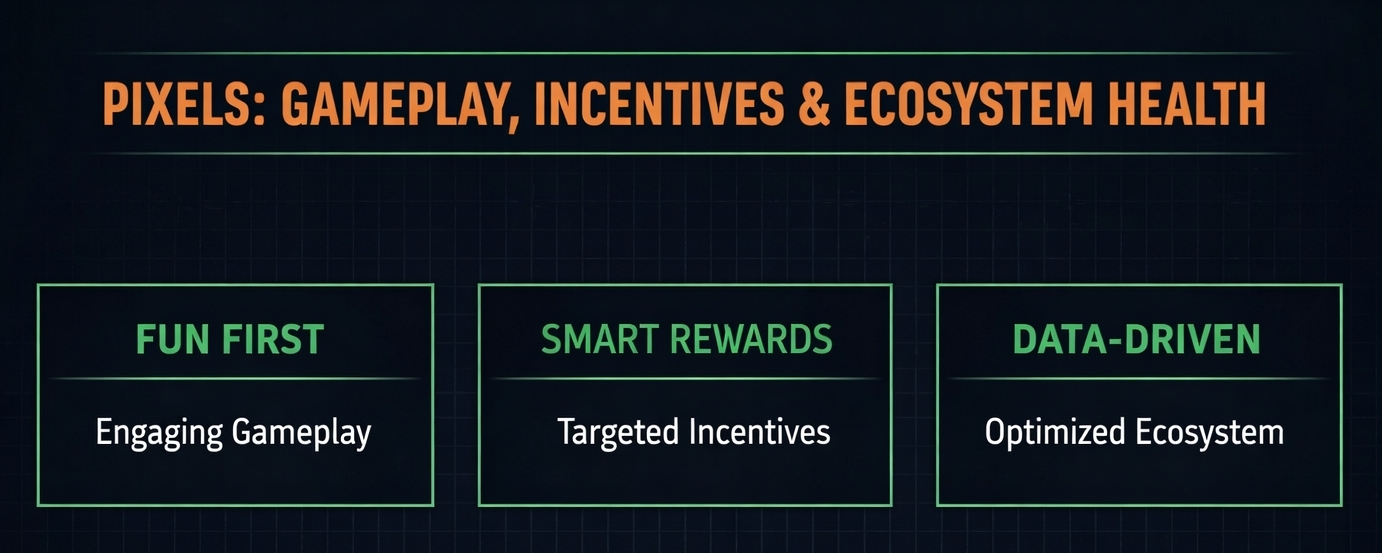
Pixels frames itself as a social casual game on Ronin that started with farming, but the bigger ambition is to solve the usual play-to-earn failure mode through fun-first design, smarter reward targeting, and a broader publishing flywheel built around data and ecosystem health.
That matters to me because the real problem in GameFi was never just inflation.
The deeper problem was incentives landing on the wrong users at the wrong time for the wrong reasons.
When rewards are sprayed too widely, the system starts paying for extraction instead of participation.
People come in to drain value, not to stay, build habits, spend thoughtfully, create content, refer others, or become part of a world.
The game begins to orbit the token, and then the token begins to suffocate the game.
Pixels is interesting because it does not pretend that this problem never happened.
Its own litepaper makes room for the idea that growth can bring token inflation, sell pressure, and badly targeted rewards that end up favoring short-term engagement over sustainable value creation.
That kind of admission gets my attention more than polished optimism does.
It feels closer to operational reality.
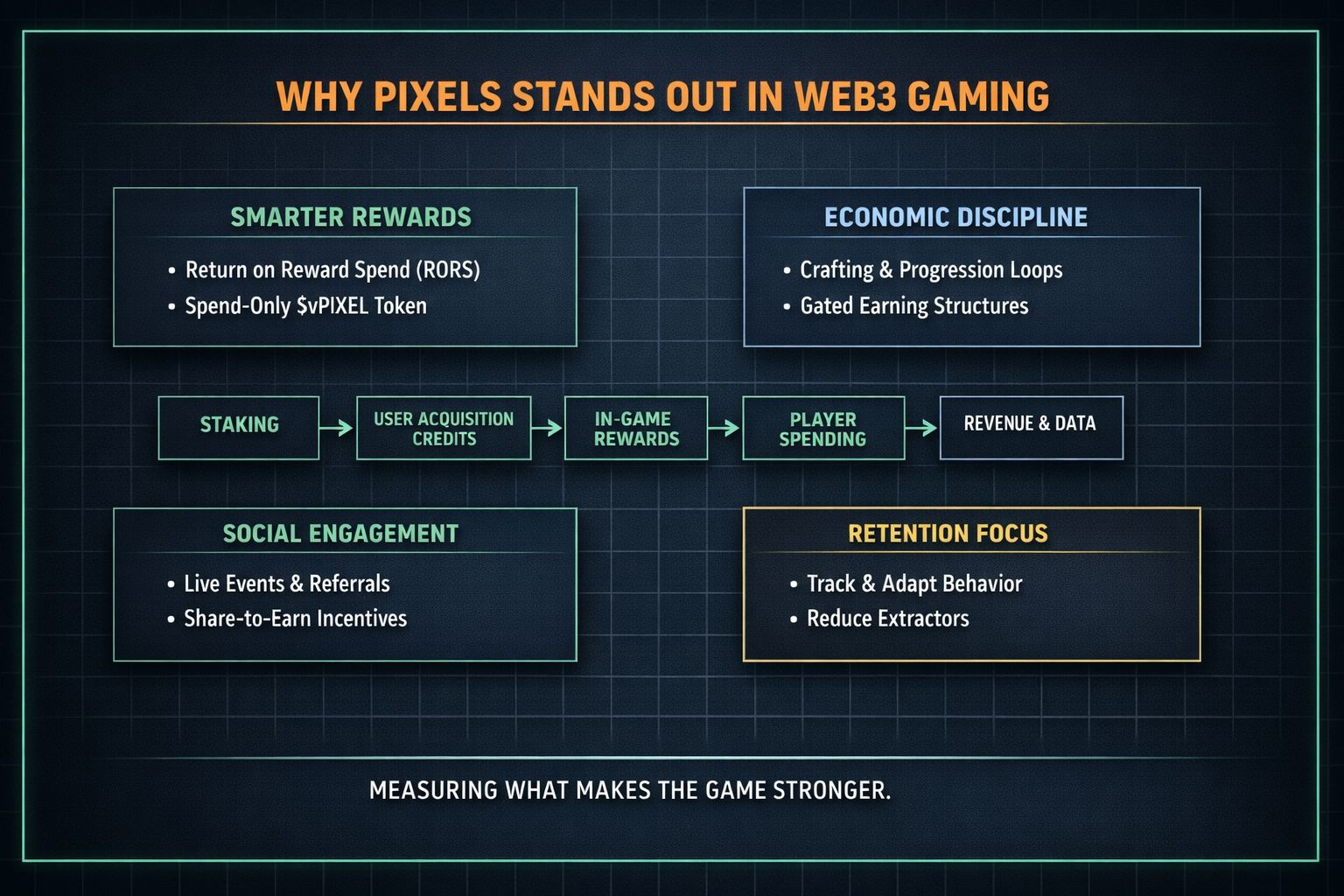
What I find more convincing is how Pixels tries to connect the casual surface of the game to deeper economic discipline.
On the surface, you still have the approachable parts that made Pixels widely recognizable in the first place: farming, progression, exploration, social mechanics, and a world that is supposed to feel easy to enter before it becomes strategic.
But underneath that, the team is pushing toward a tighter loop where crafting, earning, upgrading, and spending reinforce each other instead of leaking endlessly outward.
The litepaper points toward progressive plot upgrades with escalating costs, durability on crafting infrastructure, stronger high-tier recipes, inventory limits, and gated earning structures meant to deepen engagement rather than leave the economy wide open to idle farming.
That is the part I keep coming back to.
Ownership only matters to me if it changes behavior.
A token is not interesting just because it exists.
It becomes interesting when it changes how players commit, how they spend, how they choose where value should go, and how long they stay aligned with the ecosystem.
In Pixels, $PIXEL is positioned as the main governance and staking asset, while staking itself is being reframed so games act more like validators competing for player support.
Players stake toward games, games compete by improving retention and net in-game spend, and rewards get tied back to economic performance instead of blindly distributed emissions.
I think that is a much clearer idea than most Web3 gaming token stories.
It moves the conversation away from how many rewards can be emitted and closer to what kind of behavior is actually worth subsidizing.
That is where RORS becomes important.
Pixels uses Return on Reward Spend as a core measure of whether rewards are actually producing value back into the ecosystem.
That sounds dry at first, but I actually think it is one of the most practical ideas in the whole design.
If a reward system cannot create retention, spending, healthier loops, or better player quality, then it is not really growth.
It is just expense wearing a fun costume.
The same goes for $vPIXEL.
I do not see it as a cosmetic token tweak.
I see it as an attempt to reduce pure extraction by giving players a spend-only token backed one-to-one by $PIXEL, with the goal of pushing more activity back into ecosystem use rather than immediate sell pressure.
That only works if the surrounding game and partner experiences are good enough to deserve that spend.
But at least the mechanism is trying to solve a real problem.
What makes the model more credible to me is that Pixels keeps tying incentives back to first-party data instead of vague assumptions.
The flywheel is fairly direct.
Staking creates user acquisition credits, those credits fund targeted in-game rewards, player spending creates revenue, revenue supports stakers, and the resulting event data improves future targeting.
The system tracks behavior and then re-weights reward budgets toward actions that improve retention and monetization rather than leakage to extractors.
That is a much more serious framework than the usual play more, earn more shortcut.
I also think the social side matters more than people admit.
Pixels is not just trying to be a farming loop with token rails attached.
Its materials point to exploration, live events, referral rewards, share-to-earn mechanics, and social enhancements as part of the retention layer.
That makes sense to me because casual games live or die on habit, identity, and player-to-player pull.
People stay where there is progression, visibility, shared activity, and a reason to care tomorrow, not just a reason to claim today.
Still, none of this is magic.
A game can have better reward plumbing and still fail if the content gets stale, if the targeting system optimizes the wrong actions, if reward sinks feel forced, or if the economy becomes too extractive again.
That honesty is good, because sustainable design is not a fixed state.
It is a constant calibration problem.
Where Pixels makes the most sense to me is not as a fantasy of endless yield.
It makes sense as a live game economy that is trying to learn which behaviors actually strengthen the world.
Do players stay longer.
Do they spend back into the system.
Do they create, refer, socialize, and progress in ways that make the ecosystem denser instead of thinner.
Do incentives improve commitment or just rent attention for a few days.
That is the test I would use for @undefined and for $PIXEL over time.
In the end, I do not think real gaming adoption comes from token noise.
I think it comes from enjoyable loops, aligned incentives, and repeat behavior that feels worth returning to.
That is why Pixels holds my attention more than most.
Not because it claims to have solved Web3 gaming, but because it seems more willing than most to measure whether its rewards are actually helping the game stay healthy. #pixel
I can also turn this into a slightly more emotional Binance Square version with the same meaning but a more viral human flow.