

I’ve been watching the steady rise of on-chain gaming narratives for a while now, but what caught my attention with Pixels is not the usual promise of “play-to-earn” or speculative hype cycles. It’s the timing. Pixels arrived at a moment when the market seems quietly exhausted from complexity. Too many protocols, too many layers, too much abstraction. What Pixels does, intentionally or not, is strip things back to something almost primitive: a simple loop of farming, crafting, and social interaction, but anchored on-chain through the Ronin ecosystem.
What makes this interesting to me is not the game itself in isolation, but how it fits into a broader behavioral shift. After cycles dominated by DeFi experimentation and infrastructure narratives, I’m noticing that user attention is drifting back toward experiences rather than mechanisms. Pixels doesn’t try to compete on technical novelty. Instead, it leans into accessibility. That, in this phase of the market, is not a weakness—it’s a positioning strategy.
At a surface level, Pixels looks like a casual farming game. But underneath, it’s essentially a structured environment for on-chain economic activity. The farming loop is not just gameplay; it’s a production system. Players generate resources, convert them into higher-value items, and circulate them within a player-driven economy. This isn’t new in gaming, but the on-chain layer changes the incentives. Ownership becomes persistent, and time spent in the game has a more tangible economic dimension.
The choice of Ronin Network is also not accidental. Ronin has already proven that it can support high-frequency, low-cost interactions through its association with Axie Infinity. Pixels inherits that infrastructure advantage without needing to reinvent it. From a user perspective, this removes friction. Transactions feel almost invisible, which is critical because most users don’t want to think about gas fees or network mechanics while playing a game. They want continuity, and Pixels delivers that by design.
What I find particularly subtle is how users actually interact with the system. It doesn’t force financialization upfront. You can enter Pixels without immediately thinking about tokens or yield. Over time, though, you start to notice patterns. Certain resources become more valuable. Certain activities generate better returns relative to time spent. Without explicitly stating it, the game teaches players how to optimize. That’s where the economic layer quietly emerges.
The $PIXEL token sits at the center of this system, but not in an aggressive way. It’s not pushed as a speculative asset first. Instead, it functions as a medium of exchange, a reward mechanism, and a coordination tool within the ecosystem. From what I’ve observed, the sustainability of this model depends heavily on whether demand for in-game assets remains organic. If players are engaging because they enjoy the loop, the token economy can stabilize. If engagement becomes purely extractive, the system starts to weaken.
There are trade-offs here that shouldn’t be ignored. Simplicity, while appealing, also limits depth. Pixels risks being perceived as shallow once the novelty wears off. The economic model, although more grounded than earlier play-to-earn attempts, is still sensitive to user growth. If new users slow down, the internal economy could tighten in ways that reduce incentives for existing players. This is not unique to Pixels, but it’s more visible here because the system is so transparent.
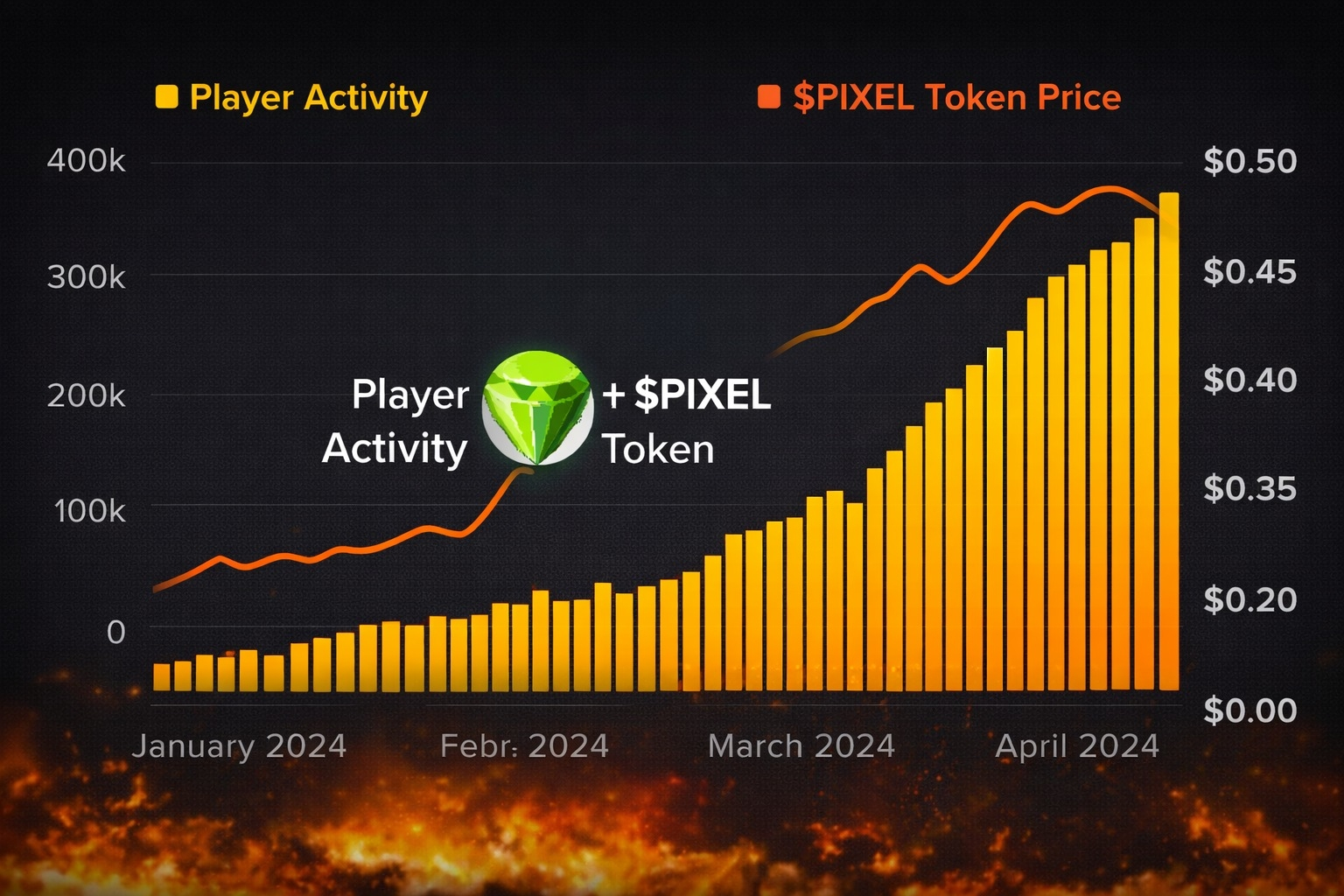
Another point that stands out to me is how price behavior might reflect what’s happening inside the game. In many crypto projects, token price moves independently of actual usage. With Pixels, I would expect a closer relationship. If player activity increases, demand for $PIXEL should follow, at least in theory. On-chain data such as transaction volume, active wallets, and in-game asset turnover could become leading indicators rather than lagging ones. That’s something I’m paying attention to more closely than the price chart itself.
Recently, there’s been a noticeable shift in how the market is treating gaming tokens. Instead of immediate spikes followed by sharp declines, I’m seeing more gradual accumulation phases. Pixels seems to be part of that trend. It’s not dominating headlines, but it’s consistently present in conversations. That kind of persistence often matters more than short-term attention.
From a broader cycle perspective, Pixels feels like a transitional project. It’s not trying to redefine Web3 gaming, but it’s refining how users interact with it. After the excesses of previous cycles, where expectations were unrealistic, there’s a move toward sustainability. Pixels aligns with that. It doesn’t promise exponential returns. It offers a system that, if balanced correctly, can function over a longer period.
What keeps me cautious, though, is the reliance on behavior. This entire model depends on how users choose to engage. If they treat it as a game first, the system has a chance. If they treat it purely as a yield mechanism, the cracks will show. I’ve seen this pattern before, and it rarely ends well when speculation overtakes utility.
Still, I can’t ignore the fact that Pixels is doing something that many projects struggle with: it’s getting people to actually use the product. Not just once, but repeatedly. That kind of engagement is difficult to manufacture. It suggests that there is something inherently sticky about the experience, even if it appears simple on the surface.
When I step back and look at it objectively, Pixels doesn’t feel like a breakthrough. It feels like a correction. A move away from over-engineered systems toward something more grounded. Whether that’s enough to sustain long-term value is still uncertain, but it’s a direction that makes sense given where the market is today.
I don’t see Pixels as the final form of Web3 gaming. If anything, it highlights how much further the space needs to go. But it also shows that progress doesn’t always come from complexity. Sometimes it comes from removing layers, focusing on behavior, and letting the system evolve from there.
For now, I’m watching how the ecosystem around @Pixels develops, how $PIXEL circulates within that environment, and whether user activity continues to feel organic rather than forced. The answers to those questions won’t come from announcements or roadmaps. They’ll come from the quiet data points that most people overlook.

And that’s where I think the real signal is. Not in what Pixels claims to be, but in how people choose to use it when no one is paying attention.