
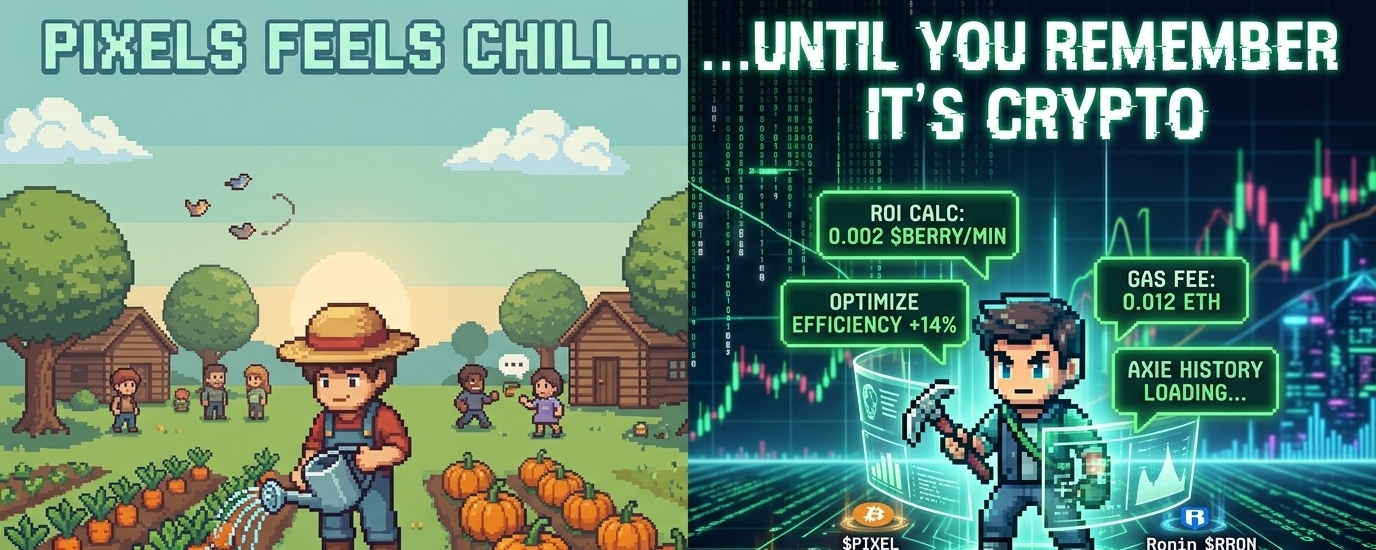
Most of these Web3 games are already broken before you even start playing them. They talk big, throw around words about ownership and earning and all that, but once you’re inside, it’s the same loop over and over. Grind, optimize, repeat. It stops feeling like a game pretty fast. Feels more like work you didn’t sign up for.
Pixels tries to act different. And to be fair, at first, it kind of is.
You log in and it’s quiet. No chaos. No loud flashing stuff telling you to buy something every five seconds. You’re just there, walking around, planting crops, figuring things out. It’s simple. Almost too simple, but in a good way. It doesn’t try to overwhelm you. That’s rare in this space.
For a bit, you actually relax.
You farm. You explore. You talk to people. The world isn’t huge or crazy detailed, but it feels alive enough. There’s something about the pace that works. You’re not rushing. You’re not chasing timers every second. You just… play.
And that’s where it hooks you.
Because after a while, you start noticing things. Not all at once. Slowly.
The loops are there. They always are. Planting leads to harvesting, harvesting leads to crafting, crafting leads to more progression. That’s normal. Every farming game does this. Nothing new. But here, there’s always that extra thought sitting in the back of your head. What is this actually worth?
Not in-game. Real value.
That’s when it starts to feel different.
You catch yourself thinking about efficiency. Are you doing this right? Is there a better way? Should you be focusing on something else to get more out of your time? It stops being just about playing and starts turning into something else. Not fully, not immediately, but enough that you notice it.
And once you notice it, it doesn’t really go away.
That’s the thing with crypto games. Even when they try to feel casual, the system underneath is built around value. It changes how you approach everything. Even small stuff like watering crops starts to feel like part of a bigger calculation.
Pixels doesn’t shove it in your face, though. That’s probably why people like it.
It keeps things quiet. The economy is there, but it doesn’t scream at you. It just sits in the background, waiting. You can ignore it for a while. Maybe even a long while. But eventually, you remember.
And when you do, it changes the vibe a bit.
Ronin being the network behind it adds another layer to all this. People haven’t forgotten Axie. That whole rise and fall is still fresh for a lot of players. So there’s always this question hanging over Pixels. Is this going to follow the same path? Is it just early days again before things get weird?
No clear answer.
Right now, it feels stable enough. Not too hyped, not completely dead. Just kind of existing in that middle space. People are playing, figuring things out, testing what works. It hasn’t exploded, which might actually be a good thing. Less noise. Less pressure.
But it also means no one really knows where it’s going yet.
The gameplay itself is easy to get into. That’s probably one of its strongest points. You don’t need to learn a million systems just to get started. You can jump in, do a few tasks, and log off without feeling like you missed something huge. That alone puts it ahead of a lot of other Web3 games.
Still, the longer you play, the more you start to see the edges.
There’s not a ton of depth yet. The loops can feel repetitive if you stay too long in one session. And if you’re someone who’s seen a lot of these games before, you can kind of predict where things might go. More systems. More incentives. More ways to tie your time to value.
Maybe that’s fine. Maybe that’s what people want.
Or maybe it’s the same trap again, just dressed up in a calmer style.
The social side helps a bit. Running into other players, seeing what they’re doing, trading, interacting. It makes the world feel less empty. That part feels more like a real game. Less like a system you’re exploiting and more like a place you’re spending time in.
But even there, you can’t fully escape the bigger picture.
Because at the end of the day, it’s still built on the idea that your time can turn into something valuable. That’s the whole pitch. Even if Pixels hides it better than most, it’s still there.
And that’s where things get messy.
Some people like that. They want their time to mean something outside the game. Others just want to play without thinking about markets and tokens and all that. Pixels sits right between those two groups, trying to keep both happy.
Not an easy balance.
Sometimes it works. You forget about everything else and just enjoy the loop. Other times, it pulls you back into that mindset where you start thinking about returns, about whether you’re playing “wrong,” about whether this is worth your time.
That’s when it starts to feel like every other Web3 game again.
Not completely. But enough.
Still, there’s something about it that keeps people around. Maybe it’s the simplicity. Maybe it’s the slower pace. Maybe it’s just that it doesn’t feel as aggressive as the rest. Whatever it is, it works for now.
You log in thinking you’ll play for ten minutes. Then it turns into an hour. Then you’re checking back later without really planning to.
That’s not nothing.
But at the same time, there’s always that doubt sitting in the background. How long before it changes? How long before the economy takes over more of the experience? How long before it stops feeling chill?
No one really knows.
For now, Pixels is one of the few Web3 games that doesn’t immediately feel exhausting. That’s already saying a lot. It gives you space to just play, at least at the start. It doesn’t rush you into anything.
But the moment you remember what it is, the feeling shifts a little.
And once that happens, it’s hard to go back to not thinking about it.