
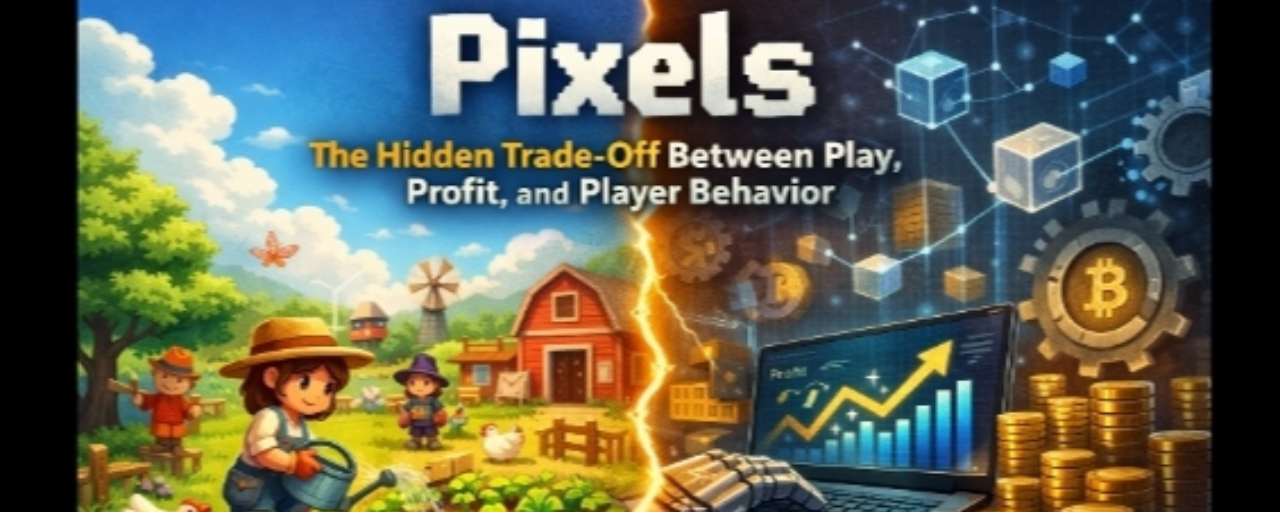
Let me explain...There’s something about Pixels that lingers in my mind longer than it probably should. Not because it is loud or revolutionary on the surface but because it feels deceptively simple. A soft, colorful farming world. Light mechanics. Social interaction. Nothing overwhelming. Nothing aggressive. And yet, beneath that calm exterior, it feels like something more experimental is quietly unfolding.
On paper Pixels is easy to categorize. A casual game layered with blockchain ownership. A place where players can farm, craft, explore and gradually tap into an on chain economy. But the more time you think about it, the harder it becomes to define what it truly is. Because Pixels doesn’t behave like a typical experiment even though in many ways that’s exactly what it represents.
The real tension sits deeper. What happens when a space designed for play subtly introduces financial awareness into every action? That shift matters more than people admit. The moment time inside a game can translate into value behavior begins to change.
For years, crypto has pushed the idea that ownership enhances engagement. If players own assets, land or outcomes they become more invested. That logic holds some truth. But ownership doesn’t just deepen attachment it reshapes intent. It brings calculation into environments that once thrived on curiosity and emotion.
This is where Pixels becomes fascinating.
It attempts to preserve a gentle almost meditative gameplay loop within a system that naturally rewards optimization. Farming, gathering, crafting these mechanics traditionally work because they are calming. Repetitive in a good way. They create rhythm. But once tied to incentives, that same repetition starts to evolve. What felt relaxing begins to feel productive. Then strategic. Eventually even obligatory.
Visually nothing changes. Emotionally, everything does.
This is the quiet cost of incentive driven design. Not whether it attracts users it clearly does but whether it can remain a game once enough players stop treating it like one. Because given enough time, every system becomes optimized. Players will find the most efficient routes, calculate returns and even organize efforts to maximize output. At that point participation shifts from enjoyment to efficiency.
And that creates pressure.
Pixels, like many crypto-native games must balance two competing forces. It wants to feel like a world but it must function like an economy. And those two systems don’t always align. Games tolerate imbalance if it creates fun. Economies demand precision. Rewards must be tuned. Scarcity must be managed. Exploits must be controlled.
Eventually design decisions stop being purely creative they become economic policy.
That reality also complicates the idea of decentralization. While ownership may be distributed control rarely is. Games require constant adjustments. Someone has to decide what changes, what breaks and what gets fixed. Full decentralization sounds ideal but in practice too much of it can destabilize the system.
So even in a “decentralized” environment, influence often concentrates among those who understand the system best and can act quickly when needed. Ownership gives participation but not necessarily authority.
Then comes the real test: what happens when growth slows.
Most crypto ecosystems look strongest during expansion. New users bring energy. Momentum hides structural weaknesses. But when attention fades the underlying reality surfaces. The question is no longer how fast it grows but whether it can sustain itself without constant inflow.
Would players still log in if the financial upside weakened? Would they continue farming, crafting and socializing purely for the experience?
Maybe they would. That possibility shouldn’t be dismissed.
Pixels could prove that ownership strengthens long-term attachment. That communities built through shared economies can outlast the incentives that attracted them. But the opposite outcome is just as plausible. Incentives may slowly reshape the culture itself teaching players to evaluate every action through output rather than enjoyment.
And if that shift happens, it won’t be obvious.
The world will still look vibrant. The community will remain active. Metrics may even appear strong. But underneath, the atmosphere could transform from play into optimization from connection into coordination from a living world into a system.
That’s what makes Pixels worth watching. It sits at the intersection of two forces that don’t naturally coexist playfulness and productivity and tries to make them work together.
At the same time, one of the most pivotal decisions behind its growth had little to do with gameplay at all. The migration to the Ronin Network didn’t just improve infrastructure it changed the experience entirely.
Before, interacting with the game often felt like managing transactions. Every action came with friction. Fees, delays, small interruptions that pulled players out of the moment. But on Ronin everything flows. Transactions are fast. Costs are minimal. Actions feel immediate. The game finally feels like a game again just with ownership still intact beneath the surface.
That shift matters more than it seems.
Lower friction doesn’t just improve usability it transforms behavior. Players stay longer. They engage more naturally. And because Ronin already hosts an established base of Web3 gamers, Pixels didn’t grow in isolation. It entered an ecosystem ready to participate not just speculate.
The onboarding experience improved too. Simpler wallets. Fewer technical barriers. No overwhelming setup. These details might sound minor, but in Web3, even small friction points can drive users away.
The results became visible quickly. More players. Higher activity. A more vibrant in-game economy. No waiting months to see impact it was immediate.
And perhaps that’s the clearest lesson.
Sometimes success doesn’t come from adding complexity but from removing it. Not from building new features, but from choosing the right foundation.
Pixels didn’t just evolve it repositioned itself.
And in doing so, it became something more than just another Web3 game. It became a live case study of what happens when you try to build something warm, human, and playful inside systems that naturally push toward efficiency.
Whether that balance holds over time or quietly tips in one direction remains the most important question of all.