
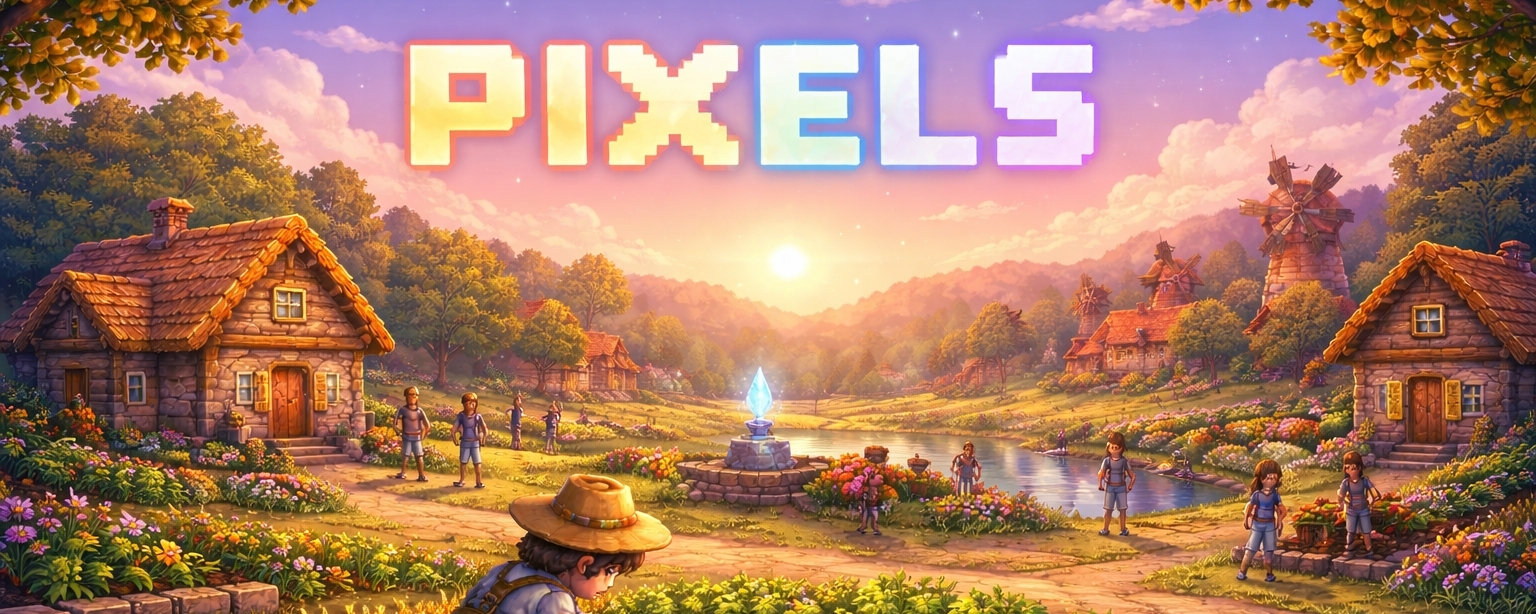
It doesn’t start with excitement. That’s probably the first thing you notice about Pixels.
There’s no rush when you enter the world, no immediate sense that you’re stepping into something competitive or high-stakes. Instead, it feels closer to arriving somewhere familiar, even if it’s your first time. You move your character, look around, and begin with something small—maybe planting a few crops, maybe just walking a little further than necessary.
And somehow, without realizing it, you stay.
That quiet pull is what defines Pixels (PIXEL) more than anything else. Not features, not mechanics, not even its place in Web3. It’s the feeling of settling into something that doesn’t try too hard to impress you.
The core of the experience is built on loops that are almost deceptively simple. You plant, you wait, you harvest. You gather materials, craft items, rearrange your space. There’s no dramatic escalation. No moment where the game suddenly demands more from you than you’re ready to give. It just continues, at the same steady pace, whether you stay for ten minutes or two hours.
That consistency changes how you approach it.
In many games, especially those connected to Web3, there’s often an underlying pressure to maximize your time. Every action feels like it should lead somewhere measurable. Progress becomes something you track closely. Efficiency becomes a habit. But in Pixels (PIXEL), that mindset doesn’t really stick.
You can try to optimize, of course. You can plan your farm layout, manage your time carefully, and think about outcomes. But the game doesn’t reward that intensity in a way that overrides everything else. If anything, it gently resists it.
Because the moment you slow down—even slightly—you start noticing different things.
The way your farm gradually takes shape over multiple sessions. The small satisfaction of logging in and seeing everything ready without having rushed it. The presence of other players moving through the same space, not competing, just existing alongside you.
That shared space is one of the more interesting parts of the experience.
People aren’t constantly trying to outperform each other. They’re building, experimenting, sometimes just passing through. You might stop near someone’s land, look at how they’ve arranged things, maybe exchange a few words, maybe not. There’s a sense that everyone is participating in the same world, but not necessarily in the same way.
And that difference matters.
It creates a kind of social environment that feels unstructured but still connected. You’re not being pushed into interactions, but you’re also never completely alone. Over time, that balance builds something subtle—a recognition of others without the expectation of constant engagement.
It’s the kind of interaction that doesn’t feel like a feature. It just feels like part of being there.
What’s interesting is how this ties into why people keep coming back.
There’s no single reason. No one system doing all the work. Instead, retention seems to come from a mix of small, consistent experiences. The comfort of routine. The curiosity of seeing what’s changed. The quiet satisfaction of making incremental progress without pressure.
It’s not addictive in the traditional sense. It’s more habitual, in a softer way.
You return because it fits easily into your day. Because it doesn’t demand too much energy. Because it offers a space where you can do something simple and feel like it was enough.
That approach feels almost out of place in the broader Web3 landscape, where so much emphasis is placed on complexity, incentives, and constant activity. Many projects try to hold attention by adding more—more systems, more rewards, more urgency.
Pixels (PIXEL) does something different by doing less.
It strips the experience down to something more manageable, more human. It doesn’t overwhelm you with choices or mechanics. It gives you just enough to engage with, and then trusts you to find your own rhythm within it.
That trust is important.
Because when players aren’t being pushed in specific directions, they start creating their own patterns. Some focus on building and expanding. Others explore. Some engage socially, others keep to themselves. The game doesn’t force these paths—it allows them.
And over time, those individual patterns start to shape the broader ecosystem.
Instead of a fast-moving, highly optimized environment, you get something slower, more organic. Progress happens, but it doesn’t feel rushed. Value emerges, but it’s not always tied to speed or efficiency. The world evolves, but in a way that reflects how people actually spend their time, not how they’re told to.
This has implications beyond just gameplay.
It hints at a different kind of sustainability. One that isn’t built on constant growth or high engagement spikes, but on steady, consistent participation. When players are comfortable, they tend to stay. Not because they have to, but because leaving doesn’t feel necessary.
That kind of retention is harder to measure, but easier to maintain.
And maybe that’s where Pixels (PIXEL) feels most relevant.
Not as a model to copy directly, but as a reminder that not everything needs to be complex to be meaningful. That sometimes, giving players less to manage results in more genuine engagement. That a game doesn’t need to constantly prove its value if the experience itself feels worthwhile.
There’s a quiet confidence in that approach.
Pixels (PIXEL) doesn’t try to define the future of Web3 gaming in bold terms. It doesn’t position itself as a solution to every problem. Instead, it offers something smaller, but more grounded—a space where people can show up, do a few simple things, and leave feeling like their time was well spent.
And if Web3 gaming is going to evolve into something more sustainable, more accessible, more human, it will likely move in this direction.
Not faster. Not louder.
Just a little more thoughtful about why people choose to stay.