
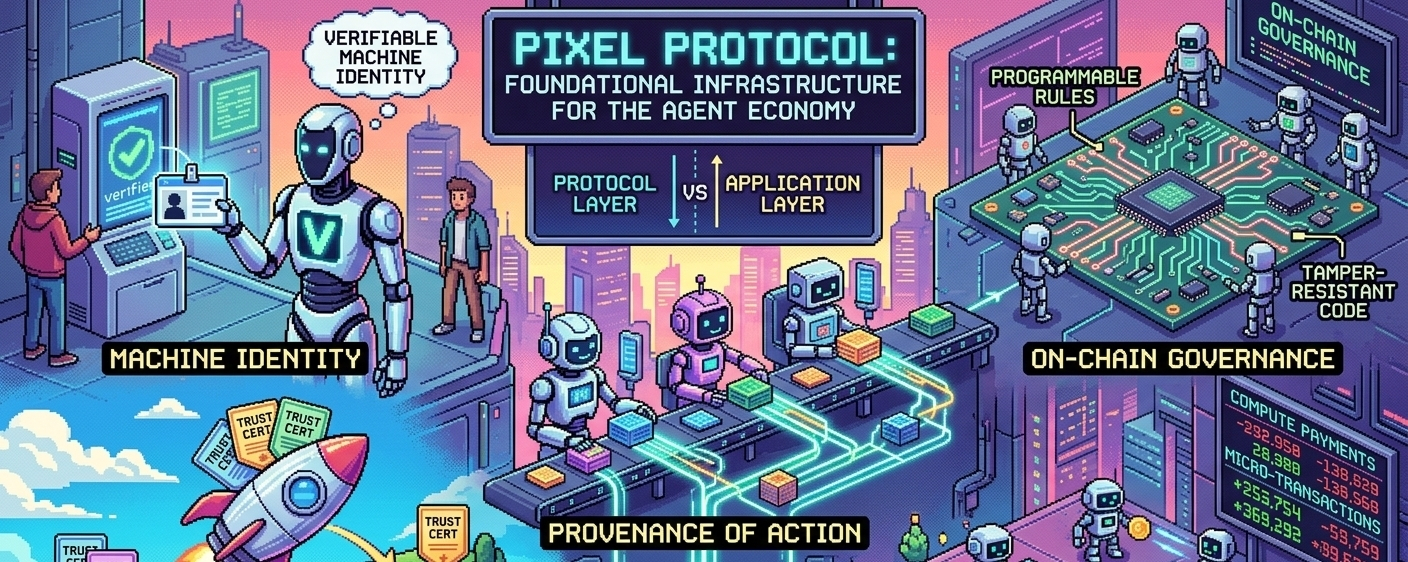
In a sea of "AI + blockchain" projects, it’s crucial to distinguish between genuine infrastructure and mere application-layer dressing. Many projects simply wrap basic automation in a token and label it "infrastructure." But for long-term value and scalability, the real challenges lie at the protocol level. This is where Pixel distinguishes itself.
Unlike many of its counterparts, Pixel is tackling the fundamental mechanics of how autonomous agents operate on-chain. This isn't just about pretty dashboards or seamless UX; it's about addressing structural gaps in how blockchains were originally designed—built primarily for human actors, human latency, and human-scale transaction frequency.
Here are the critical protocol-level problems Pixel solves:
### 1. The Challenge of Machine Identity
On-chain transactions by humans involve an inherent accountability chain (wallet, signing key). For autonomous agents, this accountability is natively absent. A protocol cannot inherently distinguish between a verified machine operating within parameters and a rogue process. Pixel addresses this by building machine identity *into the protocol itself*. Agents possess verifiable on-chain identities, creating a foundation of trust rather than assumption.
### 2. Provenance of Action in Multi-Agent Systems
Imagine an AI pipeline where five different agents pass tasks amongst themselves. Without a robust record layer, tracing actions, authorizations, and identifying failure points is virtually impossible. Pixel resolves this by creating an *attestation trail* for machine actions. Meaningful operations are anchored on-chain, transforming auditability from an afterthought to a first-class, inherent feature.
### 3. On-Chain Governance for Agents
Currently, controls for autonomous agents with capital access are primarily off-chain (API keys, rate limits, manually written rules)—a fragile system. Pixel transitions this governance layer *on-chain*. Consequently, the rules governing an agent’s operations are programmable, verifiable, and tamper-resistant. Instead of trusting a configuration file, you trust publicly auditable code.
### 4. Economic Coordination Between Machines
The burgeoning agent economy doesn’t just involve agents taking human instructions. It requires agents hiring other agents, paying for computation, and settling micro-transactions at a velocity that traditional, human-facing payment rails cannot accommodate. Pixel’s protocol-level design inherently accounts for machine-to-machine value transfer as a primary, foundational use case.
### The Power of Interoperable Trust
Beyond these internal operational issues, Pixel also addresses a critical cross-chain challenge: **Credentialing for agents working across various networks.** Currently, an agent verified on one network lacks transferable proof of that verification when moving to another, forcing it to essentially "start over."
The design of Pixel facilitates the movement of credentials and attestations alongside the agent as it navigates different chains. This ensures that trust is not restricted to a single context. In a truly multi-chain future, an agent’s inability to carry its trust history would severely cripple its expansion.
By rebuilding these foundational assumptions at the base layer rather than papering over them at the top, Pixel establishes itself as genuine infrastructure—a critical distinction when evaluating long-term value accrual in the rapidly evolving landscape of AI and blockchain integration.
