
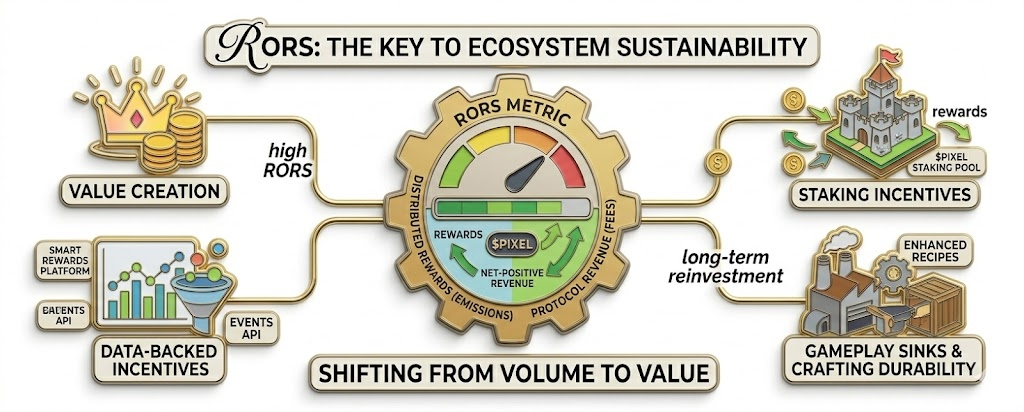
The first thing that caught my attention about Pixels was not just the game itself, but the way the team is starting to measure success more seriously. In Web3 gaming, people often focus on token price, user count, or short-term hype. But those things do not always tell the real story. A project can bring in a lot of users and still have weak economics underneath. That is why I think RORS, or Return on Reward Spend, could become one of the most important ideas inside the entire Pixels ecosystem. To me, it feels like Pixels is trying to answer a much harder question now: are the rewards being spent actually creating real value back for the ecosystem, or are they just leaving behind temporary activity?
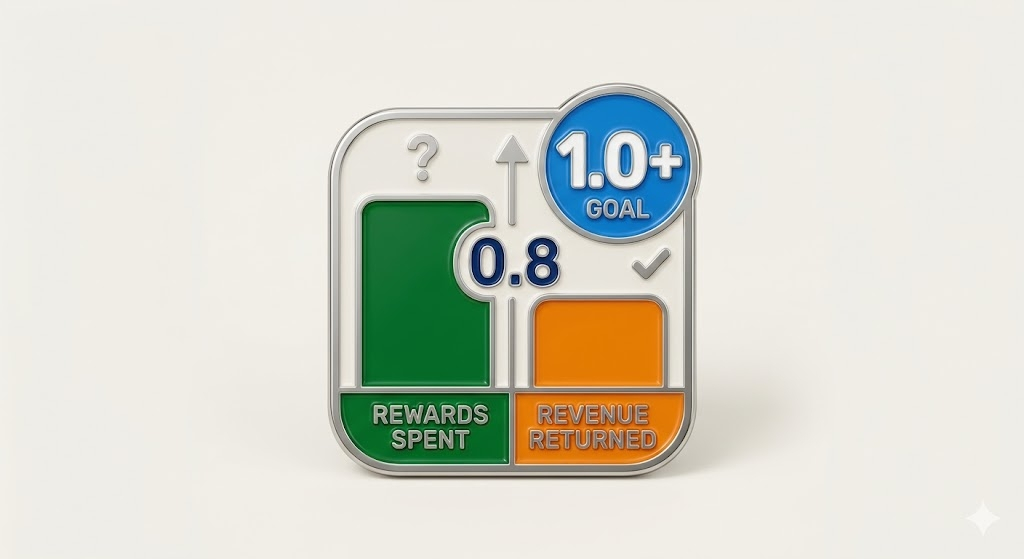
At its core, RORS is a very simple metric, and that is exactly why it matters. Pixels describes it as something similar to ROAS, Return on Ad Spend. In easy words, it compares how much is being distributed in rewards to how much revenue the protocol receives back in fees. Right now, Pixels says its RORS is around 0.8, and the goal is to push it above 1.0. That target is important because once RORS goes above 1.0, every reward token spent starts generating net-positive revenue for the ecosystem. For me, that changes the conversation completely. Instead of rewards being treated like a cost that keeps leaking out, they start becoming part of a model that can support itself. That is why I think RORS is not just another metric on paper. It could become the real test of whether Pixels is building something sustainable or not.
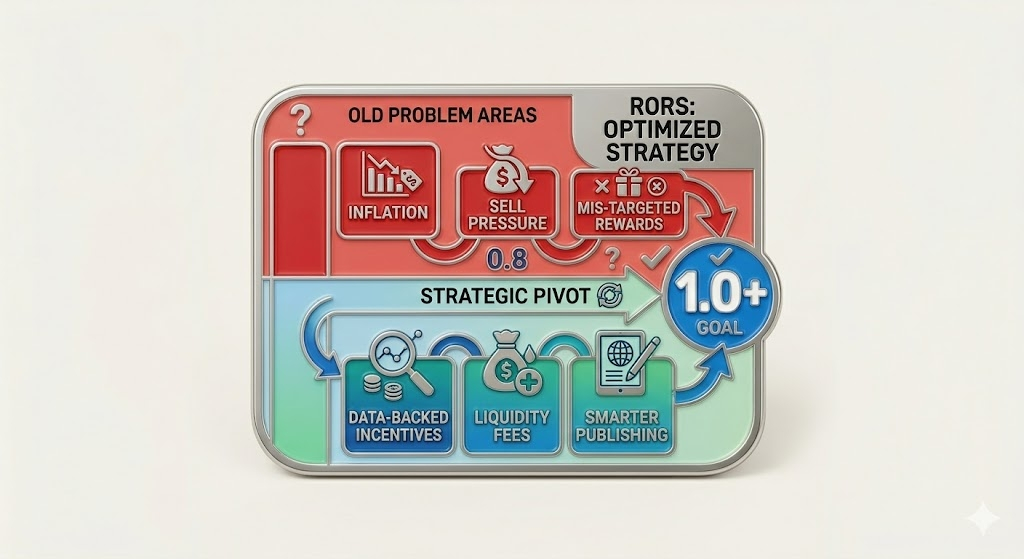
The reason this metric matters even more is because Pixels has already lived through the problems that made it necessary. In 2024, the project grew very fast, became the top Web3 title by daily active users, and generated $20 million in revenue. On the surface, that sounds like a huge success. But the team also openly pointed to the challenges that came with that growth. There was token inflation from excessive emissions, sell pressure from players extracting value without meaningful reinvestment, and mis-targeted rewards that often pushed short-term engagement instead of long-term value creation. I actually respect this part of the vision a lot, because it shows that Pixels is not pretending fast growth alone was enough. It is acknowledging that user numbers and revenue mean less if the reward system is not strong enough to support the ecosystem in a healthier way.
That is where the revised vision starts to make more sense to me. Pixels is no longer just talking about growing one game. It is talking about building a broader decentralized growth platform, something it describes almost like a decentralized AppsFlyer or Applovin for both Web3 and Web2 games. And at the center of that vision is RORS. The idea is simple: every token spent should create a measurable return, not just a temporary spike in activity. That is why the project is moving toward data-backed incentives, heavier liquidity fees on withdrawals, a new publishing model, and stronger growth-focused systems like referrals and content creation. For me, all of these changes point in the same direction. Pixels is trying to shift from rewarding volume to rewarding value, and RORS is the cleanest way to measure whether that shift is actually working.
The staking system also makes RORS more important because it changes how players and games relate to the ecosystem. In the new model, $PIXEL stays the main governance and staking token, while $vPIXEL becomes a spend-only token backed 1:1 by $PIXEL. Players can stake into individual games, effectively supporting which games deserve ecosystem resources. Then games compete by improving retention, increasing net in-game spend, and using Pixels tools more effectively. That means rewards are no longer just scattered broadly. They are tied more closely to game-specific performance. To me, this is a big shift, because once games themselves are competing to use rewards more efficiently, RORS naturally becomes one of the most important ways to judge who is actually helping the ecosystem grow in a healthy way.
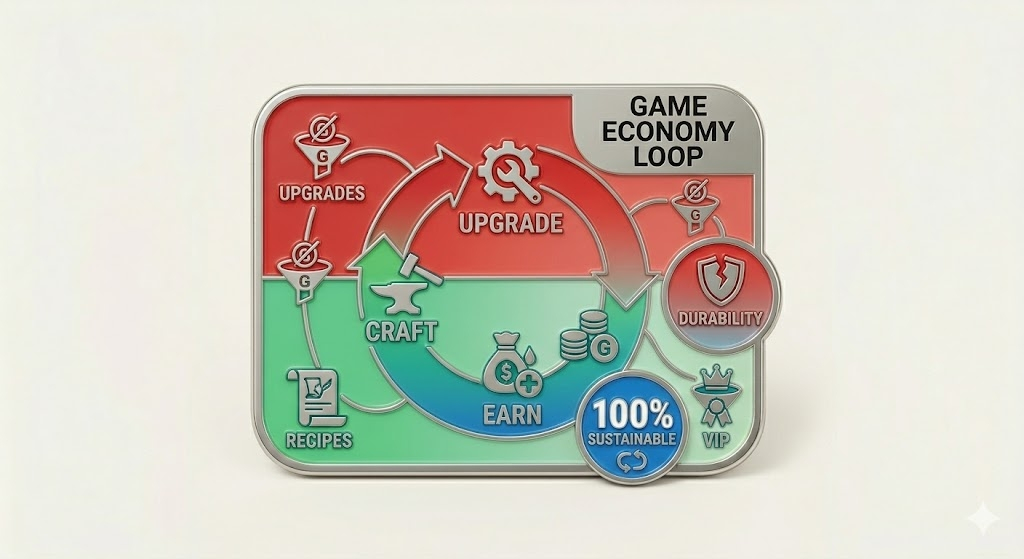
What makes this even stronger is how the same logic is being pushed into Core Pixels gameplay. The project admitted that Core Pixels had two major problems: an incomplete core loop with not enough sinks, and weak end-game activity that pushed players toward withdrawal instead of reinvestment. The fixes are clearly aimed at improving that. Progressive Speck Upgrades are meant to absorb coin inflation through expanding plot costs. Crafting Durability is supposed to renew resource demand by making tools, stations, and consumables degrade over time. Enhanced high-tier recipes are designed to absorb oversupply, while inventory caps and VIP gating add more structure to how players store, earn, and withdraw value. For me, all of this connects back to RORS in a very direct way. If the game economy becomes healthier, then rewards have a better chance of driving reinvestment instead of extraction. And if that happens consistently, RORS has a better chance of moving above 1.
Another reason I think RORS matters so much is because Pixels is not only relying on gameplay changes. It is also building a Smart-Reward Platform where rewards work like micro-ads with perfect attribution. Instead of spending budget on ad platforms, studios reward players only after they complete actions that lift real metrics, like finishing a tutorial, returning for seven days, inviting friends, or making a first purchase. That part is very interesting to me because it turns rewards into something measurable and traceable from treasury to wallet. Pixels is also aggregating first-party data across games through the Pixels Events API, using that data to model retention, LTV, spending behavior, and reward efficiency. In my view, this makes RORS even more powerful, because now it is not only measuring a game economy, it is measuring whether the whole platform is getting better at turning incentives into real ecosystem returns.
Then there is the ecosystem expansion side, which makes the long-term role of RORS even bigger. Pixels Pals, for example, is being built as a casual social mobile game, and it will feed more interaction data back into the smart-reward system. Future first-party and partner games are also expected to fit certain criteria, including strong monetization potential, open data sharing, and the ability to move toward a RORS of at least 0.9 within six months post-integration. That tells me RORS is not being treated as one internal metric for Core Pixels only. It is becoming a wider benchmark for how new titles, partner games, and the whole publishing ecosystem will be judged. For me, that is a very big deal. Once one metric starts influencing reward efficiency, publishing strategy, partner selection, and ecosystem direction, it becomes much more than a number. It becomes a kind of operating principle.

In the end, I think RORS could become the most important metric in the Pixels ecosystem because it brings everything back to one honest question: are rewards truly building value, or are they just being spent? That question matters more than hype, more than raw DAU, and more than short-term token excitement. Pixels already learned that fast growth alone does not guarantee a healthy system. Now it is trying to build a model where staking, spending, gameplay, data, and publishing all work toward stronger reward efficiency. For me, that is why RORS stands out so much. It is simple enough to understand, but deep enough to reflect the real health of the ecosystem. And honestly, if Pixels can keep pushing that number from 0.8 to above 1.0, then it will not just be improving a metric. It will be proving that its whole model is starting to work the way it was meant to.
