
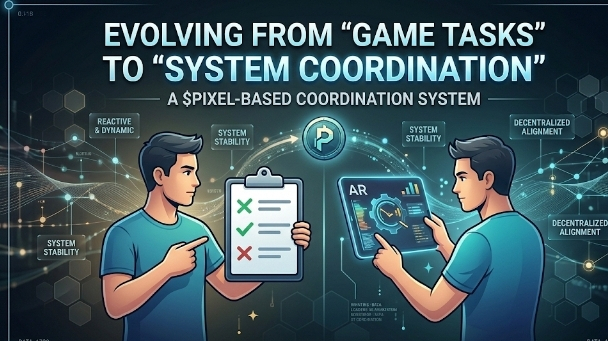
I used to treat task boards in games like a checklist.
Log in, scan the list, pick the easiest ones, repeat. Collect resources, complete small objectives, move on. It felt productive, but also strangely mechanical. After a while, the tasks stopped feeling like part of a world and started feeling like instructions I was following without thinking too much about why they existed.
And the pattern was always the same. Different game, same loop. Tasks weren’t really guiding me through an experience—they were just keeping me busy.
At that moment, I realized the task board usually isn’t about the game itself. It’s about maintaining activity. Keeping players engaged, making sure there’s always something to do, even if it doesn’t connect to anything larger.
What’s missing is intent.
Not just “do this,” but “why does this need to be done right now?” Most systems don’t answer that. They generate tasks in isolation, without reflecting what the environment actually needs. So you end up with repetition that feels disconnected from the state of the world.
That’s where something like @PIXEL started to feel a bit different, even if it wasn’t obvious at first.
Initially, I thought it was just a more structured version of the same idea. Another layer of tasks, maybe tied to rewards through Pixel but still fundamentally a loop designed to keep users active. It didn’t immediately feel like a shift.
But the more I paid attention, the more the task board started to look less random.
Instead of static objectives, it began to feel reactive. Not perfectly, but noticeably. Certain tasks seemed to appear based on what was lacking—resources that needed to be produced, actions that pushed the system forward, not just the individual player.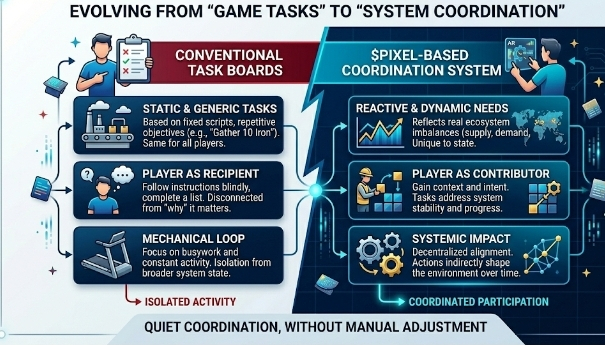
And that’s when the framing changed for me.
The task board isn’t just showing you what to do. It’s hinting at what the system needs.
$PIXEL, in that sense, isn’t just a reward mechanism. It acts more like a coordination signal. When tasks are tied to it, they’re not only guiding player behavior—they’re aligning it with a broader state. Supply, demand, progression, all subtly influencing what shows up as “work.”
So instead of playing through a fixed script, you’re participating in something that adjusts over time.
What I find interesting is that this doesn’t feel obvious while you’re playing. It still looks like a simple list. Complete this, earn that. But underneath, there’s a suggestion that the tasks aren’t entirely arbitrary.
They exist because something, somewhere in the system, requires them.
Still, I had doubts.
If most players don’t notice this layer, does it actually matter? If the experience feels the same on the surface, is the added complexity doing anything meaningful, or just making the system harder to reason about?
Initially, it felt like over-structuring something that could remain simple.
But upon reflection, the difference shows up over time, not in a single session.
If tasks consistently reflect the state of the environment, then player behavior starts to shape that environment in return. You’re not just completing objectives—you’re indirectly stabilizing or shifting the system. Resources don’t just appear; they’re produced because players were guided to produce them.
And if that loop holds, it creates a kind of balance that doesn’t rely on constant manual adjustment.
That’s where things start to extend beyond a single game.
If Pixel represents participation in these coordinated actions, then it becomes a record of contribution, not just activity. Something other systems could potentially read, interpret, or build around. Not in a forced way, but as a shared reference of what users have actually done.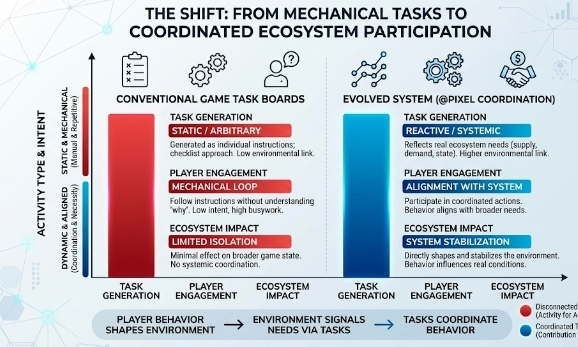
You could imagine different environments recognizing that history. Not copying it, but acknowledging it. Letting it influence access, status, or opportunities elsewhere.
But I don’t think this expands easily, at least not yet.
There’s friction in getting multiple systems to align around the same signals. Most platforms still operate independently. And even within one system, keeping tasks meaningfully tied to real conditions requires careful design. It can drift back into randomness if not maintained.
There’s also the question of whether players care enough to notice the difference.
Right now, I’m still observing it from a distance.
I hold a small amount of $PIXEL, just enough to stay connected to how things evolve. I’m not fully convinced the task system becomes something foundational, but I can see the direction it’s pointing toward.
For me, the real proof is simple.
If over time, tasks stop feeling repetitive and start feeling necessary—if players naturally follow them because they reflect real conditions, not just arbitrary goals—then the system is doing something right.
And if other systems begin to rely on those same signals, treating them as indicators of real activity rather than just in-game progress, then it becomes more than a task board.
It becomes a way of coordinating behavior across an environment.Quietly, without needing to explain itself.