
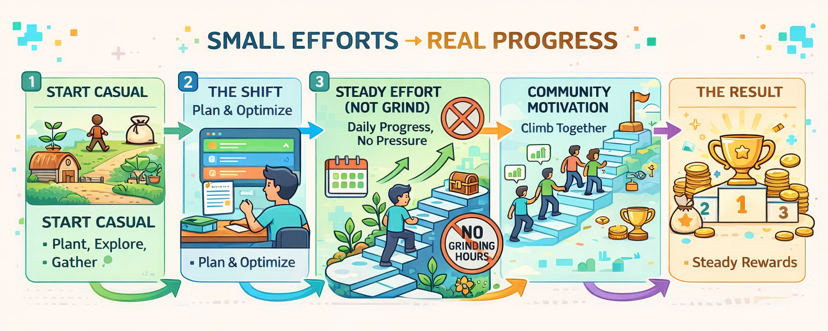
There’s something a bit different about $PIXEL when you first step into it. It doesn’t really try to explain itself too loudly. You just kind of appear there, walking around, figuring out what’s going on. At first, it feels almost too simple. Farming, moving around, picking things up. Nothing is pushing you in a specific direction.
And that’s where things get interesting.#pixel
Most Web3 games I’ve seen tend to make their intentions clear very early. You can usually tell within minutes what they want from you. There’s often this underlying pressure — not always obvious, but it’s there. Progress starts to feel tied to ownership pretty quickly. You reach a point where continuing normally doesn’t feel like the “intended” path anymore.
Pixels doesn’t do that. Not immediately, at least.
You just… play.
The farming part is straightforward. You plant crops, you wait, you harvest. It sounds repetitive, and in a way it is, but it doesn’t feel forced. There’s no rush tied to it. No constant reminder that you’re falling behind. It becomes more about rhythm than progression. You log in, do a few things, walk around, maybe talk to someone or explore a bit. Then you log out.
And somehow that loop holds up longer than you’d expect.
The world itself feels open, but not in the overwhelming way some games do. It’s not packed with noise. There’s space to move, space to think. You’re not being pulled in ten directions at once. You can ignore most things and still feel like you’re part of it. That’s not something you see often, especially in this space.
When people talk about Web3 games, they usually focus on ownership. Assets, tokens, land, all of that. And yes, Pixels has those layers too. It runs on the Ronin Network, so the infrastructure is there. But the game doesn’t start with that. It doesn’t introduce itself through that lens.
It almost delays that conversation.
You begin by interacting with the world itself, not the system behind it. And over time, you start noticing how things connect. Resources have value. Time spent doing certain tasks starts to feel like it could mean something beyond just gameplay. That’s when the question slowly shifts.
It’s no longer “what is this game about?”
It becomes “how does this world sustain itself?”
And you don’t get a direct answer. You sort of piece it together.
The social aspect plays a role here too. You see other players moving around, doing their own thing. Some are clearly more invested. They’ve built setups, optimized their routines, figured out ways to be more efficient. Others are just wandering, like you were in the beginning.
That contrast is subtle, but it says a lot.
You can exist in either state, and the game doesn’t punish you for choosing one over the other. That’s rare. Usually, systems push you toward optimization. Here, it feels optional. You can take it seriously, or you can just treat it like a place you visit.
After a while, patterns start to appear.
You notice which activities people repeat. You notice how certain areas feel more active than others. You start to understand that even though the game doesn’t force progression, there is still a structure underneath. It’s just not aggressive about it.
That balance is hard to explain.
It’s like the game trusts you to decide how deep you want to go. And because of that, engagement feels different. It’s not driven by urgency. It’s more about curiosity. You stay because you want to see what happens if you keep going, not because you’re afraid of missing out.
That shift changes how you interact with everything.
Even the idea of earning or monetization — which is usually front and center in Web3 — feels pushed to the background at first. It’s there, but it doesn’t dominate your experience. You don’t log in thinking about it immediately. You think about what you’ll do in the game.
Then, slowly, the two start to overlap.
You realize that what you’re doing has some form of value. Not in a loud or exaggerated way, but in a quiet, almost secondary layer. It doesn’t interrupt the gameplay, but it sits alongside it.
And that’s where things can go in different directions.
Some players start optimizing everything. Time, resources, movement — it all becomes calculated. Others continue playing casually, barely interacting with that layer at all. The game allows both, which creates an interesting kind of ecosystem.
It’s not perfectly balanced. No system like this ever is.
But it doesn’t feel fragile either.
You can usually tell when a game is struggling to hold its own structure together. Things feel forced, incentives feel misaligned, players start dropping off quickly. Here, it doesn’t feel like that, at least not on the surface. The pacing helps. The lack of pressure helps even more.
There’s also something about the visual style that contributes to this. It’s simple, almost nostalgic. Not trying too hard to impress. That makes it easier to stay in the experience without overthinking it. You’re not constantly reminded that you’re in a “system.” It just feels like a game first.
And maybe that’s the point.
It doesn’t try to redefine anything in an obvious way. It just adjusts small things. The order in which you experience them. The intensity with which they’re presented. The space it gives you to figure things out on your own.
Those changes seem minor at first.
But over time, they add up.
You start noticing that you’ve spent more time in it than expected. Not because you had to, but because it didn’t give you a reason to leave. That’s a different kind of retention. It’s quieter. Less visible. But maybe more stable.
Of course, questions still remain.
How sustainable is this approach long term? What happens when more players start focusing on the value side of things? Does the balance shift? Does the experience change?
It’s hard to say.
Right now, it feels like the game is still in that phase where things are forming. Systems are being used, tested, adjusted — not always visibly, but you can sense it. The world feels active, but not finished.
And maybe it’s not supposed to be.
Some games feel complete when you play them. This one doesn’t. It feels like it’s still becoming something. Still figuring out what parts matter most. Still seeing how players behave when given more freedom than usual.
You don’t really get a clear answer by the end of a session.@Pixels
You just log out, thinking about small things. What you did. What you could do differently next time. Whether you even want to approach it differently.
And that thought kind of lingers.
Not in a strong or urgent way. Just quietly, in the background, like something you might return to… or might not.#pixel
