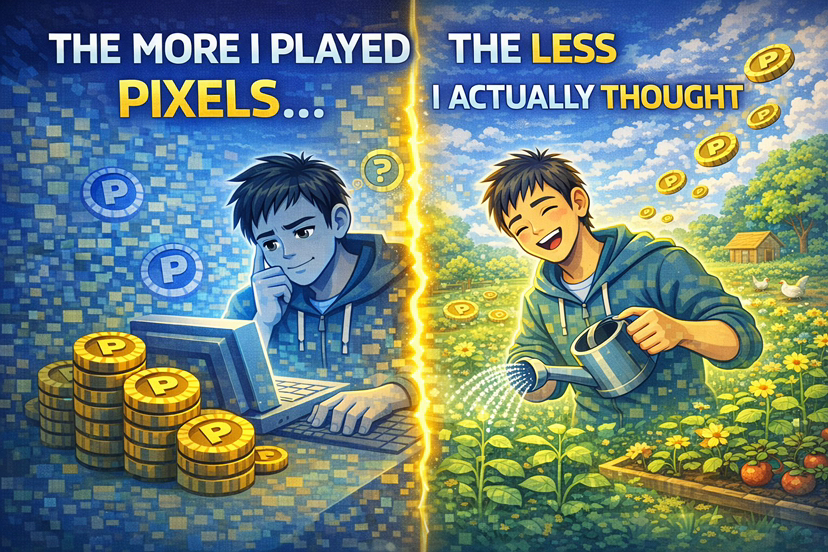
There’s something I didn’t expect to notice after spending enough time in Pixels the more I played, the less I actually thought.
In the beginning, I was very deliberate. Every action had a reason behind it. I spent time figuring things out: what to plant for better returns, which quests were worth doing first, when it was most efficient to log in.
Sometimes I even compared different approaches, trying to optimize every small detail. It felt like solving a system, and I liked that. I felt in control, like if I thought carefully enough, I could always do better.
That phase was exciting. Every decision felt meaningful.
But that didn’t last.
After a while, something shifted. I stopped thinking as much. Not because I became more skilled, but because I started doing everything out of habit.
I would log in, look around briefly, and then just move. Plant this, harvest that, complete a few quests, log out. Everything flowed smoothly, almost automatically. If someone asked me why I was doing those exact actions, I probably wouldn’t have a clear answer.
It felt like I had moved from conscious play into something closer to reflex.
At first, I didn’t notice anything wrong. On the surface, everything was still working. I was consistent, I was still earning PIXEL, and nothing seemed broken. But internally, the experience had changed.
There was less curiosity. Less intention. More repetition.
One day, I paused in the middle of playing. Not because I was tired, but because I suddenly realized I had just gone through an entire sequence of actions without really thinking about any of it.
I wasn’t deciding. I was just executing.
That moment caught me off guard.
Up until then, I had always assumed I was in control, actively choosing what to do. But in reality, I had slipped into a pattern where I was simply following what had become familiar.
So I started paying closer attention.
The structure of Pixels is built around smooth loops: do an action, receive a reward, see progress, come back again. It’s simple, clean, and easy to follow.
And because of that, my brain gradually shifted into a kind of energy-saving mode relying on habit instead of active thinking.
That’s not unusual. But what stood out to me was how invisible that shift felt.
When I stopped thinking, I also stopped questioning.
And when I stopped questioning, I wasn’t really choosing anymore.
I was just continuing.
What made it even more subtle was the presence of PIXEL. It gave everything a sense of value, which made the loop feel justified. I felt like I was being productive, so I didn’t feel the need to step back and reflect.
But eventually, I did.
And once I noticed it, I couldn’t unsee it.
It wasn’t that the game became simpler. It was that I had become too familiar with it. Familiar enough to stop engaging with it consciously.
So I tried changing things.
On some days, I intentionally broke my routine. I didn’t follow the usual path. I didn’t try to optimize. I just experimented, even if it felt inefficient.
It felt slower at first. A bit awkward. But something came back awareness.
I started thinking again. Asking myself what I was doing, and why.
That shift made the experience feel different. Not necessarily more profitable, but more real.
I don’t think operating on auto-pilot is inherently bad. In many ways, it makes things easier. But if I don’t realize when I’ve slipped into that mode, it becomes very easy to lose a sense of agency.
For me, the key isn’t whether I play more or less.
It’s whether I’m still aware of how I’m playing.
Because there’s a real difference between making a choice… and repeating something just because it has become a habit.
And that line is thinner than I thought.
@Pixels #pixel $PIXEL $RAVE $MOVR