
I’ll be honest, I usually get cautious the moment a Web3 game starts talking about rewards.
I have watched too many projects confuse activity with value, and too many token loops mistake extraction for loyalty.
That is why I did not look at pixels as just another farming game on Ronin.
What kept me reading was the feeling that Pixels is not trying to hide from the old play-to-earn problem.
It seems to be studying that failure directly, then rebuilding around a harder question.
What kind of reward system actually helps a game stay alive?
That question matters because the weakest habit in play-to-earn is usually the same.
A lot of systems pay people for showing up, but they do not really care what kind of behavior they are attracting.
So the game fills with short-term farmers, the economy leaks outward, and the reward budget slowly becomes a machine that funds exits.
You can get impressive surface numbers with that for a while.
You can call it growth.
But if players are not staying because the game is enjoyable, social, creative, or personally sticky, then the whole thing starts eating itself.
That is the part of Pixels that caught my attention.
The official direction feels more grounded than the usual GameFi promise.
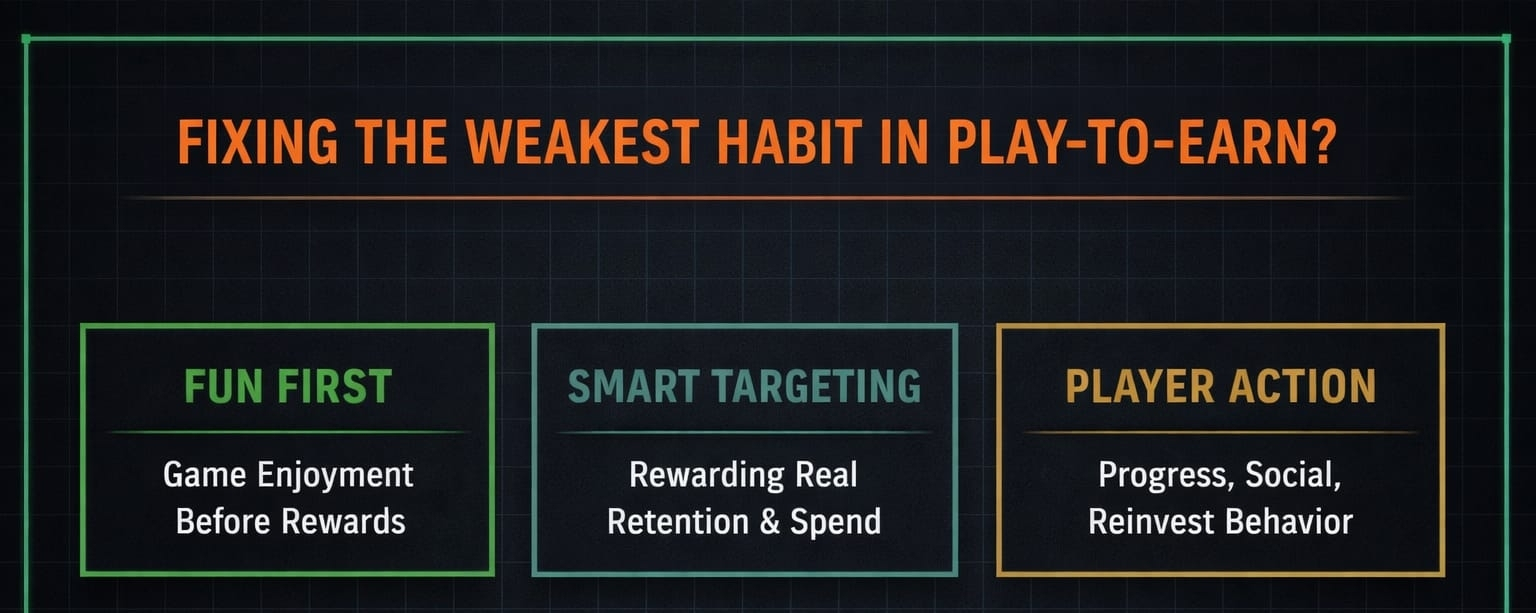
The game is supposed to be fun first, and I think that line matters more than people admit.
Not because it sounds good in a pitch, but because it sets a limit on what rewards are supposed to do.
The reward is not meant to replace the game.
It is supposed to support the game.
That difference sounds small until you look at what usually breaks these economies.
Pixels began as a farming game, but the broader ambition looks bigger than one crop loop or one token cycle.
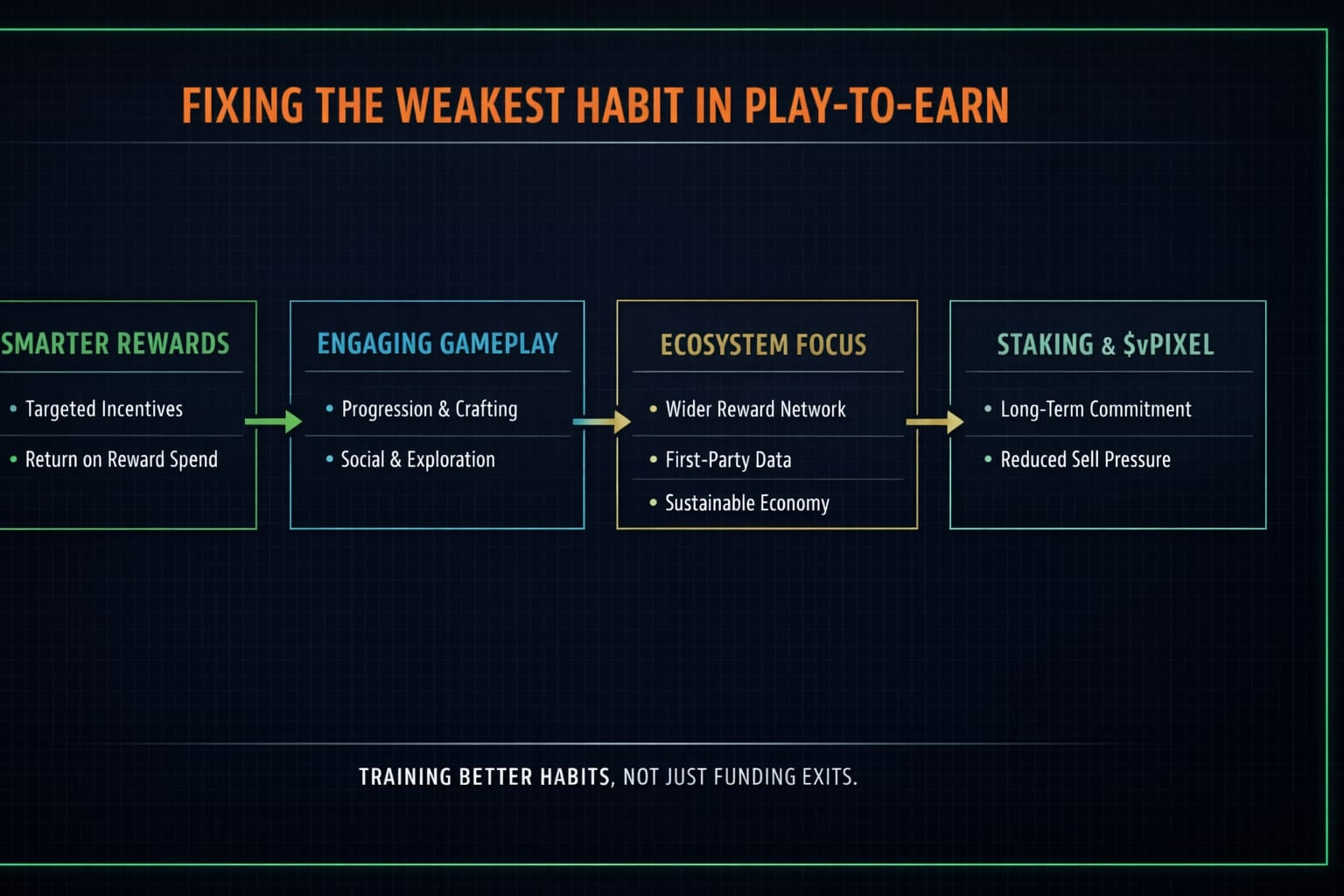
What I found more interesting is how the project talks about smarter reward targeting, first-party data, and a wider ecosystem loop where better data leads to better targeting, and better targeting lowers waste.
That is a much more serious frame than simply spraying tokens across users and hoping retention appears later.
In practical terms, Pixels seems to understand that sustainable game economies are built through behavior, not slogans.
If a system only rewards extraction, it teaches players to treat the world like a temporary mine.
If it rewards progression, reinvestment, exploration, social participation, and useful spending, it starts teaching a different habit.
That is where the core game design becomes important.
Farming is still part of the identity, but it is not the whole story.
Progression, crafting, land use, storage pressure, resource management, upgrading, higher-tier production, and social interaction all give players more reasons to stay inside the world instead of treating it like a quick payout screen.
That makes the casual side of Pixels more important than it first looks.
Casual does not mean shallow.
In this case it means the game is trying to create repeatable, low-friction habits that can grow into stronger commitment over time.
Exploration matters.
Creativity matters.
Showing off a space matters.
Referrals matter.
Creator participation matters.
Even small social actions matter when the goal is to make a game feel lived in rather than merely farmed.
That is also why ownership only matters to me when it changes behavior.
If players own assets but still act like temporary extractors, then ownership is mostly decorative.
But if ownership encourages reinvestment, progression, identity, and longer-term participation, then it becomes more meaningful.
That is where Pixels feels more thoughtful than a lot of Web3 gaming projects I have seen.
The player is not just meant to touch the system.
The player is supposed to matter to the system’s long-term health.
That is why the idea of RORS stood out to me.
Return on Reward Spend is a plain way of asking whether rewards are creating real value back into the ecosystem.
I like that because it strips away a lot of romantic language.
It forces a harder conversation.
Are the incentives actually improving retention, spending, and ecosystem quality, or are they just producing temporary activity?
That is a much better question than asking whether emissions are making people show up for a few days.
The token design gets more interesting when viewed through that same lens.
Pixel is not just there to decorate the economy.
It sits at the center as the governance and staking asset.
And the staking idea becomes much more interesting once games are treated more like validators competing for player support.
That creates a tighter connection between token support and actual operating quality.
If a game cannot retain people, cannot use incentives well, and cannot create real participation, then it should not be able to hide behind token noise forever.
I also think $vPIXEL is one of those details that says a lot about how the team is thinking.
A spend-only token backed 1:1 by Pixel may not sound exciting on the surface, but the logic is practical.
It tries to reduce pure extraction and keep more value circulating inside the ecosystem.
That matters because a lot of GameFi systems break when every reward instantly becomes sell pressure.
Pixels seems to be trying to redirect that loop toward in-ecosystem use instead.
That does not guarantee success, but it is at least aimed at the real problem.
The broader ecosystem angle is where my interest grew more.
Pixels does not seem to want to stay just a single game with a token attached.
It looks like the team is trying to build a wider reward and publishing system where data, event tracking, reward optimization, creator loops, and acquisition efficiency all reinforce each other.
That is a more believable ambition to me than pretending one game can endlessly grow through emissions alone.
Still, none of this is magic.
A game can still fail if the content becomes stale.
A reward model can still be configured badly.
A social system can still become repetitive.
And data systems can still optimize the wrong behavior if the design judgment behind them is weak.
That is why I do not look at Pixels and assume the hard part is finished.
I look at it and think the hard part is finally being taken seriously.
That is enough to make me pay attention.
So when I look at pixels, $PIXEL, and the wider #pixel ecosystem, I do not really ask whether the token is loud enough.
I ask whether the system is training better habits.
Are players staying longer?
Are they spending more meaningfully?
Are they upgrading instead of only cashing out?
Are they referring others because the game is worth sharing?
Are they participating more deeply over time?
That is the test that matters to me.
Not a short DAU spike.
Not a noisy market week.
Not the usual cycle of attention followed by silence.
Real adoption in gaming usually comes from enjoyable systems, aligned incentives, and repeat behavior that feels natural enough to last.
And that is why Pixels stayed on my radar after I looked deeper.
Not because it solved everything, but because it seems to understand that the weakest habit in play-to-earn was never a lack of rewards.
It was rewarding the wrong behavior for too long.
Can pixels make $PIXEL rewards strengthen real player habits instead of just funding another exit loop?