
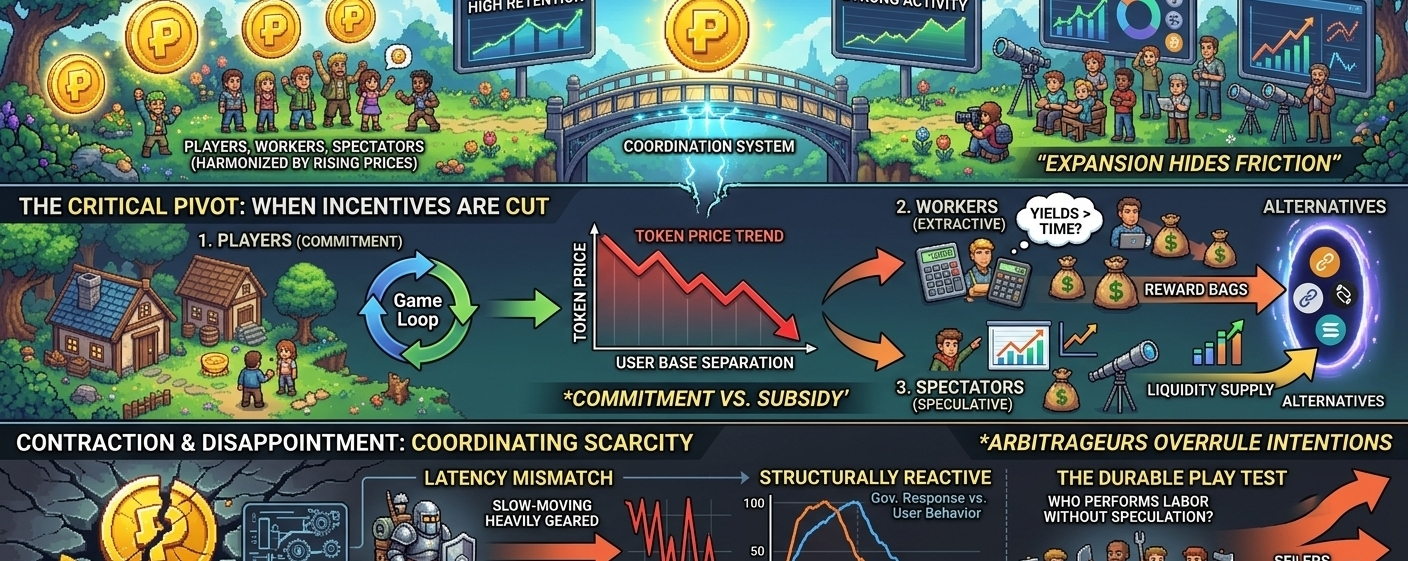
I study markets through the moments people prefer not to discuss: the hours after momentum fades, the weeks after incentives are cut, the months after volume leaves. That is where a coordination system becomes visible. In expansion, almost any protocol can look coherent because rising prices hide friction. In contraction, behavior stops pretending. For Pixels, the more useful question is not whether the game attracts users or whether the chain can process activity. It is what fails first when PIXEL, functioning as coordination infrastructure, is asked to organize people during scarcity rather than abundance.
The first pressure point I watch is the difference between activity and conviction. Systems tied to games often report large participation numbers because the cost of trying is low and the possibility of extracting value is emotionally attractive. But participation under subsidy is not the same thing as commitment under stress. When token prices weaken, the user base begins to separate into three groups: players, workers, and spectators. Players remain for the game loop. Workers remain only if yields justify time. Spectators remain only if price action might return. Those groups behave similarly in bull phases and completely differently in drawdowns. That separation matters because many in-game economies are calibrated as if engagement were one unified resource. It is not. It is three motives temporarily sharing one interface.
I have watched capital rotate in and out of narratives long enough to know that retention statistics can become misleading precisely when they look strongest. If rewards pull in extractive users, headline activity may rise while underlying loyalty falls. In that environment, the token becomes a payroll rail more than a social glue. People are coordinated, yes, but around selling schedules rather than around long-term participation. Once that happens, every reward distributed can increase visible usage while quietly deepening future exit pressure. The architecture may still function perfectly at the technical layer, yet behaviorally it begins to hollow out.
For Pixels, this creates a subtle asymmetry. The easier it is for newcomers to monetize time, the more attractive onboarding becomes. But the easier it is to monetize time, the faster rational users compare in-game returns to outside opportunities. They do not need to hate the product to leave. They only need better alternatives. In crypto, alternatives appear quickly. Capital moves faster than communities admit. A user who seemed loyal yesterday can become liquidity supply tomorrow.
The second pressure point is pricing authority without explicit authority. Decentralized systems often frame themselves as removing intermediaries, but market price becomes the new intermediary. When PIXEL coordinates access, rewards, status, or progression, the token market starts dictating internal behavior even if no single actor intends it. Designers can propose balance changes. Communities can vote. None of that overrides a falling external price. If the token weakens sharply, every internal incentive denominated in it is repriced downward in real time. Governance forums may still speak the language of autonomy, but the order book has already made the decision.
This is where latency becomes dangerous. Game systems adjust slowly because changes affect fairness, user trust, and economy balance. Markets adjust instantly because sellers do not wait for committee review. That mismatch means a protocol can become structurally reactive. By the time a governance response is discussed, users have already changed behavior, farmers have already optimized around the gap, and long-term holders have already absorbed another drawdown. The chain may be fast, yet coordination itself becomes slow.
I see a clear trade-off here: capital efficiency versus resilience. If rewards, sinks, and token utility are optimized tightly for growth, the system can feel vibrant during expansion. Resources circulate quickly. Demand appears healthy. Metrics look impressive. But tightly optimized systems often have less slack when stress arrives. If you instead build with more friction, more buffers, and less aggressive monetization, growth may look weaker in good times while survivability improves in bad times. Most markets reward the first model until suddenly they do not.
There is also an uncomfortable question that gaming tokens rarely escape: if speculative upside disappeared for two years, who would still show up every day? Not who would check the chart, not who would hold and hope, but who would perform the repetitive labor that sustains the economy. If that number is much smaller than public activity suggests, then the protocol may be coordinating extraction flows more than durable play.
None of this means Pixels is uniquely fragile. It means it faces the same discipline every tokenized coordination system faces. Intentions do not set equilibrium conditions. Incentives do. A pleasant community, a capable team, and real users can still be overruled by payout math and market reflexes. I have seen narratives with stronger branding and deeper liquidity fail this exact test because they confused motion with stability.
When belief is abundant, PIXEL can organize time, attention, and ambition efficiently. When belief thins out, it must organize disappointment, reduced returns, and selective exits. Those are harder resources to coordinate. The interesting part is not whether the system keeps running. Most systems keep running. The interesting part is whether the people inside it continue acting like participants once the token starts treating them like arbitrageurs.