
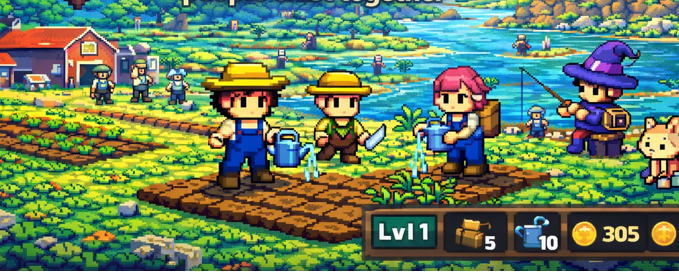
There is one thing that has gradually made me see PIXELS differently: I no longer see it as just a game. On the surface, it is still a light farming, exploration, and social interaction game, but the more I watch how users exist inside it, the more I feel that PIXELS operates more like a community space than a purely entertainment product. I think that difference matters, because many Web3 games still stop at creating activity, without really creating the feeling of co-presence.
In a normal game, people can log in, complete a gameplay loop, and leave. In a community space, value does not sit entirely in individual action, but in the fact that other people are there too. With PIXELS, what catches my attention is not only what I plant, what I harvest, or how I optimize. It is the feeling that this world has its own rhythm because many people are leaving traces of themselves inside it. Players are not just interacting with a system. They see each other, pass by each other, casually observe one another, and in a fairly natural way begin to create the sense that this is a place where people live, not just a place where mechanics exist.
I think the first mechanism that gives PIXELS this community-like quality is continuous presence. A real community does not always need big interactions. Sometimes it only needs a steady rhythm of return, where users feel that their presence continues from yesterday into today. PIXELS does this fairly well through small loops that are light enough to return to without pressure. But precisely because they are light, players can form a habit of showing up, and when many people show up in the same rhythm, the game begins to take on the shape of a social layer.
The second mechanism is that the social aspect is not separated from the product itself. Many projects talk a lot about community, but their communities mostly live on X, Discord, or Telegram. In that case, the product becomes little more than a reason for discussion. With PIXELS, I get the sense that the community is pulled back inside the game space itself. That creates a fairly clear use case: users do not just come to “play,” but to continue participating in a shared rhythm, where the presence of others makes the experience feel far less dry.
Another use case I see clearly is that PIXELS can serve as a relatively soft entry point for newcomers to Web3. Someone who is not especially interested in blockchain can still step in first as if entering a space with its own routines, pace, and sense of community. When the experience begins with “being in a world with other people” rather than “joining an asset system,” the psychological barrier becomes much lower.
Still, I think caution is necessary. A community space is only durable when the core experience remains alive even after growth begins to slow. If user density drops sharply, the sense of liveliness can disappear very quickly. And if the social layer depends only on having a crowd, rather than on deeper reasons to stay, then sooner or later its limits will show. That is probably why I do not see PIXELS as a complete solution. I only see it touching a more interesting direction than many other Web3 games: turning play into not just a sequence of actions, but a way of existing together inside a digital world.
