
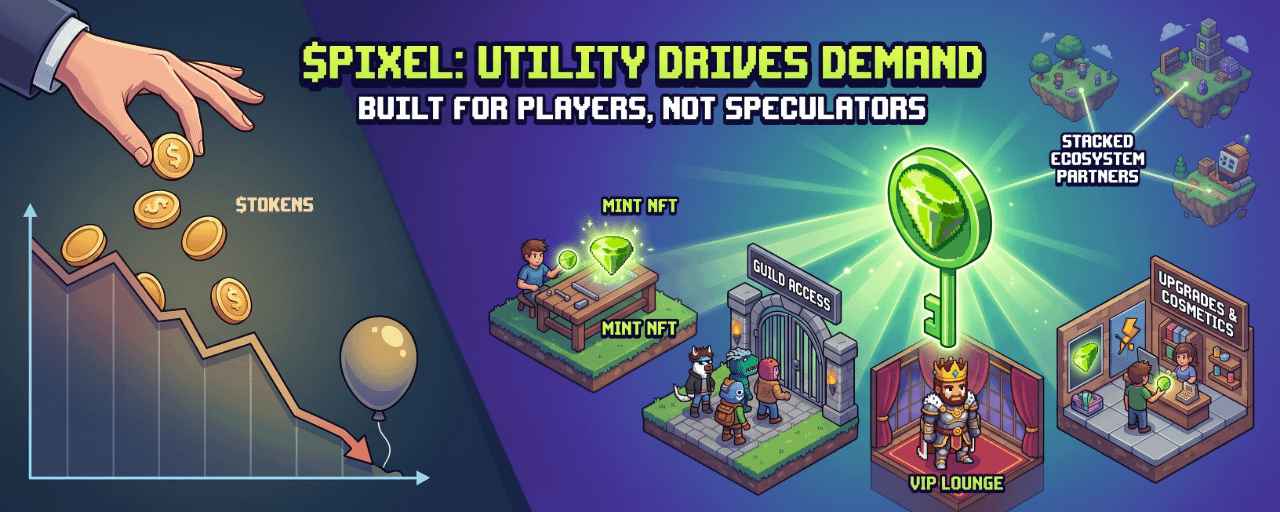
I've held a lot of gaming tokens over the years. The pattern is almost always the same. Token launches with a lot of excitement, early players earn it through gameplay, it hits an exchange, price pumps for a few weeks on speculation, then the sell pressure from farmers overwhelms any real demand and the whole thing slowly deflates. By the time the game releases its "major update," the token is already down 80 percent and nobody is paying attention anymore.
The problem was never the game. The problem was that the token had no reason to exist outside of being earned and sold.
That sounds obvious when you say it out loud. But you'd be surprised how many teams still launch a token without asking the most basic question: why would anyone want to hold this instead of sell it?
PIXEL started from a different place. Not a perfect place, but a different one.
When I first looked at the actual utility list, it wasn't just a list of in-game purchases dressed up to sound important. Minting NFTs requires PIXEL. Joining guilds requires PIXEL. VIP access, the thing that actually changes what you can earn and how fast you can progress, requires PIXEL. Cosmetics, upgrades, the parts of the game people genuinely want because they care about their presence inside the world, all of it runs through the same token.
That changes the demand profile completely.
In most gaming tokens, the only people buying are speculators betting on price. In Pixels, the people buying are active players who need the token to access things they already want. That's a fundamentally different buyer. Speculators leave when momentum fades. Players buy because the game pulled them in and the token is the key to the next thing they want to do.
But here's where it gets more interesting.
Stacked is what happens when you take that utility logic and scale it beyond a single game. The Pixels team spent years figuring out how to make PIXEL mean something inside one ecosystem. Now they're building infrastructure that lets other studios plug into the same reward and loyalty system. And $PIXEL sits inside that infrastructure as the cross-ecosystem currency.
Think about what that actually means for token demand. Right now, demand comes from Pixels players. Once Stacked is running across multiple games, demand comes from every studio that integrates and every player inside those studios who wants access to what PIXEL unlocks. The demand surface gets broader every time a new game joins. The token isn't tied to the success of one title anymore, it's tied to the health of an entire network.
That's a completely different risk profile than any gaming token I've held before.
Most tokens I've watched die didn't die because the game failed. They died because the token was structurally disconnected from everything happening inside the game. Players were earning it but nobody needed it. The moment farming rewards slowed down, there was nothing left holding the price up because there was never any real demand underneath the speculation in the first place.
$PIXEL has actual sinks. The Farmer Fee mechanism means that players withdrawing on-chain are contributing directly to staking rewards or burn. The vPIXEL option keeps liquidity inside the ecosystem for players who want full value without the fee. Every part of the system is designed to create reasons to hold or spend rather than just reasons to earn and exit.
Is it perfect? No. Token economies never are and anyone who tells you otherwise is selling something.
The AI layer inside Stacked also matters here in ways people aren't fully talking about yet. When the system can identify which players are genuinely engaged versus which ones are farming to dump, it can route rewards more efficiently. That means the token isn't bleeding out into wallets that will immediately hit a DEX. It's going to people who are likely to spend it back into the ecosystem. That's not just good game design, that's monetary policy at the player level.
What I keep coming back to is this. The gaming tokens that survived long term weren't the ones with the most aggressive emission schedules or the biggest initial airdrop. They were the ones where people found genuine reasons to stay inside the ecosystem long after the initial excitement faded. Where the token felt like part of the experience rather than the whole point of it.
PIXEL isn't there yet. But it's the closest thing I've seen to a gaming token that's actually trying to get there structurally rather than just hoping hype does the work.
And in a space where most tokens are just rewards with a ticker, that matters more than most people are giving it credit for right now.
