
When Speed Feels Like Confidence, But Isn’t
There was a point when I stopped noticing how quickly I was making decisions.
Not because I became better.
Because the process started to feel smooth.
I would open a position after a short interaction. A few lines of output. A structure that looked coherent. A conclusion that didn’t resist me. It felt like clarity, but it was actually alignment the tool and my bias moving in the same direction.
That distinction matters more than most people think.
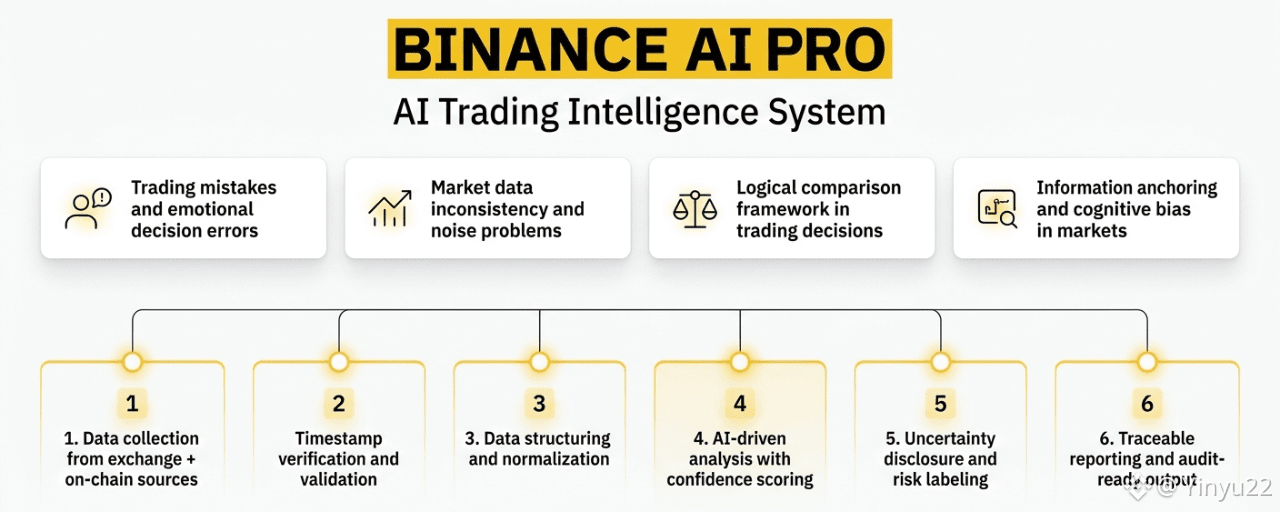
The problem with tools like Binance AI Pro is not that they are wrong.
It’s that they are consistent.
Consistency creates trust.
Trust reduces friction.
And reduced friction quietly lowers your guard.
You stop asking whether the answer is complete, and only check if it is usable.
I noticed this the day I compared two trades that should have had nothing in common.
One was small enough to ignore if it failed.
The other was large enough to affect how I would think for the rest of the week.
Same workflow.
Same number of questions.
Same level of scrutiny.
The only difference was the number on the order ticket.
That’s when it became obvious:
I wasn’t scaling my thinking. I was repeating a habit.
There is a subtle trap here.
AI does not hesitate.
It does not slow down when your size increases.
It does not ask, “Are you sure this deserves more attention?”
It answers with the same tone, the same structure, the same confidence.
So unless you interrupt that flow deliberately, your decision-making stays flat while your exposure does not.
What makes this dangerous is not the size of the mistake.
It’s the invisibility of the mismatch.
If you lose on a small trade, it feels like noise.
If you lose on a large trade, it feels like bad luck.
In both cases, the root is often the same:
You didn’t deepen the process when it actually mattered.
I started changing one thing.
Before I ask anything, I define what kind of decision I’m about to make.
Not in terms of the market.
In terms of consequence.
Because consequence is what should shape the questions, not curiosity.
For low-impact decisions, speed is fine.
You are testing ideas, not defending capital.
For mid-impact decisions, context starts to matter.
You need to understand what else moves with your position, not just the position itself.
But for high-impact decisions, the question changes completely.
It is no longer:
“Does this setup make sense?”
It becomes:
“What happens to me if this is wrong, and have I already accepted that outcome?”
That question is uncomfortable for a reason.
It forces you to simulate failure before you commit.
And most people don’t want to do that, especially when everything already looks “good enough.”
Tools like Binance AI Pro are powerful precisely because they remove effort.
But effort is sometimes the only signal that tells you to slow down.
When that signal disappears, you have to replace it with intention.
Otherwise, you end up trusting a process that feels identical at every scale
even when the consequences are not.
The real edge is not faster answers.
It’s knowing when an answer deserves resistance.
And building a habit where the size of your position is reflected in the weight of your questions, not just the speed of your execution.
@Binance Vietnam #BinanceAIPro $XAU
Giao dịch luôn tiềm ẩn rủi ro. Các đề xuất do AI tạo ra không phải là lời khuyên tài chính. Hiệu quả hoạt động trong quá khứ không phản ánh kết quả trong tương lai. Vui lòng kiểm tra tình trạng sản phẩm có sẵn tại khu vực của bạn.
Giao dịch luôn tiềm ẩn rủi ro. Các đề xuất do AI tạo ra không phải là lời khuyên tài chính. Hiệu quả hoạt động trong quá khứ không phản ánh kết quả trong tương lai. Vui lòng kiểm tra tình trạng sản phẩm có sẵn tại khu vực của bạn.