
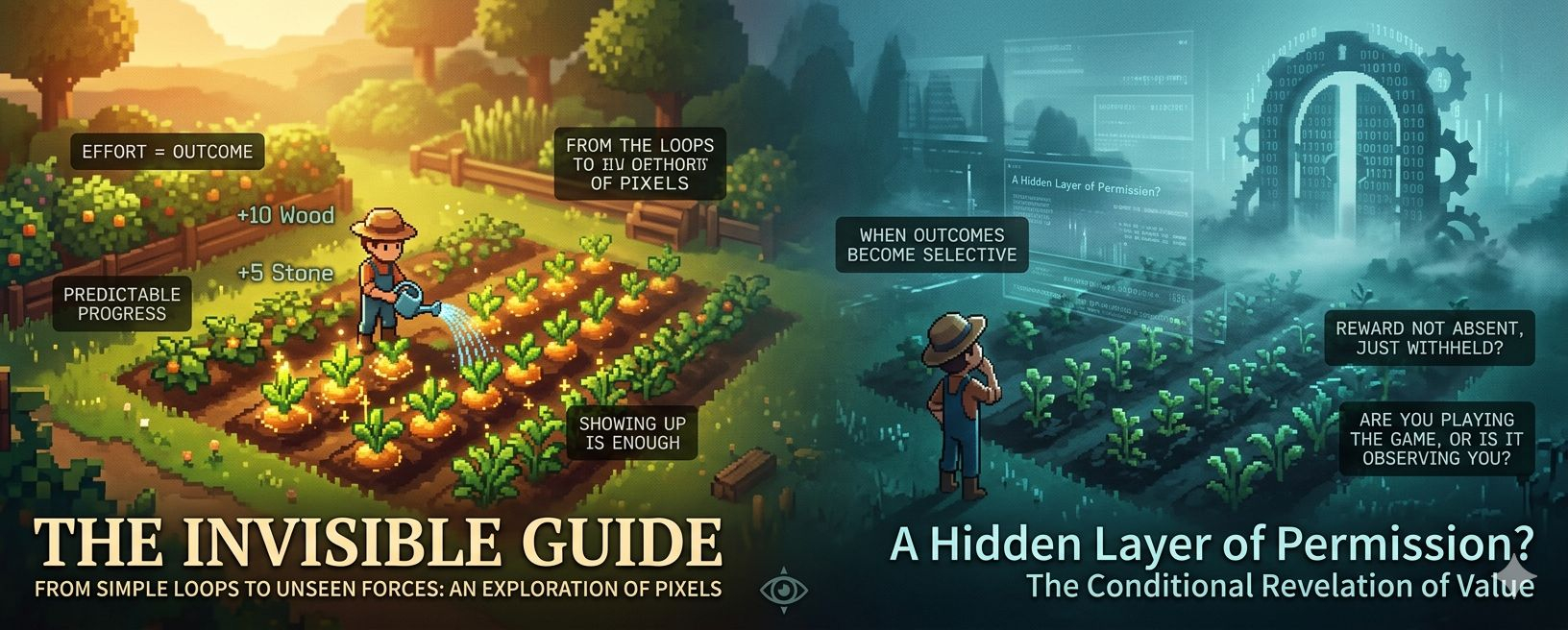
I entered the world of Pixels (PIXEL) expecting exactly what it presented—soil, seeds, time, and a quiet sense of progress. I moved through the land with no resistance. Plant, water, harvest. Expand a little. Repeat.
Everything responded.
Every action seemed to carry weight. Effort translated cleanly into outcome, like a system that respected consistency. I didn’t need to think about it. I just needed to show up and do the work.
And so I did.
Hours blurred into loops. The kind that don’t feel like repetition because they produce something—resources, upgrades, small visible steps forward. Nothing overwhelming, just enough to keep the motion going. Enough to feel like I was building toward something real.
It was smooth. Predictable.
Until it wasn’t.
There wasn’t a moment where things broke. No obvious interruption. Just a slight misalignment that was easy to ignore at first. A harvest that felt lighter than expected. A cycle that didn’t quite return what it used to.
Same effort. Same timing. Same decisions.
Different outcome.
I paused, but only briefly. Systems fluctuate. That’s normal. I told myself I was overthinking something designed to be simple. So I continued, trusting that consistency would correct itself.
But the pattern didn’t correct.
It evolved.
Some sessions felt unusually generous, almost like the system was leaning toward me, amplifying what I was already doing. Other sessions felt… quiet. Not empty, just restrained. As if something was present but not fully revealing itself.
And the strange part was—it didn’t feel random.
Randomness has a certain honesty to it. This felt selective.
Curated, even.
I began to watch more carefully. Not just what I was doing, but how the system responded over time. I repeated actions deliberately, trying to isolate variables that might explain the difference. Timing, sequence, pacing—small adjustments to see if anything shifted.
Sometimes it did.
But not in a way that created clarity.
It created tension.
Because every small success felt like confirmation, and every inconsistency dissolved it. The more I tried to understand the relationship between effort and reward, the less stable it seemed.
And slowly, without deciding to, I started changing the way I played.
Not based on rules I understood—but on patterns I thought I felt.
Maybe it’s not effort… maybe it’s alignment.
The idea didn’t arrive as a conclusion. It slipped in quietly, somewhere between repetition and doubt. Alignment with what, I couldn’t say. There were no visible indicators, no instructions, nothing that acknowledged this possibility.
But the outcomes kept suggesting it.
It felt like there was another layer—something beneath the visible mechanics. Not hidden in a way that invites discovery, but hidden in a way that shapes behavior without being seen.
I noticed how I hesitated before completing certain actions. Not because I didn’t know what to do, but because I wasn’t sure if this was the moment the system would respond.
I noticed how I stayed longer during “good” cycles, as if something invisible had opened, and I didn’t want to miss it. And how I pulled back during quieter ones, even though the actions themselves hadn’t changed.
The loop was still there.
But it didn’t feel equal anymore.
Effort was constant.
Exposure wasn’t.
Maybe rewards don’t disappear… they just don’t show up.
That thought lingered longer than it should have.
Because if rewards are not absent, just withheld—or delayed, or filtered—then what I experience isn’t the full system. It’s a version of it. A surface shaped by something deeper, something that decides when value becomes visible.
And if that’s true, then the loop I’m repeating isn’t just about production.
It’s about permission.
Permission to see results. Permission to feel progress. Permission to believe that what I’m doing matters in that moment.
I kept playing, but my attention shifted.
I wasn’t just farming anymore.
I was watching.
Watching how often the system responded. Watching when it seemed to open and when it stayed quiet. Watching myself, too—how quickly I adapted, how easily I adjusted my behavior without ever fully understanding why.
It didn’t feel forced.
That’s what made it harder to notice.
There was no resistance. Just subtle nudges. Small variations that slowly reshaped the way I moved inside the system. Encouraging certain rhythms. Softly discouraging others.
Not through rules.
Through exposure.
And the more I tried to map it, the more it slipped out of reach. Not because it was complex but because it wasn’t meant to be seen directly.
It was meant to be felt.
Maybe the system decides what I’m allowed to see.
That idea stayed with me longer than anything else.
Because if what I see is conditional… if outcomes are not directly tied to effort, but to something I cannot observe or control… then the structure I trusted at the beginning was never complete.
It was just convincing.
I still move through the fields. I still plant, water, harvest. The loop continues exactly as it did before.
But it doesn’t feel the same.
There’s a distance now. A quiet awareness that what appears in front of me might not fully belong to what I just did. That progress might not be a direct reflection of effort, but a reflection of something choosing when to reveal it.
And sometimes, in the middle of a perfectly normal cycle, I pause—not because I’m confused, but because I’m noticing something I can’t quite define.
Something that was always there.
Something that might have been guiding every step from the beginning.
And I can’t tell anymore
if I’m playing inside the system…
or if I’ve only been seeing the parts of it that it decided to show me.
