
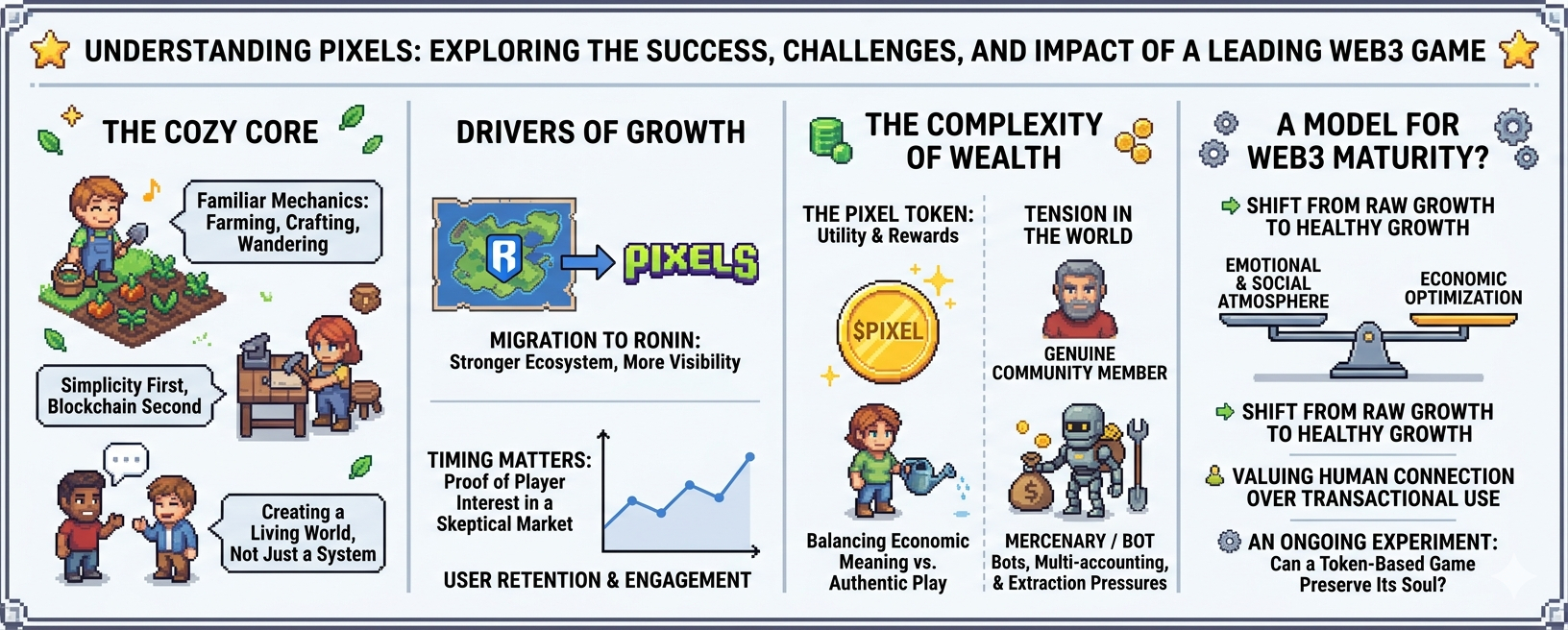

Pixels is one of those rare Web3 games that became interesting not because it promised a revolution, but because it felt approachable from the start. In a space where so many projects talk about ownership, token utility, and digital economies before they ever prove they are enjoyable, Pixels went in a softer direction. It offered something familiar: farming, crafting, wandering around, meeting other players, and slowly building a place for yourself in a shared world. That simplicity gave it an advantage. It did not ask people to fall in love with blockchain first. It gave them a game world they could understand almost immediately.
That is a big part of why Pixels stood out. Most Web3 games have struggled with one basic problem: they often feel more like systems than worlds. Players can usually sense when a project is built around financial incentives first and actual play second. Pixels felt different because it leaned into comfort. Its pixel-art style, easy rhythm, and social atmosphere gave it a kind of warmth that many blockchain games never manage to create. It did not arrive trying to look like the future of gaming. Instead, it looked like a place where people might actually want to spend time.
What made that even more important was the timing. Pixels grew during a period when Web3 gaming badly needed proof that players still cared about games, not just rewards. The first wave of blockchain gaming had already shown how quickly user activity could rise and disappear. Numbers would surge when earnings looked attractive, then vanish when the economics weakened. That pattern created a lot of skepticism. So when Pixels began gaining real momentum, people paid attention. It looked like another farming game on the surface, but underneath, it was becoming a test of whether a Web3 title could attract users by feeling human rather than purely transactional.
Its move to Ronin played a huge role in that growth. That migration was not just a technical shift from one chain to another. It changed the game’s environment completely. Ronin already had a strong identity around gaming, and that gave Pixels a much more natural home. Suddenly it was no longer just another blockchain project trying to find an audience. It was part of an ecosystem where users already understood wallet-based games and were more willing to engage with them. The move gave Pixels more visibility, more energy, and a stronger sense of belonging. In many ways, it was the moment when the game stopped looking like a niche experiment and started looking like a major player.
Still, growth in Web3 is never a simple victory. The bigger a project gets, the harder it becomes to separate genuine community from opportunistic traffic. That is where Pixels became more complicated. Its popularity brought attention, but it also brought all the familiar pressures that come with tokenized games. Some people joined because they liked the world. Others joined because they saw economic potential. Some wanted to build and socialize. Others wanted to optimize every action for maximum extraction. In a normal online game, that difference matters. In a blockchain game, it can shape the entire future of the economy.
That tension sits at the center of the Pixels story. The game became successful partly because it felt welcoming and easy to enter. But the very openness that helped it grow also made it vulnerable. Once rewards become meaningful, a game starts attracting behavior that has very little to do with play. Bots become a problem. Multi-accounting becomes a problem. Repetitive actions start being treated like economic opportunities rather than part of a living world. What begins as a cozy farming game can slowly become something much colder underneath. Pixels had to face that reality in a very public way, and in some ways that honesty made it more interesting than projects that only celebrated inflated user numbers.
The PIXEL token made that balancing act even harder. Like many Web3 game tokens, it was meant to do several things at once. It could support utility, progression, access, and broader ecosystem value. In theory, that gives players a stronger relationship to the world. Their time and participation feel connected to something bigger than just daily gameplay. But tokens also change the emotional logic of a game. Once value becomes liquid, everything starts to feel different. A farming loop is no longer just a farming loop. A quest reward is no longer just a reward. Players begin looking at systems through the lens of efficiency, strategy, and profit.
That does not mean tokens automatically ruin games, but it does mean they introduce pressure into places that would otherwise be simple. Pixels has spent much of its life trying to manage that pressure. On one side, it needs enough economic meaning to remain relevant as a Web3 title. On the other, it needs to protect the softness that made people care in the first place. That is not easy. The more a project succeeds, the more likely it is to attract users who do not care about the world itself. They care about what can be taken from it.
What makes Pixels worth paying attention to is that it seems to understand this problem. Over time, the conversation around the project shifted from raw growth to healthier growth. That change matters. Early Web3 gaming often treated wallet counts as the ultimate proof of success. Pixels helped show why that metric can be misleading. A huge number of users sounds impressive, but it does not automatically mean a game is healthy. If too many of those users are bots, mercenaries, or temporary reward-seekers, then the game world can start weakening beneath the surface even while the numbers look strong. In that sense, Pixels matured by recognizing that not every active user contributes equal value.
There is also something important about the tone of the game itself. Pixels never tried to win by being louder than everyone else. It won attention by being readable. In Web3, that may be one of the most underrated strengths a game can have. Most players do not want complexity at the door. They want ease at the door and depth later. Pixels understood that. It let people come in first, learn naturally, and settle into the rhythm before asking them to think about wallets, assets, and on-chain mechanics. That is a smarter design instinct than many projects in this space have shown.
At the same time, the game should not be idealized. A cozy art style can make a project feel healthier than it actually is. Soft visuals do not solve token inflation, user churn, or reward imbalance. A welcoming world can still be carrying a very fragile economy under the surface. That is why Pixels remains more of a serious case study than a perfect success story. It shows both the promise and the stress of trying to make blockchain gaming feel normal. It proves that accessibility, charm, and social energy can attract players. But it also shows how quickly those qualities are tested once real money, farming behavior, and scale enter the picture.
In many ways, Pixels matters because it feels like a collision between two very different ideas of what a game should be. One idea is emotional and social. It values atmosphere, routine, familiarity, and the quiet pleasure of returning to the same world again and again. The other idea is economic. It values optimization, scarcity, extraction, and measurable return. Most of the time, these two ideas do not fit together naturally. Pixels has spent its entire journey trying to hold them in the same space without letting one destroy the other.
That is what makes it more significant than it first appears. It is not just a farming game with a token. It is an example of how hard it is to keep a game feeling human once financial incentives become part of its foundation. And yet, that is also why it deserves credit. Unlike many projects that never get beyond theory, Pixels has had to wrestle with these contradictions in real time, in front of a real audience, inside a real economy.
The best way to understand Pixels is not as a finished answer, but as an ongoing experiment. It showed that Web3 gaming does not always need to feel aggressive, complicated, or sterile. It can be gentle. It can be social. It can feel like a place instead of a marketplace. But it also showed that once a game starts growing around tokenized systems, protecting that feeling becomes incredibly difficult. The challenge is no longer just attracting users. The challenge is preserving the soul of the experience while the economics around it become heavier.
That is why Pixels became such an important project in the conversation around blockchain gaming. It proved that accessibility still matters, that tone still matters, and that players are more likely to stay in a world that feels alive than in one that feels like a spreadsheet. At the same time, it reminded everyone that no amount of charm can fully escape the pressures of a token economy. The game succeeded in making Web3 feel more inviting, but its real story lies in what happened after that invitation worked.
In the end, Pixels stands out because it tried to do something many others only talked about. It tried to make blockchain gaming feel natural. Not futuristic, not overly technical, not built only for speculators, but natural. That attempt is what gave it weight. Whether it ultimately becomes a long-term success or simply a memorable phase in the evolution of Web3 gaming, it has already done something valuable. It forced the industry to confront a more serious question than how to drive hype. It asked whether a game connected to a token economy can still feel warm, social, and genuinely worth coming back to.
That question is still unanswered. But Pixels made it feel real.
