
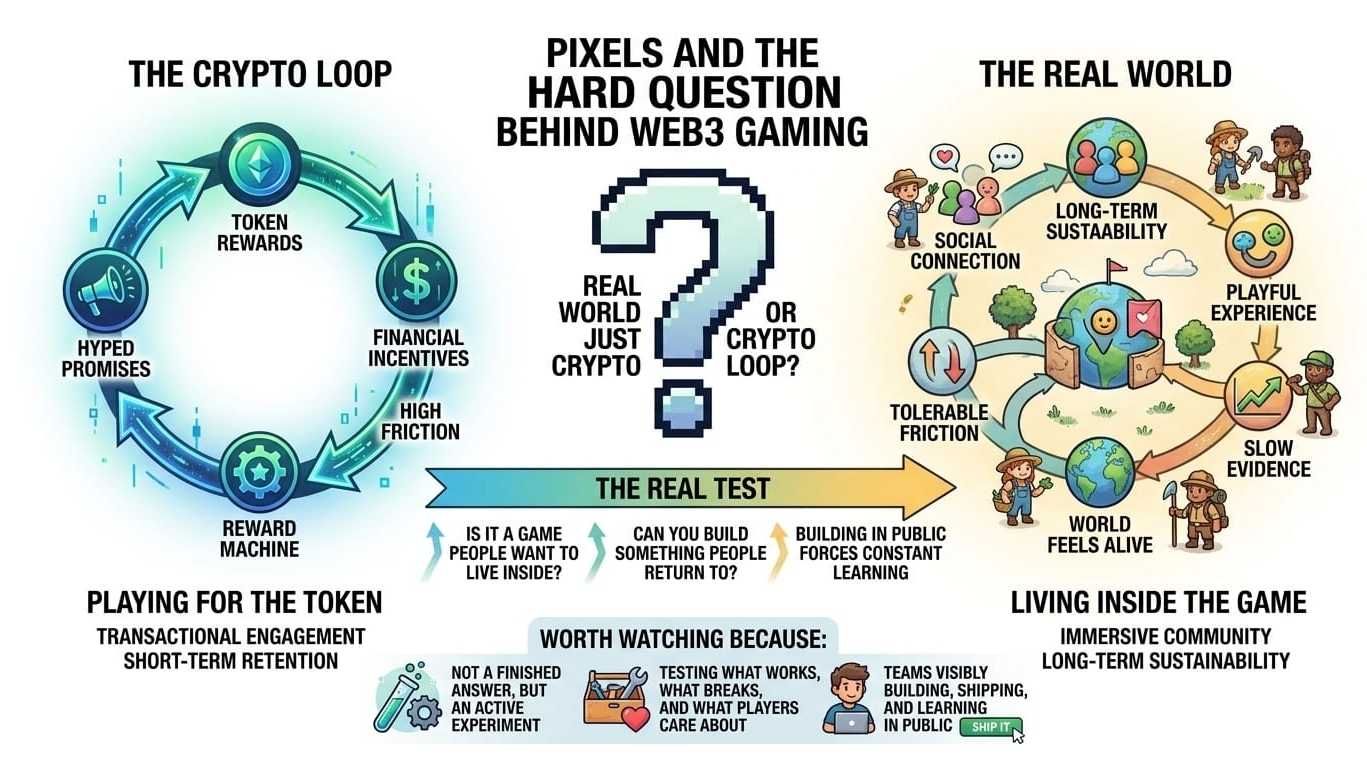
What I keep coming back to with Pixels is a simple question: is this actually a game people want to live inside, or just another crypto loop wrapped in softer colors?
That is what makes it interesting to watch. On the surface, Pixels looks light: farming, exploring, crafting, a friendly open world. But under that, it is trying to answer a harder question that a lot of Web3 games still have not solved. Can you build something people return to because the world feels alive, not because the token tells them to?
Being on Ronin helps. There is already a user base there, already a habit of onchain gaming, already some cultural fit. But infrastructure is the easy part. The real test is whether the team keeps shipping in a way that makes the game feel more like a place and less like a reward machine.
That is where I think Pixels deserves attention. Not because it has “farming” or “social” or “open world” in the description, but because building in public like this forces constant learning. You can see the tension in real time: how much of the economy should feel financial, how much should feel playful, how much friction players will tolerate, how much depth the world actually needs.
And honestly, that is the more useful way to look at projects like this. Not as finished answers, but as active experiments. Some teams talk about Web3 gaming like the category is already figured out. Pixels feels more like a team still testing what works, what breaks, and what players actually care about.
That alone does not make it a success. But it does make it worth watching. In a space full of polished promises, I pay more attention to teams that are visibly building, shipping, and learning in public.
Sometimes that is the real signal. Not certainty. Not hype. Just the slow evidence of people making something, adjusting it, and teaching you what this category might become.