
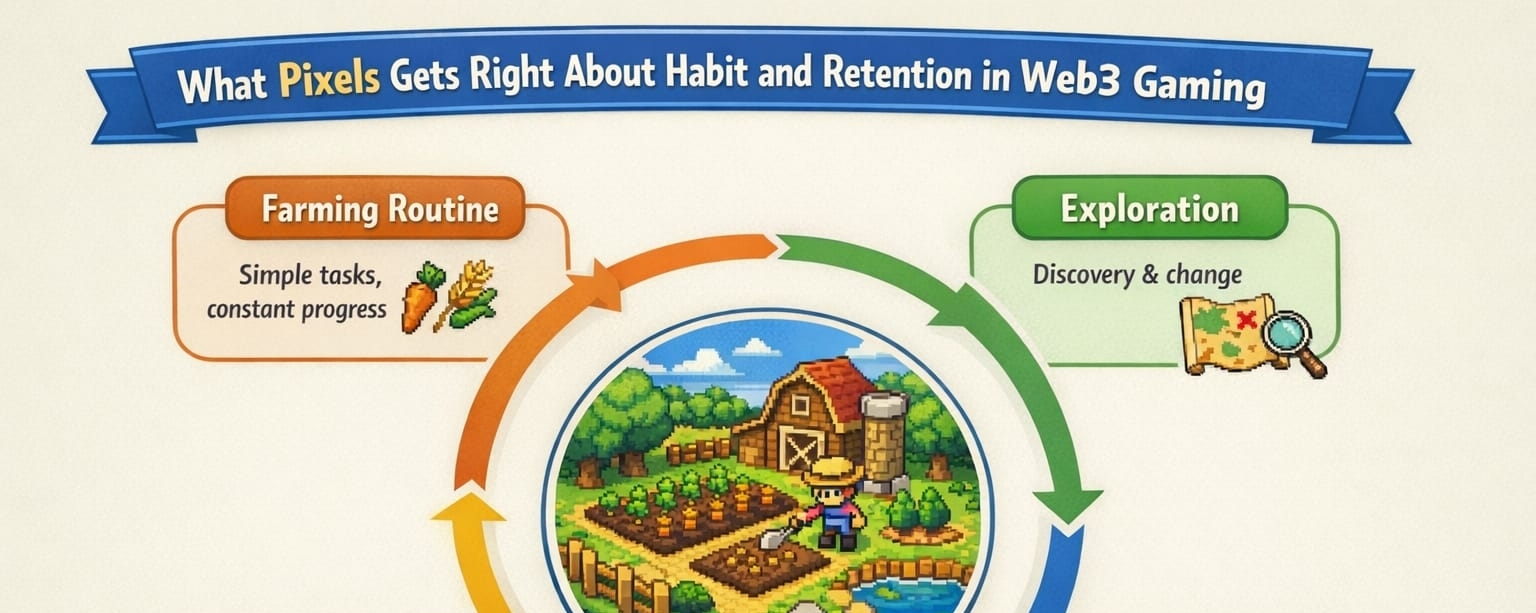
What keeps bringing me back to Pixels is not the farming itself. I have seen farming loops in games for years, and I have also seen crypto projects wrap tokens, land, and marketplaces around almost every genre possible. That part alone does not impress me anymore. What catches my attention here is something more subtle. Pixels understands that people do not stay just because a game offers ownership, and they do not stay just because a token exists in the background. They stay when the routine starts to feel natural, when progress feels visible, and when the world gives them small reasons to return without needing to shout for attention every five minutes.
That is the part I keep coming back to. Pixels is not simply trying to be a blockchain game that happens to include farming. The way I interpret it, it is using farming, exploration, and social interaction as habits first. The mechanics are simple on the surface, but underneath them there is a clear understanding of what makes people settle into a game instead of just testing it once and disappearing. In Web3, that matters more than most teams seem to realize.
I pay close attention to that because user behavior tells the truth faster than marketing ever will.
On paper, Pixels is easy to explain. It has farming, gathering, land, progression, exploration, and a social layer that makes the world feel shared instead of empty. But I do not really look at it from the surface description. What interests me here is what those systems are doing underneath. Why do people keep coming back to something this simple? Why does a relaxed loop become sticky in one project, while other games with far more features struggle to hold attention for even a short time?
Usually the answer is not complexity. It is rhythm.
Pixels gets that rhythm right. Farming gives people routine. Exploration breaks that routine just enough to keep it from feeling mechanical. Social interaction gives the whole thing context. So instead of asking one feature to carry the full experience, the game spreads engagement across several light behaviors that support each other. That is a much smarter design choice than it looks.
I have seen this pattern before. The projects that depend on a single emotional trigger are usually fragile. If they rely too heavily on hype, they fade once excitement cools. If they rely too heavily on rewards, they start struggling the moment those rewards feel weaker. If they rely too heavily on some big future promise, they often fail because users want a reason to care now, not later. Pixels feels more grounded than that. It gives people something to do immediately, and that matters.
The farming loop is doing more work than it seems. It is not there just to give players crops or resources. It is there to normalize return behavior. That is what I find interesting. A lot of Web3 games try too hard to prove they are innovative, and in the process they forget that players are not looking for innovation every second. Most of the time they are looking for flow. They want to know what to do, feel some progress, and slip into a routine that feels rewarding without becoming stressful. Pixels understands that better than many bigger projects.
That creates one of the more important contrasts in Web3 gaming.
The space loves to talk about digital ownership, player economies, and empowerment. In theory, all of that sounds strong. In practice, most users first want something much simpler. They want a reason to care today. Not after the ecosystem matures. Not after some token model finally stabilizes. Today. That is where so many projects get it wrong. They lead with ideology instead of behavior. Pixels feels different because it leads with activity first. It gives users a world they can move through before asking them to care about the bigger framework behind it.
That order matters.
Ronin matters too, and I do not see it as a minor detail. In Web3 gaming, infrastructure is often treated like background noise, but I have spent enough time watching players drop off to know how destructive friction can be. If the system feels annoying too early, curiosity dies fast. People do not always leave because the game is bad. Sometimes they leave because the effort around the game is too visible.
Ronin helps Pixels because it lowers enough of that friction for the game loop to actually breathe. That is important. It means the user gets pulled into the routine before the technical side starts feeling heavy. In my view, that makes a huge difference. A game does not become sticky just because it is on-chain. It becomes sticky when the chain fades into the background and the player stays focused on the experience itself.
That is still rare in Web3.
Too many projects build worlds where the blockchain remains louder than the game. Every action feels like it is reminding the player that they are inside an ecosystem instead of inside a living world. Pixels benefits from the fact that Ronin gives it a smoother foundation. The experience has more room to feel like a game first, which is exactly how it should be if the goal is long-term retention rather than short-term speculation.
The social layer is another reason the game sticks.
A lot of teams say their game is social just because players can chat or stand in the same environment. That is not enough. Real stickiness comes from light social visibility. People like feeling that others are around, progressing, noticing things, moving through the same routines. It does not always require deep coordination or intense multiplayer systems. Sometimes it is enough that the world feels inhabited.
Pixels does that well. It feels shared. And that matters more than many people think.
I have noticed that players often stay longer in environments where their actions feel quietly witnessed, even if the interaction itself is minimal. That sense of presence changes the emotional texture of the game. It makes basic routines feel less isolated. Suddenly farming is not just resource collection. It becomes part of a social space. Exploration is not just movement. It becomes something that happens inside a world where others are also moving, building, and participating.
That is where Web3 games often misread their own audience. They assume ownership alone creates attachment. I do not think that is fully true. Ownership can deepen attachment, yes, but only after people already care. Before that, it is mostly an abstraction. Social familiarity usually comes first. Habit comes first. Emotional comfort comes first. Once those things are in place, the ownership layer can matter more. But if a project expects the economic layer to create emotional loyalty by itself, the result often feels transactional.
And transactional communities are weaker than they look.
They can generate activity. They can generate numbers. They can even create excitement for a while. But they often struggle to create real staying power because the people inside them are there to extract, not to belong. I have seen this happen many times in crypto. The user base appears active, but the culture underneath is thin. The moment conditions change, the activity disappears because there was never much attachment there to begin with.
Pixels feels stronger when it behaves like a place first and an economy second.
That does not mean the economic side is unimportant. It is always important in Web3. Incentives shape behavior whether teams admit it or not. The real question is whether those incentives support the experience or slowly start to distort it. That is one of the biggest risks for any successful blockchain game. If rewards become too dominant, users begin treating the entire system like labor. Once that happens, the mood changes.
The world starts feeling less alive.
Curiosity gets replaced by efficiency. Exploration becomes calculation. Social interaction becomes utility. Even the relaxed atmosphere starts thinning out because players stop engaging with the world and start optimizing around output. I pay close attention to this because it is usually the point where a Web3 game either protects its identity or starts losing it.
This is the challenge Pixels will always have to manage. Its stickiness can attract people, but incentives decide what kind of people stay. If too many users are there only because of extraction, the emotional core of the game becomes weaker. But if the game can keep people attached to routine, comfort, and social identity, then the economy becomes something that supports the world instead of consuming it.
That balance is not easy.
Still, I think one of Pixels’ biggest strengths is that it does not try too hard to pretend it is something revolutionary every second. It uses familiar systems. It keeps things readable. It avoids overwhelming the player. Some people dismiss that quickly because the market has trained them to respect complexity more than clarity. I do not see it that way. In crypto especially, simplicity is often underestimated.
I have seen simple systems outperform more ambitious ones many times.
Not because they are deeper on paper, but because users actually understand how to live inside them. That matters. A game can have impressive mechanics, layers of token design, and endless strategic language around its ecosystem, but if the average user does not settle into it naturally, none of that really helps. Pixels seems to understand that sustainable attention is often built from small repeated behaviors, not from giant promises.
Exploration helps a lot here too. It keeps the world from collapsing into pure maintenance. Farming gives structure, but exploration gives looseness. Without that looseness, a system like this can become too predictable too fast. Players need some uncertainty. Not chaos, just enough movement that the world feels larger than the checklist in front of them.
That is why exploration matters more than it first appears.
It adds texture. It makes the game feel less like a production loop and more like a space. In Web3, that is especially important because so many projects naturally drift toward financialization. The more financialized a game feels, the more it risks becoming cold. Exploration softens that. It gives players moments that are not purely about output. It reminds them that there is still curiosity in the system, still a reason to move through the world for something other than efficiency.
And texture matters.
People remember texture. They remember how a world feels when they spend time in it. They remember whether it felt alive, whether it felt calm, whether it made them want to return. Retention is not always about raw incentives. Sometimes it is about memory. Sometimes it is about emotional familiarity. Sometimes it is simply about whether the environment made daily repetition feel pleasant instead of draining.
That is where Pixels becomes more interesting to me than the label “farming game on blockchain” suggests. What it is really doing is testing how much softness a Web3 game can preserve while still operating inside crypto structures. That is not a small thing. Crypto naturally hardens products. It turns behavior into metrics, users into wallets, activity into dashboards. Games need the opposite energy if they want to last. They need mood. They need comfort. They need repetition that does not feel oppressive. They need a reason to care that does not sound like a financial pitch.
Pixels seems more aware of that than most.
But I do not look at it uncritically. The risk is obvious. Familiarity can become shallowness if the world does not keep evolving in meaningful ways. Sticky loops work well, but only for so long if users begin to feel they have already seen the whole system too early. When that happens, retention starts leaning more heavily on external rewards, and that is usually where pressure builds.
So the real challenge is not just getting people in. It is giving the world enough depth over time without destroying the calm rhythm that made it attractive in the first place.
That is difficult. Add too much complexity and you damage accessibility. Add too little and repetition becomes exposed. A lot of promising Web3 games struggle exactly there. Early success hides structural weaknesses. Strong activity makes everything look healthier than it really is. Then the novelty fades, and suddenly the deeper questions matter.
Do users still care when the excitement settles? Do they still return when rewards fluctuate? Do they still see the game as a place worth inhabiting, not just a loop worth exploiting?
That is the real question behind Pixels for me.
Not whether it has farming. Not whether it has social features. Not whether it runs on Ronin.
What interests me more is whether it can keep turning routine into belonging.
Because that is what truly sticky experiences do. They make ordinary actions feel like part of a larger pattern. They teach users how to return without forcing them. They build enough rhythm, enough visibility, and enough texture that coming back starts to feel natural. In a market that still confuses speculation with engagement, that kind of quiet retention is more valuable than most people realize.
The way I interpret it, Pixels stands out not because it made Web3 gaming louder, but because it made it softer, smoother, and easier to live inside, and in this market, that may be the smartest move of all.
