
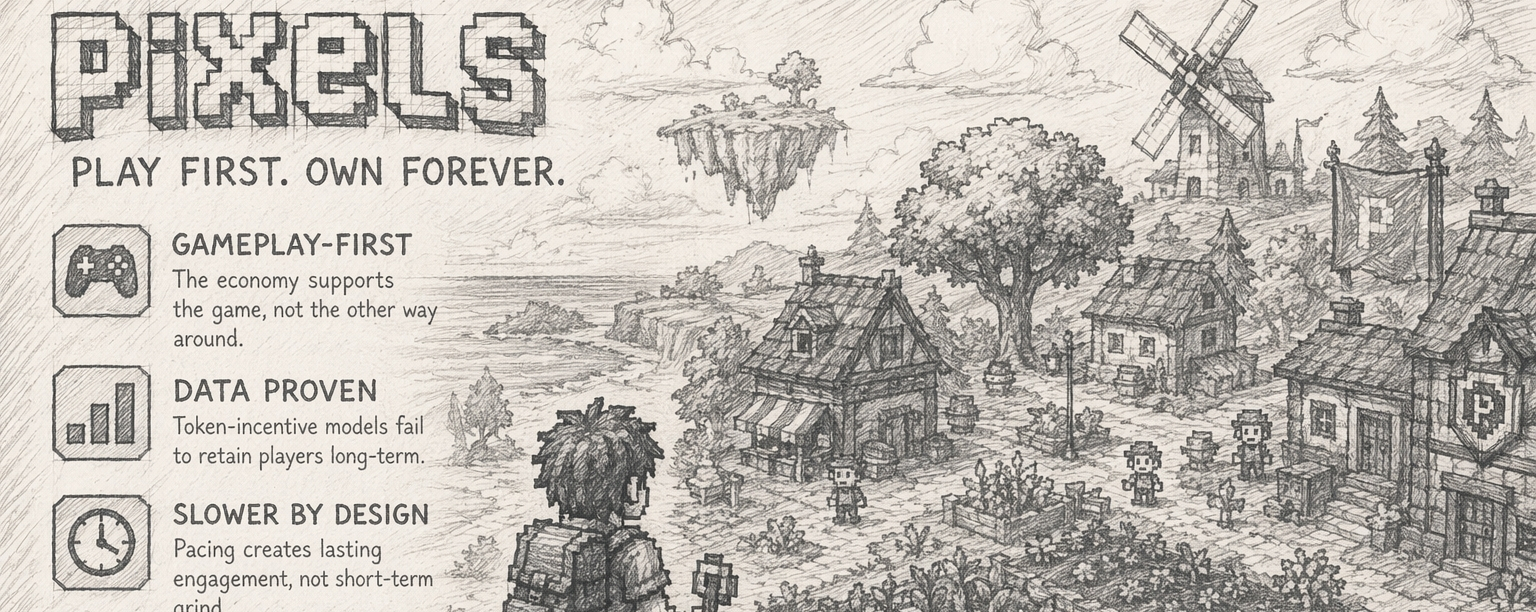
Most Web3 games put the token first and hope players follow. Pixels is trying the opposite — and the early results are worth paying attention to.
Key Takeaways
Pixels takes a gameplay-first approach by placing the economy in the background rather than at the center of the experience.
Historical Web3 gaming data shows that token-incentive-led models consistently struggle to retain users beyond initial reward cycles.
Slower progression pacing appears to be a deliberate design decision — one that changes how players relate to the game long-term.
If this model holds, it could represent a structural shift in how blockchain games are designed and evaluated.
First Impressions: Intentionally Understated
When you first open Pixels, there is no immediate wave of flashy mechanics or aggressive reward prompts. The experience is slower — almost deliberately minimal — as if the game is not trying too hard to impress at first glance. For most users conditioned by fast-reward Web3 environments, that quietness can feel disorienting.
But that restraint is doing something intentional. Rather than front-loading incentives to hook users in the first session, Pixels lets the experience unfold gradually. It is an approach that most blockchain games no longer attempt — and one that deserves closer examination.
The game did not feel like the next big thing immediately. That was actually the first signal that something different was happening.
The Core Loop — Simple by Design
At its surface, Pixels is straightforward: grow crops, gather materials, interact with other players, and develop your land. None of these mechanics are new. Similar loops have existed in traditional games for decades. What sets Pixels apart is not what you do, but how ownership is embedded into the experience.
The on-chain layer is present throughout — but it is never pushed to the foreground. Players are not constantly reminded that they are earning or that their assets live on-chain. That design restraint changes the psychological relationship a player has with the game. You approach it less like a yield-farming dashboard and more like an actual world worth spending time in.
What Historical Web3 Gaming Data Actually Shows
The pattern across most blockchain games has been predictable and well-documented. A token launches, a wave of users arrives chasing incentives, activity metrics spike, and then — once rewards slow — the drop-off begins. This is not a failure of intention. It is a structural consequence of building the economy before the experience.
At peak Web3 gaming cycles, a significant portion of on-chain gaming activity was driven by short-term farming behavior rather than sustained player engagement. The gap between "users" and "players" became the defining challenge of the sector.
The Economy Sits in the Background — On Purpose
Pixels appears to be experimenting with a different ordering of priorities. Instead of building around the token and hoping gameplay fills in around it, the game leans into the experience first and lets the economic layer follow quietly behind. The result is a measurable shift in player behavior.
Players report logging in not to extract value, but to expand their land, optimize resources, or simply spend time inside the world. That distinction — between extraction-focused sessions and engagement-focused sessions — is more significant than it sounds. It is the difference between a user and a player, and historically, only one of those groups builds sustainable game economies.
📌 Why This Matters for Investors
Games that retain players through genuine engagement — rather than token incentives alone — tend to sustain in-game asset demand more consistently over time. If Pixels maintains its current design philosophy at scale, it could represent a template that changes how Web3 game projects are evaluated at the fundraising and listing stage.
Pacing as a Strategic Decision
One of the most discussed elements of Pixels is its progression pacing. Progress is slow — and for users conditioned by rapid reward cycles, that can feel counterintuitive at first. But the slower rhythm appears to serve a clear purpose: it removes the pressure of constant optimization and replaces it with a more organic pattern of engagement.
Rather than chasing the next reward every few minutes, players develop longer time horizons. They plan. They return consistently, but without urgency. That behavioral pattern — steady rather than intense — is arguably more valuable to long-term ecosystem health than high short-term engagement spikes.
The Real Question: Does It Scale?
The gameplay-first approach works when the world itself is worth returning to. The harder question is whether Pixels can maintain that experience quality as its player base grows and economic pressures increase. Scaling a token economy without compromising the design philosophy that made the game compelling in the first place is one of the most difficult challenges in Web3 game development.
What is clear is that the bet being made here is not on hype cycles or speculative token price. It is on whether a blockchain game can hold attention the same way a well-built traditional game does — because the world itself is genuinely worth being in. That is a harder thing to build. But if it works, the retention data suggests it lasts significantly longer.
The most durable Web3 games will not be the ones with the highest token launch prices. They will be the ones that gave players a reason to stay after the incentives faded.
Pixels is not a guaranteed success story. Its token economy is still being stress-tested, and the long-term sustainability of its model remains to be seen at full scale. But as an experiment in what blockchain gaming design could look like when experience precedes economics, it is one of the more coherent attempts the sector has produced.
For anyone tracking the evolution of Web3 gaming beyond the boom-and-bust cycle, Pixels is worth watching — not for its price action, but for what its player behavior data will eventually tell us about whether this model is repeatable.