
There’s an assumption in gaming, especially in Web3, that attention has to be captured aggressively.
Something always needs to be happening. Systems need to layer on top of each other. Rewards need to arrive fast enough to keep people engaged. Every mechanic has to prove its value immediately.
But then there’s Pixels (PIXEL), which seems built around the opposite idea.
It doesn’t demand urgency. It doesn’t overwhelm new players with complexity. It doesn’t push the feeling that if you miss a day, you’ve fallen behind. And strangely, that may be one of the biggest reasons it works.
Because the experience begins from a quieter place.
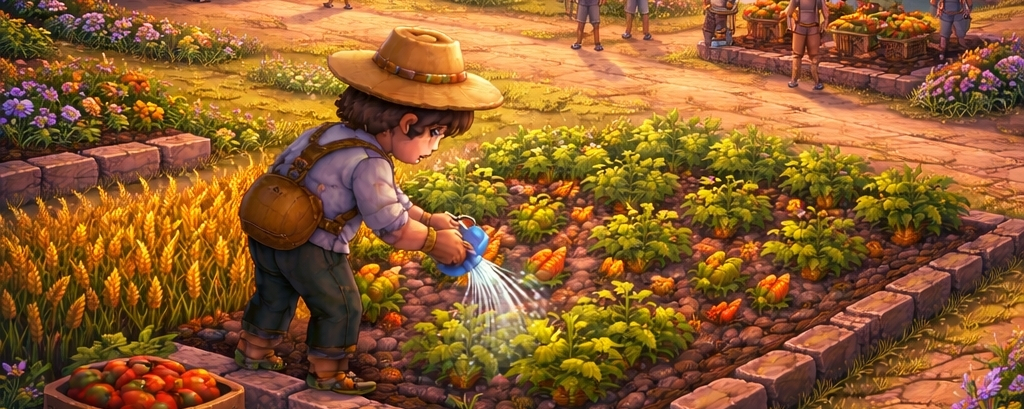
You log in and start doing ordinary things. Planting. Harvesting. Gathering resources. Moving through a world that feels active but never crowded. None of these actions are dramatic on their own, but together they create a rhythm that feels steady and familiar.
And that rhythm matters more than it first appears.
Many games rely on intensity to keep players engaged. Pixels (PIXEL) leans on routine.
That difference changes the relationship people build with the game.
Instead of treating each session like a challenge to optimize, players often approach it more like a place they revisit. You check your farm. You adjust a few things. You wander. Maybe you talk to another player. Maybe you spend most of your time doing very little at all.
And somehow, that never feels wasted.
There’s a kind of trust in design that comes from allowing simple actions to carry the experience.
Farming, for example, would sound repetitive if described mechanically. Plant crops. Wait. Harvest. Repeat.
But in practice, repetition can become comforting when it isn’t overloaded with pressure.
You begin to recognize that not every game loop has to be exciting in a traditional sense. Sometimes it only needs to feel satisfying enough to return to.
That’s where Pixels (PIXEL) feels unusually grounded.
It understands that retention doesn’t always come from making players chase something. Sometimes it comes from creating an environment people naturally want to spend time in.
That distinction is subtle, but important.
Forced retention often depends on obligation. Natural retention depends on comfort.
One creates pressure.
The other creates habit.
And habits tend to last longer.
This becomes even more visible when you look at the social side of the game.
In many multiplayer environments, interaction is structured around competition, coordination, or performance. Social systems often feel engineered.
In Pixels (PIXEL), interaction often feels softer than that.
You see people moving through the same spaces, tending land, exploring, trading, talking. Sometimes you participate directly. Sometimes you simply observe.
But even passive presence has value.
It creates the feeling that the world is shared.
And shared worlds tend to feel more alive than systems built entirely around isolated progression.
That sense of quiet community may be one of the most underrated parts of the game.
Because people do not just stay for mechanics.
They stay for familiarity.
They stay because certain places begin to feel recognizable.
They stay because other players become part of the environment.
Over time, this changes how the ecosystem grows.
Instead of being driven only by incentives, it begins to be shaped by behavior.
How people spend time.
How they build routines.
How they create value through participation, not just extraction.
That’s a very different foundation for sustainability.
And sustainability is where Pixels (PIXEL) becomes especially interesting.
A lot of Web3 projects focus on growth through expansion—more users, more features, more systems, more economic layers.
But sustainable worlds often grow differently.
They deepen before they expand.
They strengthen the core experience before adding complexity.
They make sure people want to stay before asking new people to arrive.
Pixels (PIXEL) often feels closer to that model.
Its strength doesn’t seem to come from doing everything.
It comes from doing a few things consistently well.
That may sound simple, but simplicity is harder to sustain than it looks.
Because simple design leaves less room to hide weak foundations.
If the core loop is not enjoyable, players notice.
If the world doesn’t feel worth revisiting, players drift away.
If social presence feels empty, the atmosphere disappears.
But when those fundamentals work, simplicity becomes durable.
And durability matters much more than novelty over time.
Especially in Web3, where many projects are built around momentum.
Momentum can bring people in.
But it doesn’t always keep them there.
Quiet consistency often does.
That may be the larger lesson Pixels (PIXEL) offers.
Not that every Web3 game should look like a farming world.
But that long-term ecosystems may depend less on complexity than many assume.
People often stay where they feel relaxed.
They return to systems that respect their time.
They invest in worlds that don’t constantly demand more from them.
And perhaps most importantly, they build lasting communities where participation feels voluntary, not pressured.
That idea feels increasingly important as Web3 gaming matures.
Because the question is slowly changing.
It’s becoming less about how many mechanics a game can support.
And more about whether people genuinely want to keep living inside its world.
That is a harder question.
But it’s also a more meaningful one.
And Pixels (PIXEL), in its quiet way, seems to be answering it.
Not through ambition alone.
But through rhythm.
Through simplicity.
Through the understanding that sometimes the games that last longest are not the loudest ones
but the ones people can imagine returning to, long after the novelty is gone.