
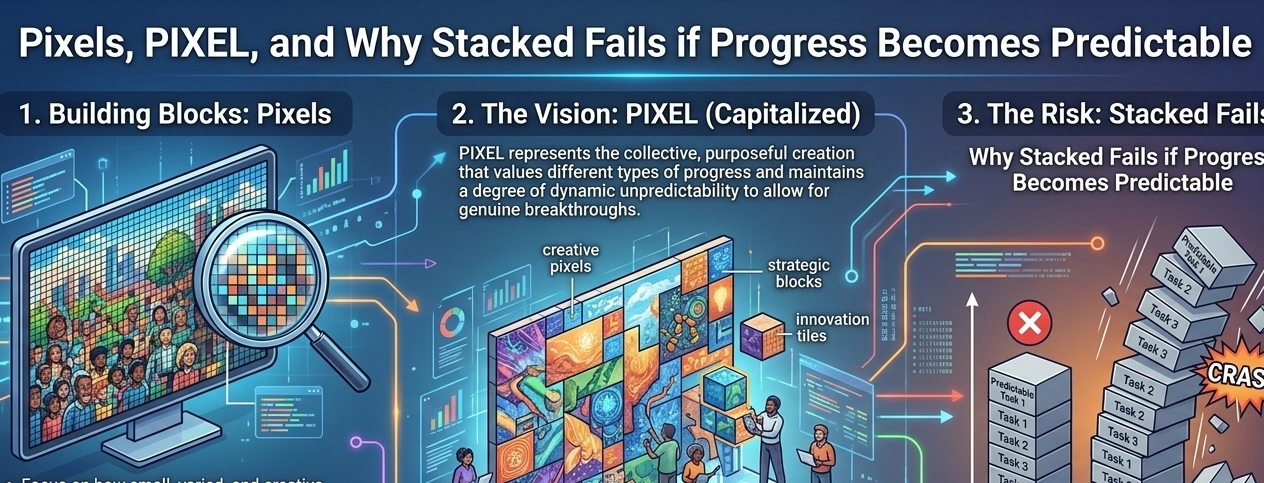
Pixels is not competing on engagement. It is competing on whether engagement can remain unequal under pressure. Farming, exploration, and creation are simple by design, which guarantees repetition. The real risk is not boredom. The real risk is predictability. If repeated actions lead to predictable outcomes, then progress stops functioning as a signal and collapses into routine.
The system only works if similar effort produces different visible results. That difference cannot be cosmetic. It has to affect how players are positioned relative to each other. If two players can follow the same path and reach the same state within a similar timeframe, then Stacked is not filtering progress. It is just displaying it.
This is where most systems break. They reward activity but fail to restrict outcomes. Pixels cannot afford that structure. Without enforced limits on how progress converts into visible standing, scale will compress the system into uniformity. The more players participate, the faster differentiation disappears.
Stacked must act as a constraint, not a reward layer. It has to control who progresses, how fast they progress, and how much of that progress becomes visible. If every action is immediately reflected in status, then status inflates. Once inflated, it loses meaning. At that point, players are no longer competing for position. They are just accumulating output.
The tension is unavoidable. Increasing accessibility brings more players into the loop but also increases the chance that many players end up looking the same. Increasing scarcity protects differentiation but limits how many players can feel meaningful progress. Pixels has to operate between these forces without letting either side dominate.
The failure condition is clear and observable. When players stop adjusting their behavior based on others, the system has already flattened. A functioning status system changes decisions. A failed one only tracks activity. If Stacked stops influencing how players play, it has already lost its role.
PIXEL is not neutral in this structure. If token distribution allows uniform progression, it reduces the distance between players and weakens the hierarchy. If it restricts progression too aggressively, it preserves gaps but introduces friction that feels disconnected from effort. The token must create uneven progression, or it accelerates convergence.
Pixels does not fail when players leave. It fails when players stay but stop caring about relative position. That is the moment repetition turns into maintenance instead of advancement. If Stacked can prevent predictability, the system holds. If not, no amount of activity will stop it from collapsing into sameness.
