
I will be honest... I usually get cautious the moment a Web3 game starts talking too confidently about rewards.
I have seen too many systems mistake activity for value, and too many communities celebrate distribution before asking what that distribution is actually doing to player behavior.
That is why pixel became more interesting to me only after I stopped looking at it like a simple farming game and started looking at the harder question sitting underneath it.
The question is not whether Pixels can hand out rewards.
The question is whether reward spending inside a casual, social game can be treated with the same seriousness that other companies treat ad spend, retention spend, or product investment.
What pulled me in is that Pixels is not presenting itself as just another play-to-earn machine on Ronin.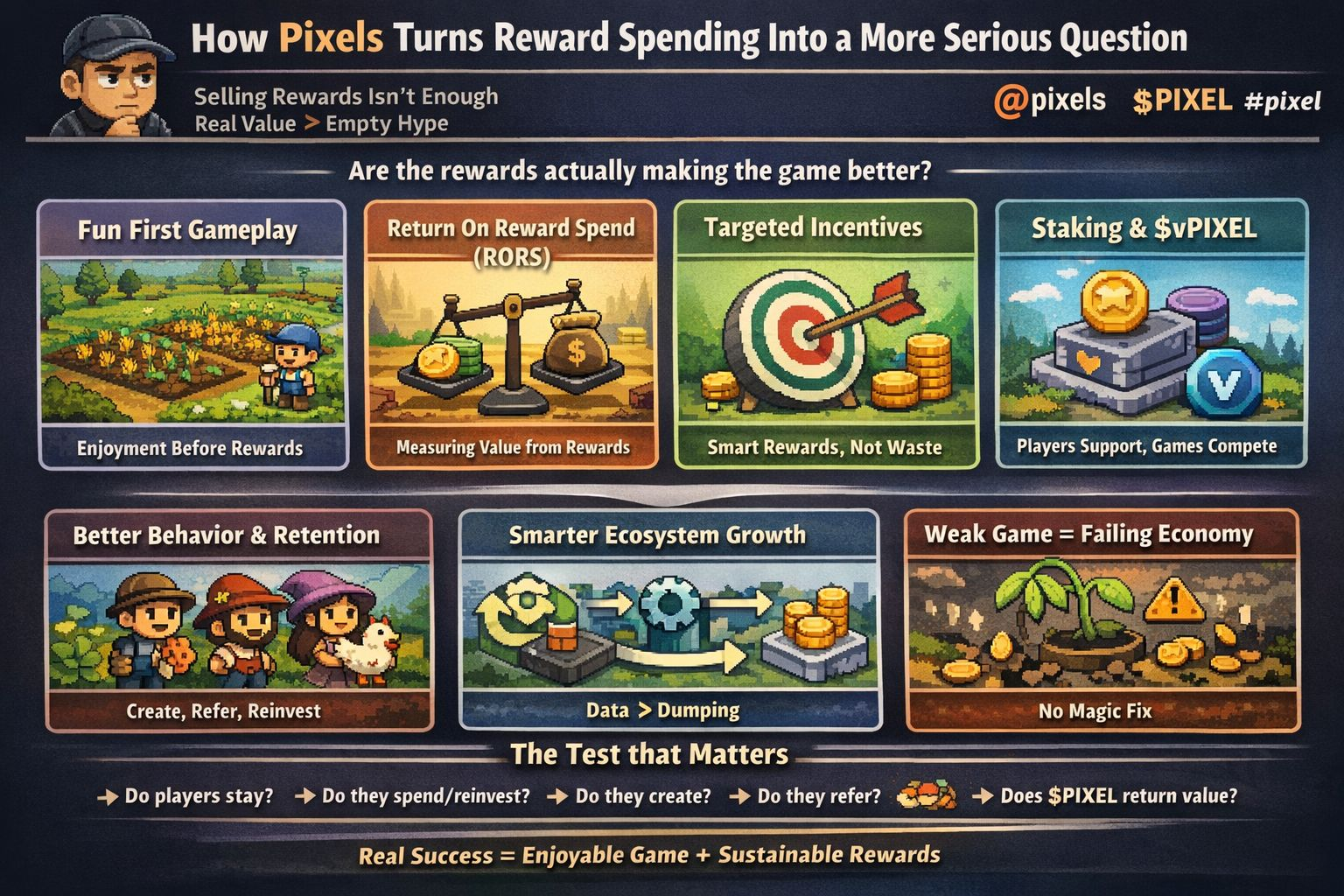
The official litepaper makes it pretty clear that the bigger ambition is to solve weak reward design through a mix of fun-first gameplay, smarter targeting, and a publishing loop built around data.
That sounds abstract at first, but I do not think the idea is abstract at all.
It is actually a very practical response to a problem most GameFi projects never solve.
If a game is not genuinely enjoyable, rewards attract the wrong crowd.
And once the wrong behavior becomes the dominant behavior, the economy starts serving extraction instead of play.
That friction feels real in Pixels because the team openly admits where earlier design broke down.
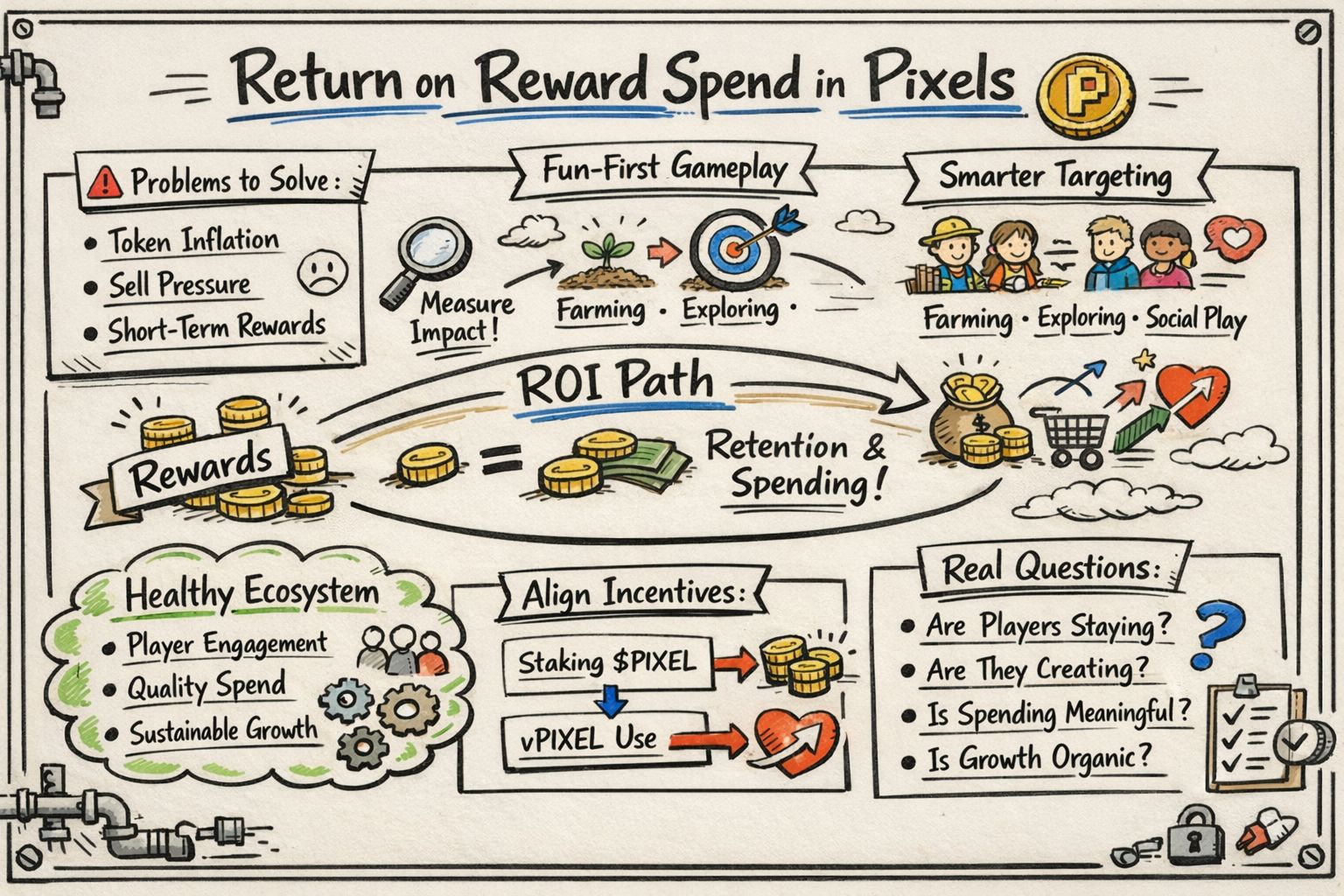
In the litepaper, they point to token inflation, sell pressure, and rewards that were not precise enough, often paying for short-term engagement instead of sustainable value.
I pay attention when a team says that directly, because most projects would rather protect the story than diagnose the system.
Pixels seems to be doing the opposite.
It is trying to build around the idea that fun comes first, but incentives still need to be measured like a serious operating expense.
That is where RORS caught my attention.
Return on Reward Spend is such a simple idea that it almost feels obvious once you hear it.
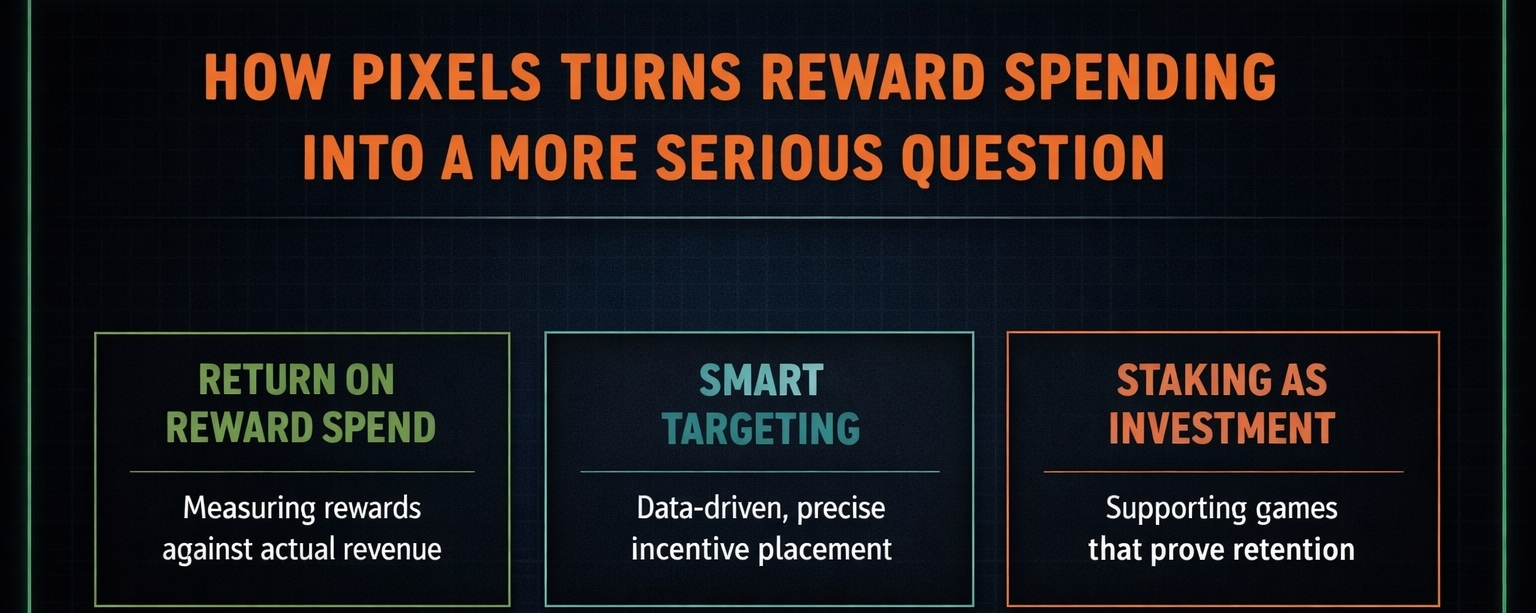
Pixels describes it as a way to compare rewards distributed with revenue coming back through fees, and the litepaper says the figure has been around 0.8 with a stated goal of pushing above 1.0.
I like this framing because it strips away a lot of fake comfort.
• A token can trend for a while.
• A player count can spike.
• A social feed can look alive.
• None of that automatically means the reward system is healthy.
But once a project starts asking whether reward spending is actually producing durable return, the conversation becomes much more serious.
In a game like Pixels, that matters because the surface layer is intentionally casual.
You have farming, progression, exploration, social loops, creator behavior, referrals, events, ownership, and all the small reasons people come back even when they are not thinking like traders.
That kind of environment is valuable, but only if rewards strengthen those loops instead of hollowing them out.
The official materials suggest Pixels is moving toward more targeted incentives, using first-party event tracking and player data to direct rewards where they improve retention, spend quality, and overall ecosystem health.
That is a lot more interesting to me than generic emissions.
I also think the staking redesign says a lot about how Pixels wants PIXEL to function.
The litepaper does not frame staking as passive decoration.
It frames games as the validators, with players staking pixel toward games they believe deserve ecosystem support.
So staking becomes a way to direct incentives, not just park capital.
Games then have to compete for that support by improving retention and net in-game spend.
That is a stronger model than pretending every reward dollar is equally productive.
The same goes for $vPIXEL.
I do not see it as some cosmetic token layer.
What matters is the logic behind it.
The official design presents it as a spend-only token backed 1:1 by $PIXEL, meant to reduce pure extraction pressure and encourage value to stay inside the ecosystem longer.
Again, that is a behavior question.
Ownership only matters when it changes what players do next.
If a reward gets instantly dumped, it behaves one way.
If it keeps circulating through upgrades, events, access, transactions, or other in-ecosystem uses, it behaves another way entirely.
What makes this more than token design to me is that Pixels is still a game, and a social one at that.
The litepaper talks about exploration realms, live events, referral-based rewards, share-to-earn mechanics, and other social enhancements meant to grow player networks more organically.
That matters because sustainable game economies usually depend on habits, identity, and community, not just payout rates.
A farming game on Ronin can look casual on the surface while still acting like a serious experiment in how player behavior gets shaped over time.
I also think this is where the broader ecosystem angle starts to make sense.
Pixels is not only trying to make one game survive.
The flywheel in the litepaper is clearly about staking, user acquisition credits, spend, revenue share, richer data, and smarter targeting across more games.
That is why I take the reward question more seriously here than I would in a normal GameFi post.
The team is not just asking how to pay players.
It is asking how to redirect growth spending toward players who actually improve the system.
Still, I do not think this is magic.
A model like this can still go wrong.
If gameplay gets stale, if social loops weaken, if targeting rewards the wrong cohort, or if the economy becomes too dependent on optimization tricks instead of genuine enjoyment, the same old extraction pattern can come back under a smarter name.
Data can improve incentives, but it can also make a weak game look temporarily efficient.
That is why I stay a bit skeptical.
Better tooling does not cancel the need for better play.
The practical test for me is pretty simple.
Do players stay longer.
Do they spend in ways that suggest commitment instead of exit behavior.
Do they create, refer, participate, and come back with more purpose over time.
Does PIXEL support a healthier loop between playing, progressing, and reinvesting.
Do the rewards make the world feel more alive, or just more subsidized.
That is the standard I would use for pixel, and honestly for any project using pixel and Pixel as part of a sustainability story.
Real gaming adoption does not come from reward noise alone.
It comes from enjoyable systems, aligned incentives, and behavior that repeats for reasons stronger than short-term payout.