
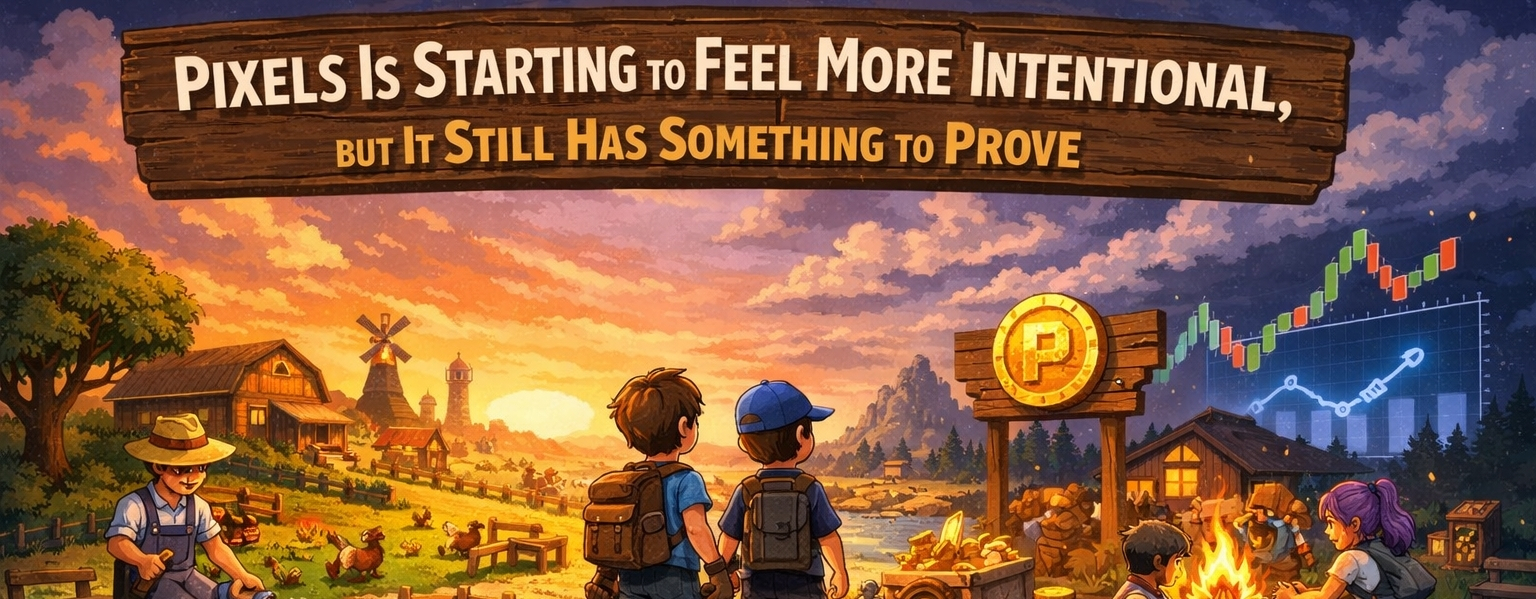
Pixels is one of those projects that has become more interesting to me slowly.
Not because of one big update. Not because of hype. And not because I suddenly think every Web3 game is finally figuring it out. It is more that, over time, Pixels has started to feel less like a crypto game trying to hold attention and more like a world that is being shaped with a bit more care.
That difference matters.
At first, Pixels was easy to place in the usual category. A social casual farming game on Ronin. Bright visuals, open world, simple loops, token in the background. Crypto has seen a lot of this before. A game shows up, people rush in, activity spikes, and for a while everything looks alive. But in this space, activity can be misleading. A busy system is not always a healthy one. Sometimes people are there because the incentives are strong, not because the world itself has any real pull.
That is why I keep looking at smaller things.
I pay attention to where friction is being removed. How easy it is to enter, move around, understand the loop, and keep playing without feeling pushed. Those details are usually more revealing than the loud stuff. When a product starts reducing friction in the right places, behavior changes. People stop treating it like a temporary opportunity and start using it more naturally. The system begins to feel less forced.
That is where Pixels seems to be improving.
It still carries the usual Web3 tension. You can feel the token in the background. You can feel how quickly attention can shift toward speculation. That part has not disappeared. And I do not think it should be ignored. In crypto games, it is always possible to mistake financial movement for product strength. A lot of activity can come from rewards, expectations, and market mood rather than real attachment.
But even with that in mind, Pixels feels a little more intentional than before.
The world looks less like a thin layer built around extraction and more like something trying to create its own rhythm. The social side feels more important. The routines feel more settled. The whole thing seems less awkward about what it wants to be. That does not mean it is fully there. It just means it is starting to feel more designed and less assembled.
And I think that is the real shift.
Because the big problem with most Web3 games is not getting people in. It is giving them a reason to stay once the novelty fades and the rewards stop doing all the work. Anyone can create traffic for a while. That is the easy part. The hard part is building something people return to because it fits into their day, because it feels familiar, because it offers something light but real beyond extraction.
Pixels seems closer to that than it did before.
I do not mean that in some dramatic way. I am not saying it has solved the model. I am saying it feels like the project is moving from raw activity toward actual habit. And there is a difference between the two. Activity can be bought. Habit usually has to be earned.
That is why I find it worth watching.
What I see is a game trying to become more usable, more social, and more natural without losing the energy that brought people in to begin with. But that is also where the tension remains. Web3 projects often depend on speculation to get momentum, then struggle to grow into something that can stand without it. Pixels still feels close to that edge. It may be improving the product, but the real question is whether the product can eventually carry more weight than the token around it.
I do not think we fully know that yet.
What I do know is that Pixels feels less random than it used to. Less like a temporary loop built to capture attention. More like a system that is learning how to hold people a little more honestly. That does not make it durable. It does not guarantee staying power. But it does make the project harder to dismiss.
And maybe that is the most accurate way to put it.
Pixels looks closer now. Closer to becoming something people might actually keep returning to. Closer to feeling like a real product instead of just an active one. But it is still somewhere in the middle. Still caught between utility and speculation, between progress and dependence, between being a place people use and a cycle people eventually move on from.
The shape is changing. I can see that much.
I am just not fully sure yet what it is changing into.
I can also make it even more human and Twitter-article style if you want it to sound less formal and more like your natural voice.
