
I kept coming back to Pixels after a few long nights of reading and thinking, and not for the reasons I expected. It wasn’t excitement. It wasn’t even curiosity in the usual sense. It was more like a quiet itch—something about it didn’t quite settle in my mind.
And honestly, I should admit this.
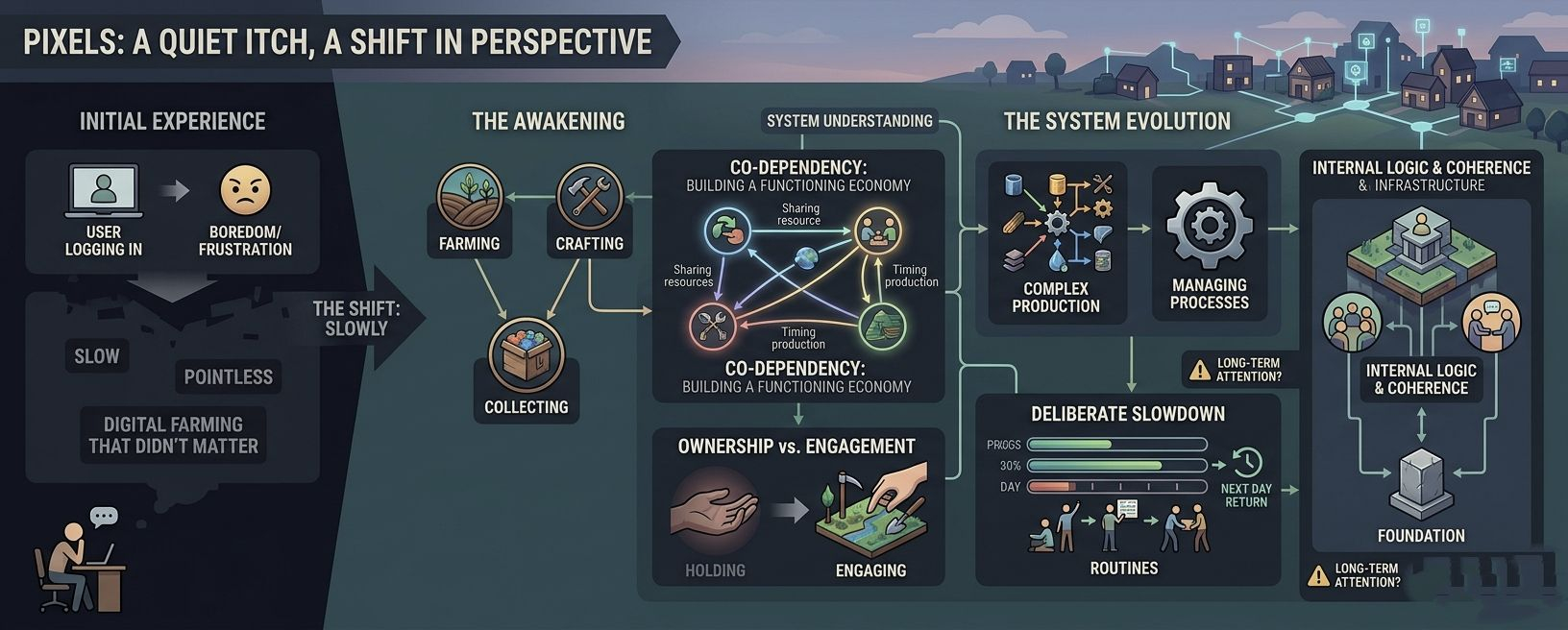
The first time I logged back in after months, I almost closed it within minutes. It felt slow. Pointless, even. Like I was wasting time doing digital farming that didn’t really matter.
But then something shifted.
Not suddenly. Slowly.
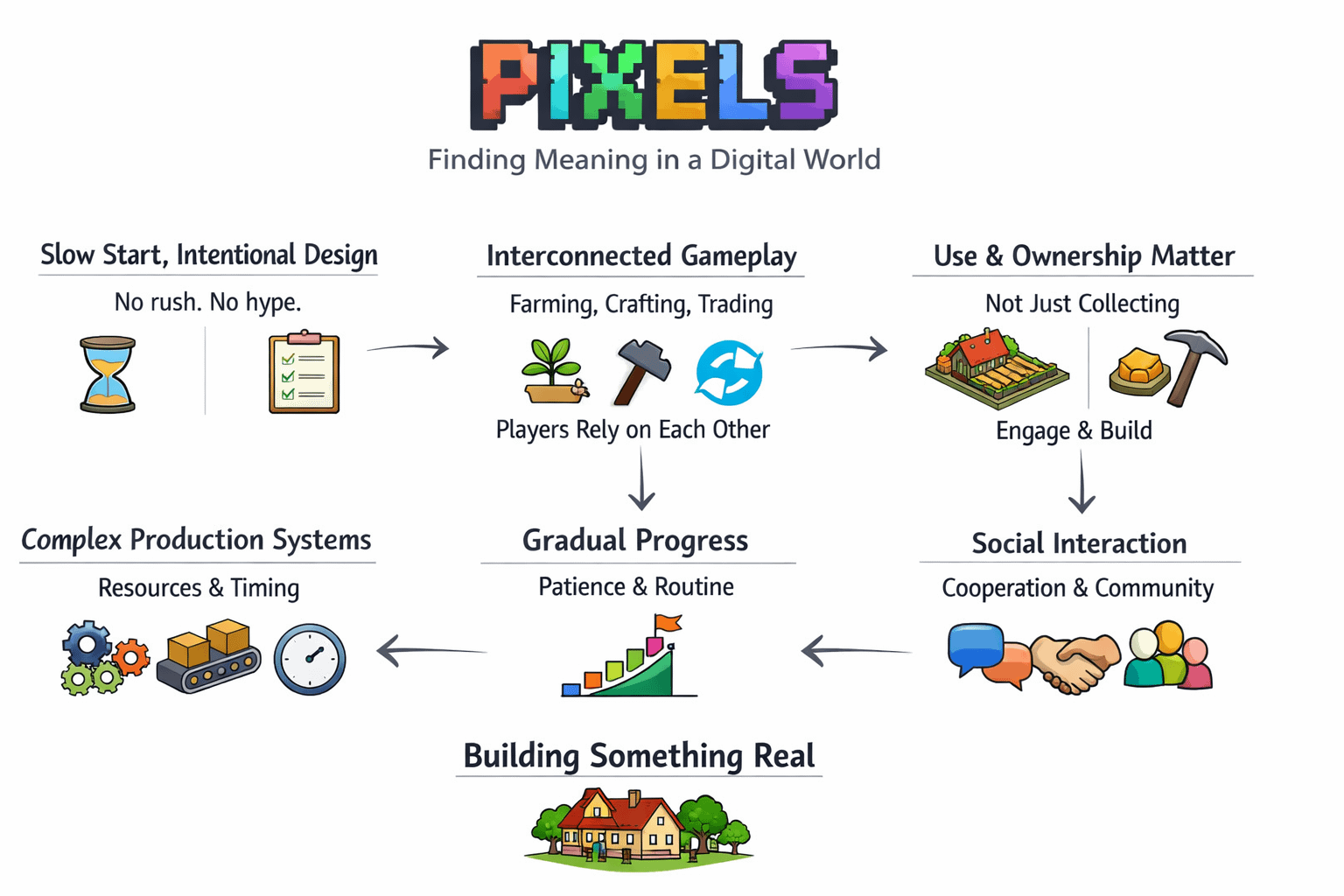
I started noticing that Pixels doesn’t rush you. It doesn’t try to impress you right away. And that’s strange, because most digital projects today are built to grab attention instantly. Pixels doesn’t. It almost risks boring you. But if you stay a little longer, you begin to see what it’s actually trying to do.
At its core, Pixels is dealing with a problem that most digital economies haven’t solved yet: how do you build a system where people don’t just show up, extract value, and leave? Because that’s what usually happens. Early users benefit, late users struggle, and eventually the whole thing loses meaning.
Pixels seems to understand this. Or at least, it’s trying to.
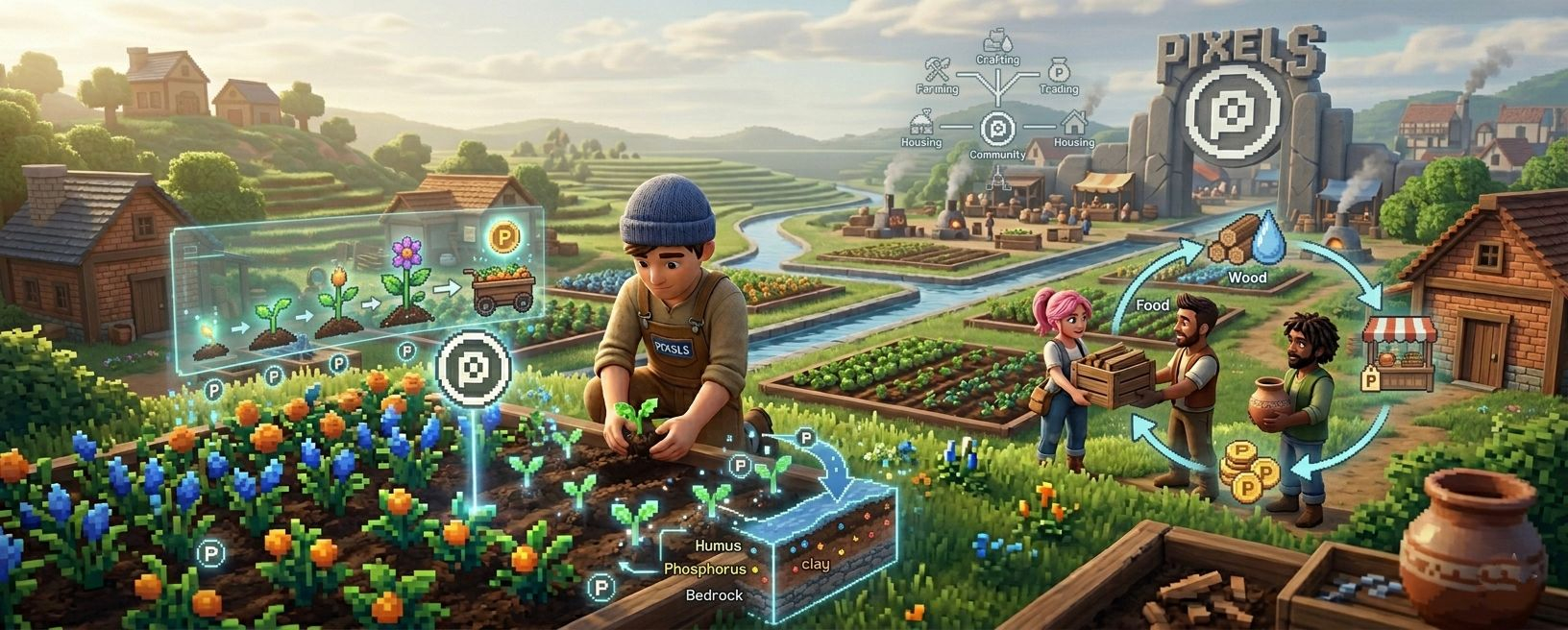
The design feels intentional in a very quiet way. Farming, crafting, collecting—these are simple actions, but they’re not isolated. What you grow or produce doesn’t exist in a vacuum. It connects to other players, other needs, other timelines. You’re not just “playing”—you’re participating in something that depends on others, even if you don’t immediately notice it.
That dependency matters.
Because real economies—actual, functioning ones—aren’t built on independence. They’re built on reliance. On timing. On people needing each other’s output. Pixels leans into that idea, even if it doesn’t explain it directly.
And then there’s ownership.
In many digital systems, owning something becomes the end goal. You collect, you hold, and that’s it. Here, ownership feels… incomplete without use. Land, items, resources—they don’t really mean anything unless you’re actively doing something with them. Maintaining them. Building on them. Letting others interact with them.
It’s a subtle difference, but it changes behavior.
You don’t just hold. You engage.
Lately, the project has been evolving in a direction that makes this even clearer. The introduction of more complex production systems—where resources flow through multiple steps, where timing and coordination start to matter—has changed the pace of everything.
It’s no longer just about doing tasks.
It’s about managing processes.
And that shift is important. Because when a system moves from simple actions to connected systems, it starts to feel less like a game and more like infrastructure. Something that runs. Something that needs to be maintained.
At the same time, it feels like the people behind Pixels are trying to slow things down in a deliberate way. Not slow in terms of development, but in how rewards are experienced. You don’t get everything instantly. Progress takes time. Effort builds gradually.
And maybe that’s the point.
It feels like they don’t just want users to come in, make something, and leave. It feels like they want people to stay. To build routines. To return the next day and continue something that wasn’t finished.
That’s not easy to design. Most systems fail at exactly this stage.
The social layer adds another dimension to all of this. Interaction isn’t forced, but it’s always there in the background. Trading, sharing, cooperating—it all emerges naturally from the structure rather than being pushed as a feature.
And that makes it feel… real. In a small way.
Still, there are things that aren’t clear. And I think it’s important to say that.
I don’t know if this kind of system can hold attention long-term. I don’t know if the balance between effort and reward will stay stable as more people join. And I’m not sure if the slower pace, which feels thoughtful now, might eventually push people away.
That’s the risk.
Because building something that asks for patience in a fast-moving space is always dangerous.
But there’s something here. Something different.
Pixels doesn’t feel like it’s trying to prove itself loudly. It’s not chasing attention. It’s trying to make its internal logic work first—to make sure that if people stay, there’s actually something holding them there.
And that’s rare.
Maybe I’m reading too much into it.
Maybe I’m wrong.
Maybe this project won’t last another year.
But right now, what I see is a system that’s trying—quietly—to figure out how digital spaces can feel a little more like real ones. Not perfect. Not complete.
Just… coherent.