
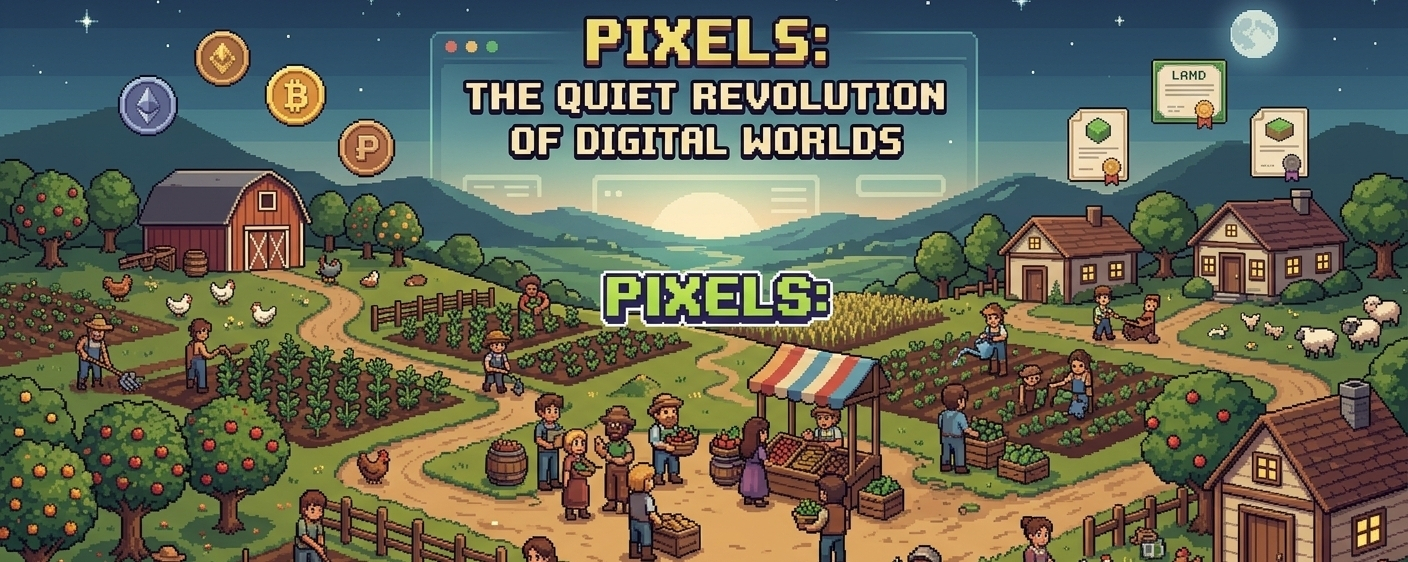
In an industry driven by noise, hype cycles, and sudden bursts of attention, Pixels emerged almost quietly. There were no massive announcements, no exaggerated promises of instant wealth, no aggressive campaigns demanding visibility. Instead, it appeared as something deceptively simple — a pixelated farming game reminiscent of an earlier era.
Beneath that nostalgic surface, however, lies a carefully engineered system. Pixels is not just a game, nor merely a token-driven ecosystem. It is an experiment in building a digital world where people stay not because they are incentivized to extract value, but because they find meaning in the routine.
To understand Pixels, you have to revisit the early wave of Web3 gaming — the era of “play-to-earn.” Growth was explosive, but fragile. Many systems prioritized financial rewards over engagement, attracting users who came to extract rather than participate. Economies inflated, rewards lost value, and ecosystems collapsed.
Pixels emerged from that environment but chose a different direction. Initially launched on Polygon and later migrating to the Ronin Network, its evolution was not just technical — it was philosophical. It shifted from chasing scale to prioritizing sustainability.
At the surface level, the experience remains simple: farming, crafting, gathering, exploring. But beneath that simplicity is a layered economy. Land ownership through NFTs, resource-driven production cycles, and a dual-currency model separate effort from speculation. Soft currency rewards gameplay, while the PIXEL token connects to the broader market. This distinction is deliberate — not all value is meant to be financialized.
More importantly, Pixels defines itself by what it avoids. It avoids making profit the core motivation. It avoids frictionless systems that collapse under excess. It avoids infinite reward loops. Instead, it introduces limits — energy systems, scarcity, and progression that requires patience.
These constraints reshape behavior. Players plan. They wait. They return. Over time, this builds something rare in Web3: habit. And habit is what transforms a product into a living ecosystem.
That design philosophy is reflected in its growth. Without relying heavily on hype, Pixels has attracted a large and active user base. More importantly, it has achieved retention — something most Web3 projects struggle with. Players are not just arriving; they are staying.
Its impact extends beyond itself. Pixels has played a key role in revitalizing the Ronin Network, driving activity, transactions, and renewed attention. It is not just part of an ecosystem — it is helping sustain it.
The introduction of the PIXEL token adds another layer, linking the in-game economy to the broader crypto market. With listings on major exchanges, value can flow beyond the game. Yet this connection is carefully balanced. Participation in the token economy remains optional, ensuring the system does not become purely speculative.
Looking forward, Pixels is beginning to evolve beyond a single game. Systems like Realms point toward a platform model — a shared infrastructure where multiple worlds and experiences can exist. This shift is critical. It determines whether Pixels remains a successful game or becomes a lasting foundation.
Still, challenges remain. Economic balance, bot activity, and exploit risks require constant attention. The simplicity that makes the game accessible may also limit depth for advanced players. And like all Web3 projects, it exists within a cyclical narrative that can shift rapidly.
Its future depends on maintaining balance — between fun and finance, accessibility and ownership, growth and sustainability. Lean too far in any direction, and the system risks losing its identity.
But if that balance holds, Pixels represents something more than a game.
It represents a different philosophy.
Not speed, but patience.
Not hype, but consistency.
Not extraction, but participation.
In a space obsessed with moving fast, Pixels is testing a quieter idea — that the worlds which last are not built in moments of excitement, but over time, shaped by routine, care, and the people who choose to stay.
