
There is a kind of game people admire, and a different kind people quietly keep returning to.
Those are not always the same thing.
Some games impress immediately. They introduce complex systems, fast progression, layers of strategy, and a sense that there is always something important happening. They create momentum. They feel ambitious from the start.
Then there are games that reveal themselves more slowly.
Pixels (PIXEL) often feels like one of those.
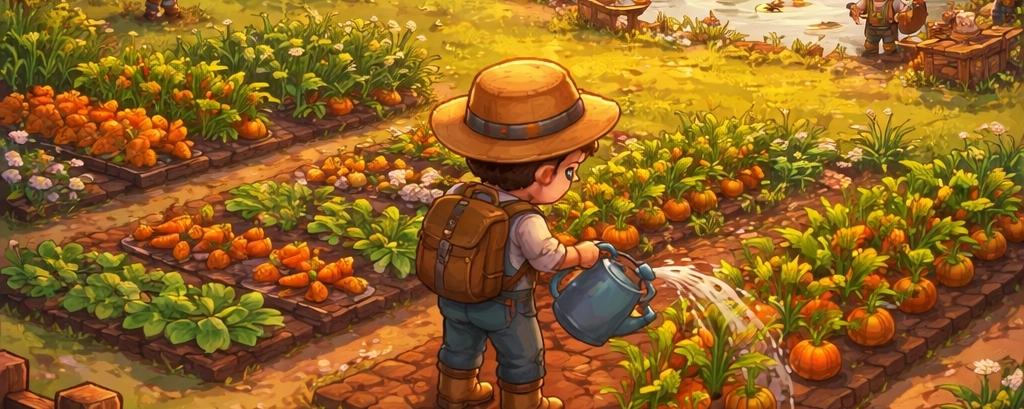
It doesn’t rush to prove its depth. It doesn’t front-load the experience with pressure or complexity. Instead, it gives you simple things to do and lets those things gradually become meaningful.
You plant something.
You harvest something.
You move through a shared world.
You make small adjustments to your space.
You return the next day and continue.
At first, it can seem almost too simple.
But over time, that simplicity starts to feel less like limitation and more like design confidence.
Because simple loops can carry surprising weight when they create rhythm.
And rhythm can create attachment.
That may be one of the quiet strengths of Pixels (PIXEL).
The game often feels less concerned with keeping players constantly stimulated and more concerned with giving them a world they can settle into.
That changes how the experience feels.
You are not pushed into treating every session like something to optimize.
You are not constantly calculating whether your time is being used efficiently.
Often, you are simply spending time in the world.
And that distinction matters.
Because spending time somewhere is emotionally different from managing a system.
One feels like presence.
The other often feels like work.
In much of Web3 gaming, that difference has been easy to overlook.
Many projects have focused on complexity as a signal of depth. More mechanics. More incentives. More layers intended to increase engagement.
But complexity does not always create stronger retention.
Sometimes it creates fatigue.
Sometimes it creates friction.
And sometimes it makes participation feel heavier than it needs to be.
Pixels (PIXEL) seems to take another path.
It reduces friction.
It trusts smaller actions.
It allows engagement to emerge through habit rather than pressure.
That may be why its retention often feels natural.
People do not only come back because a system tells them they should.
They come back because the world fits easily into their routine.
And routines are powerful.
Not because they create excitement every day.
But because they create continuity.
Continuity is often what turns a game into something people stay with.
And staying is where ecosystems begin to deepen.
You can see this in the social layer too.
There is something understated but important about how players exist around one another in Pixels (PIXEL).
Interaction often feels unforced.
You pass others farming.
You notice how they build.
You share space while doing ordinary things.
Sometimes conversations happen.
Sometimes they don’t.
But even simple coexistence has value.
Because shared presence creates atmosphere.
And atmosphere often matters more for community than formal social systems alone.
People tend to form stronger attachment to worlds that feel inhabited.
Not just because other players are there.
But because those players make the world feel alive.
Over time, familiar patterns emerge.
Familiar names.
Familiar spaces.
Familiar rhythms.
And that familiarity often becomes part of why people continue showing up.
That is where community starts becoming something deeper than interaction.
It becomes part of the environment itself.
And that may be one reason Pixels (PIXEL) feels interesting as a long-term ecosystem.
Because sustainability is not only about whether systems function.
It is about whether people keep caring enough to participate.
Whether the world still feels worth inhabiting after novelty fades.
Whether simple actions still feel satisfying months later.
Those are harder questions.
But they are often the questions that determine what lasts.
And perhaps that is what Pixels (PIXEL) quietly points toward.
That sustainable Web3 worlds may not be built only through bigger mechanics or more elaborate economic structures.
They may also be built through comfort.
Through familiarity.
Through giving people a world that does not constantly demand attention—
but still feels worth returning to.
That idea feels especially relevant now.
Because as Web3 gaming matures, the conversation is shifting.
Less toward what can be added.
More toward what can endure.
And endurance often depends on softer things than people expect.
Trust.
Routine.
Atmosphere.
Ease.
A sense that being there still feels good.
Pixels (PIXEL) seems to understand those things.
And that may be part of what makes it meaningful beyond itself.
Not because it claims to define the future of Web3 gaming.
But because it quietly suggests a future where online worlds succeed not by asking the most from players—
but by giving them reasons to stay.
And in the long run, that may be the stronger foundation of all.