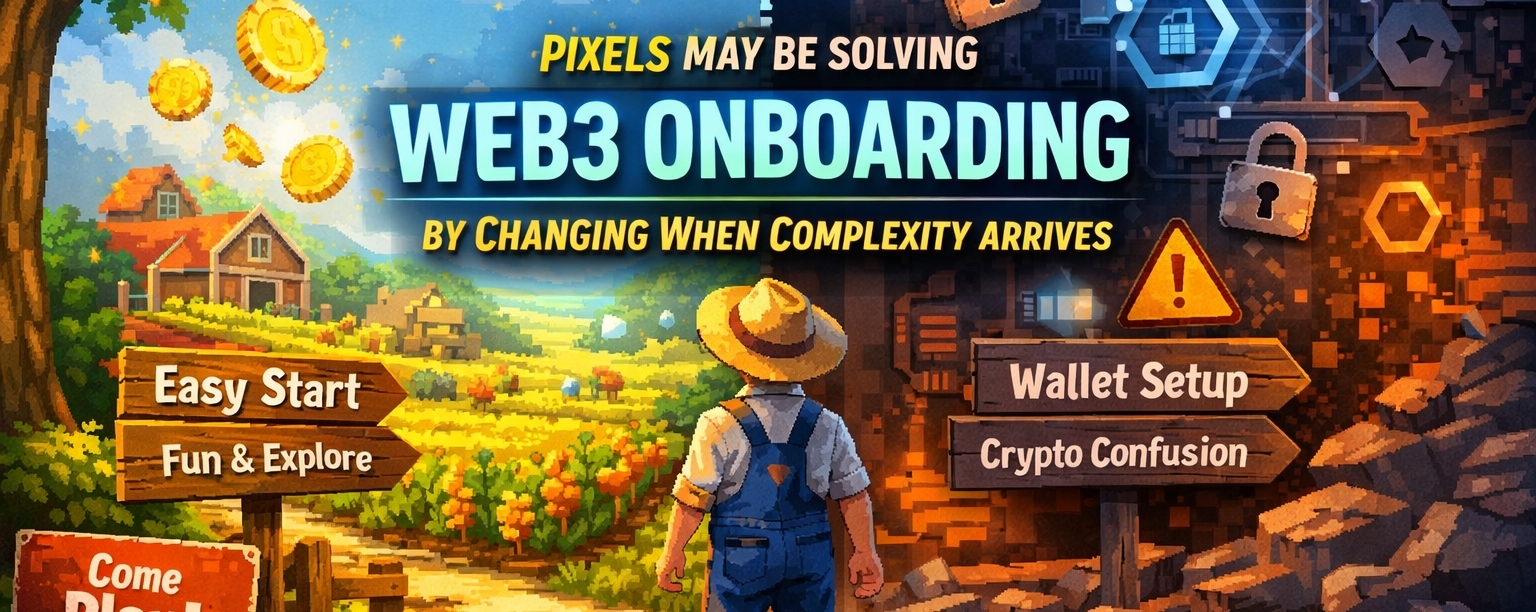
I think most Web3 games made the same early mistake. They asked people to understand the rails before they could enjoy the ride. Wallet first. Setup first. Sign this. Connect that. Learn the system before you even know why it matters. That flow kills curiosity fast. Pixels feels different. Not because it hides Web3 completely, but because it seems to change when you have to feel it. Its own lite paper says Pixels wants to be a fun, easy-going, blockchain-backed game and a gateway for millions into Web3. That wording matters. It puts the game first, not the complexity.
The more I looked at Pixels, the more this felt intentional. The game is browser-based, playable through its web entry point, and the official site pushes a simple idea: play for free, explore, build, progress, play with friends. That is a softer invitation than what most crypto games used to offer. It feels less like entering a system and more like entering a world. And that difference is huge when the market is full of people who are curious about Web3 but still tired of friction.
What really sharpens the thesis is the account flow. Pixels lets new users create an account with phone or email, and the signup options include SMS, WhatsApp, or email. The docs also make it clear that this can become your main login method unless you later connect a wallet. That is not some tiny UX convenience. That is a design decision with consequences. It means Pixels may be separating participation from immediate crypto fluency. You do not need to think like a wallet-native user on day one just to get inside.
And honestly... that may be the real innovation here.
Because people usually adopt utility before infrastructure. They do not fall in love with login architecture. They fall in love with momentum. Habit. Progress. Familiar loops. A little ownership later feels exciting. Too much infrastructure too early feels like homework. Pixels seems to understand that. Even its FAQ keeps the message simple: the game is free-to-play, and users can play on mobile through a wallet browser or even a regular browser with social login. That keeps the first contact light. Clean. Human.
Then the deeper Web3 layer shows up when it actually becomes relevant. Pixels’ help docs explain that users can later attach a crypto wallet from the dashboard, while also attaching email or phone login methods there. So the system does not reject crypto. It stages it. That is the important part. The player meets the heavier layer later, after some trust, habit, and understanding already exist. Like opening the hard chapter only after the story has made you care.
And that feels very aligned with where the market is now. The loud “wallet-first” era has cooled. Projects that keep winning attention are usually the ones trying to reduce friction, widen access, and make crypto feel usable instead of ceremonial. Pixels fits that shift well because its onboarding path does not demand belief before experience. It lets the experience do the persuading first. The game teaches value before the blockchain asks for commitment.
That is why I think Pixels is not just simplifying Web3 onboarding. It may be reordering it. First the world. Then the habit. Then the deeper system. In a space where so many projects still throw users into cold technical water, Pixels feels more like a slow river entry. You walk in. You adjust. Then suddenly you realize... you are already inside Web3.
That is a much smarter design choice than most people are giving it credit for.