
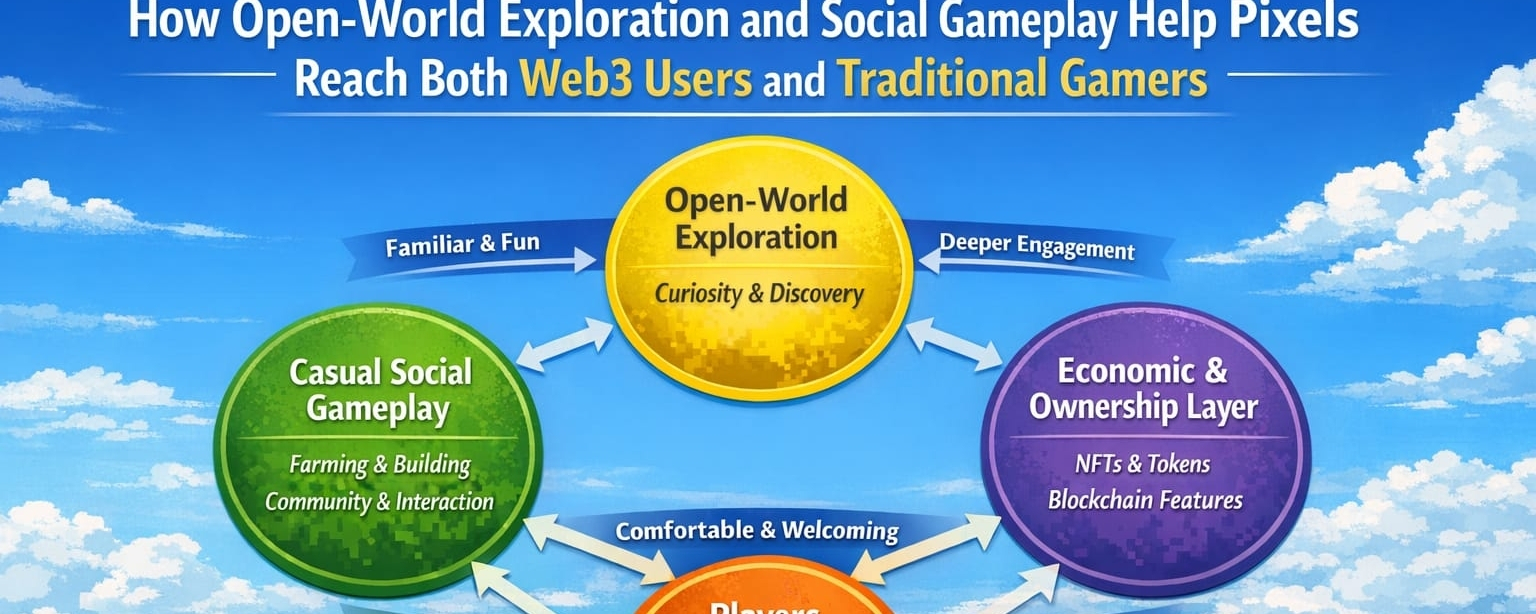
What makes a game grow beyond its niche is not noise. It is not token hype, not temporary farming incentives, and definitely not the usual “this will onboard millions” promise that gets repeated every cycle. What actually matters is whether people want to stay. That is the part I pay close attention to with Pixels. Beneath the Web3 label, I see a game trying to solve one of the hardest problems in crypto gaming: how to make the experience feel inviting enough for traditional players while still giving blockchain users something meaningful to care about.
That matters more than many people realize.
A lot of Web3 games still make the same mistake. They act like ownership alone is the product. They push wallets, assets, rewards, and token mechanics to the front, then expect players to become emotionally invested afterward. I think that logic is backwards. If the world itself does not feel alive, if the experience does not feel easy to enter, and if the gameplay does not create a natural reason to return, the rest becomes decoration. People may arrive for speculation, but they do not stay for it.
This is where Pixels stands out to me.
The open-world exploration piece is more important than it looks on the surface. In many games, movement is just a way to get from one task to another. In Pixels, exploration helps create curiosity, and curiosity is one of the strongest hooks any game can have. When players feel like they are discovering a place rather than just clicking through a system, the experience starts to breathe. I see this clearly: exploration gives the world texture. It makes the game feel less like a financial tool and more like an actual environment people can belong to.
That sense of place matters because it lowers resistance.
Traditional gamers do not usually enter a game asking about tokenomics. They enter asking a simpler question: is this fun, and does this world make me want to spend time here? Casual social gameplay helps answer that in a very direct way. Farming, chatting, visiting other players, sharing space, building routines, and participating in a relaxed loop create something comfortable. It is not trying too hard. It does not demand that every player become competitive, strategic, or financially motivated on day one. That softness is a strength, not a weakness.
I think many people miss this point because they still judge games in crypto through a narrow lens. They look for explosive mechanics, aggressive incentives, or some big “revolutionary” feature. But mass appeal is often built through familiarity, ease, and social comfort. Pixels seems to understand that better than a lot of projects in this space. It gives Web3 users a layer of ownership and economic relevance, but it wraps that inside a more approachable game loop. That balance is hard to get right.
What stands out to me is how the social layer acts like a bridge.
For Web3-native users, social activity adds stickiness to the ecosystem. It makes participation feel more human and less transactional. For traditional gamers, it softens the blockchain side by shifting attention toward interaction, identity, and daily engagement. In other words, people do not need to be sold on crypto first. They can be pulled in by the world, the routine, and the community, then slowly become more open to the ownership side later. That is a much smarter path than forcing the Web3 pitch upfront.
There is also a deeper lesson here. If a game wants to attract both audiences, it cannot behave like it is serving two different products at once. It has to make the overlap feel natural. Pixels gets closer to that by using casual gameplay as the entry point and open-world design as the emotional glue. Exploration creates interest. Social play creates attachment. Web3 mechanics then sit underneath that as an added layer instead of an obstacle. From my view, that order changes everything.
The warning is obvious too. If the economic side ever becomes louder than the experience itself, the balance can break. I watch that closely. The moment players start feeling that the world exists mainly to support a reward loop, immersion weakens. And once immersion fades, the broader audience starts to pull away. Traditional gamers are especially sensitive to that. They can tell when a game wants something from them before it gives them something meaningful first.
The opportunity, though, is real.
Pixels shows that Web3 gaming does not need to win by arguing harder. It can win by feeling better. It can win by making the game world enjoyable enough that blockchain becomes a supporting feature rather than the headline. That is the shift I think this market has needed for a long time. Not louder promises. Better design. Not more extraction. More belonging.
At the end of the day, I do not think Pixels is interesting because it is a Web3 game. I think it is interesting because it understands something bigger: people stay where they feel curious, comfortable, and connected. That is the formula that can pull in both crypto users and traditional gamers. And if more projects fail to understand that, they will keep building systems people visit briefly instead of worlds people actually care about.
