
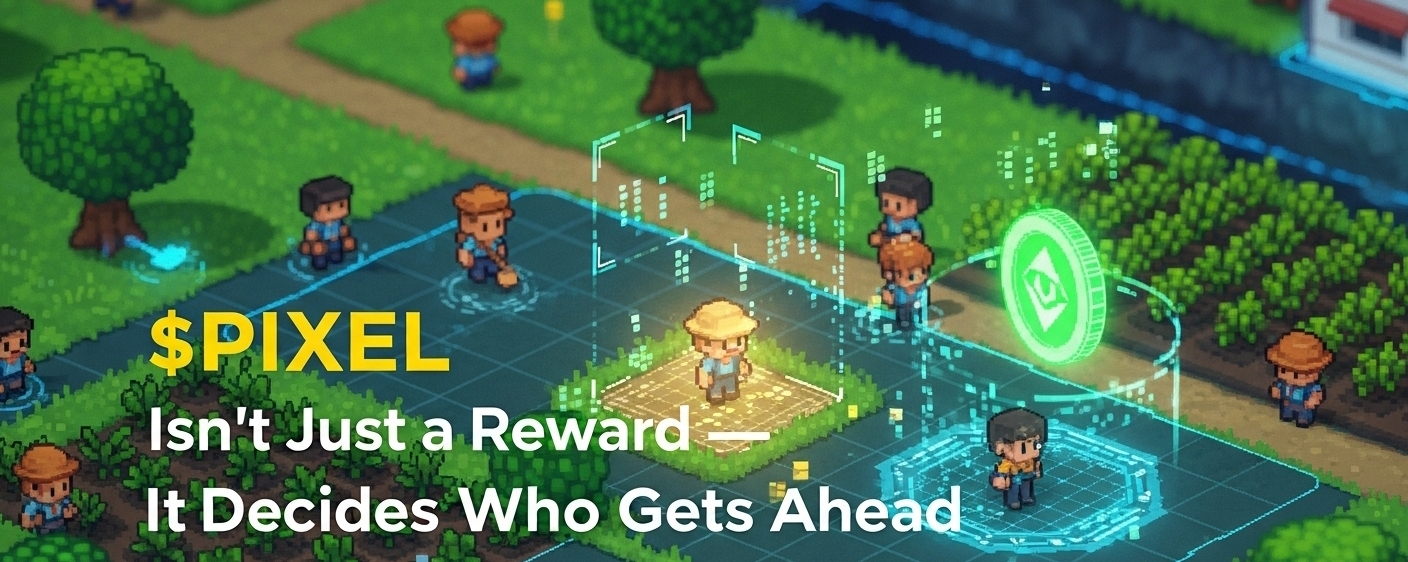
At first, Pixels didn’t feel like anything unusual.
You log in, do a few tasks, and things just move forward. It’s calm, almost predictable. The kind of experience that doesn’t try too hard to impress you. It actually feels closer to older browser games, where progress was slow but steady.
That’s what made it easy to ignore at the beginning.
But after spending more time inside it, something started to feel slightly different. Not in a bad way, just… uneven. Some players didn’t seem to progress faster, yet their position in the system felt more stable. Not stronger, just more consistent.
It wasn’t about grinding more. Or spending more.
It felt like their presence carried over in a way others didn’t.
That’s when a thought started forming.
Maybe PIXEL isn’t really focused on rewarding gameplay in the usual sense. Maybe it’s quietly shaping which kinds of player behavior are worth keeping.
It’s not something you notice immediately. There’s no message, no clear signal. But over time, certain patterns start to stand out. Some actions seem to matter beyond the moment they happen.
In most games, what you do is temporary. You complete tasks, earn rewards, and then everything resets in how the system evaluates you. It tracks your progress, but it doesn’t build on how you played.
Pixels doesn’t quite feel like that.
There’s a subtle sense that repetition isn’t just repetition. When behavior becomes consistent, it starts to carry weight. Not just in rewards, but in how the system responds to you later.
It’s almost like your actions slowly shift from being effort to becoming something the system recognizes.
And once something is recognized, it becomes easier to work with.
That changes the dynamic in a quiet way.
Instead of valuing every action equally, the system seems to lean toward patterns it can predict. Not in an obvious or controlled way, but gradually. Some behavior gets reinforced, while other actions simply pass through without leaving much impact.
If you think about it from a structural perspective, it makes sense. Systems naturally prefer stability. Predictable behavior reduces uncertainty. It creates something that can be built around.
So instead of just pricing activity, PIXEL might be indirectly connected to something else — reliability.
Not in a moral sense. Just in how consistent and repeatable your actions are.
And once behavior becomes reliable enough, it doesn’t just get rewarded. It starts getting reused.
That’s where things feel different.
Because reuse creates continuity. A single action doesn’t carry much weight, but a repeated pattern starts influencing how the system organizes itself around you. It might affect opportunities, or reduce friction in ways that aren’t clearly visible.
Nothing is announced. There are no clear thresholds.
The system just slowly aligns itself with what it already understands.
This kind of behavior isn’t unique to games either. Many platforms quietly move in this direction over time. They figure out which users create stability, which patterns are predictable, and they start prioritizing those — without ever explicitly saying it.
Pixels might be moving in a similar direction.
And if that’s the case, then PIXEL isn’t just acting as a reward. It becomes part of a filtering process. A way to reinforce certain behaviors while letting others fade into the background.
That brings up some interesting questions.
Growth, for example, might not mean what it usually does. More players doesn’t automatically create more value. If new behavior isn’t consistent, it doesn’t really accumulate. It just cycles through.
In that sense, a smaller group of predictable players could be more valuable than a large group of random ones.
But there’s also a tradeoff.
If players start noticing that only certain patterns seem to “work,” they might stop experimenting. The game slowly shifts from exploration to optimization. From playing freely to playing correctly.
And that can make everything feel narrower over time.
There’s also the question of visibility.
Right now, most of this remains unclear. You can sense it, but you can’t define it. And as long as it stays that way, it works quietly in the background.
But if outcomes start depending too much on patterns players don’t understand, it could eventually lead to frustration.
It’s not something that shows up immediately. It builds slowly.
The final question is whether $PIXEL truly sits at the center of all this. Because if players can move through these reinforced patterns without needing the token in a meaningful way, then its role becomes weaker.
So none of this is guaranteed.
Still, that initial feeling remains.
That slight unevenness. That sense that not everything resets the same way.
Maybe that’s the real shift happening here.
Not play-to-earn. Not even play-to-own.
Something closer to play-to-be-recognized.
But only if your behavior becomes predictable enough to matter.
And if that’s true, then the real game inside Pixels isn’t about doing more.
It’s about becoming the kind of player the system already understands.
