
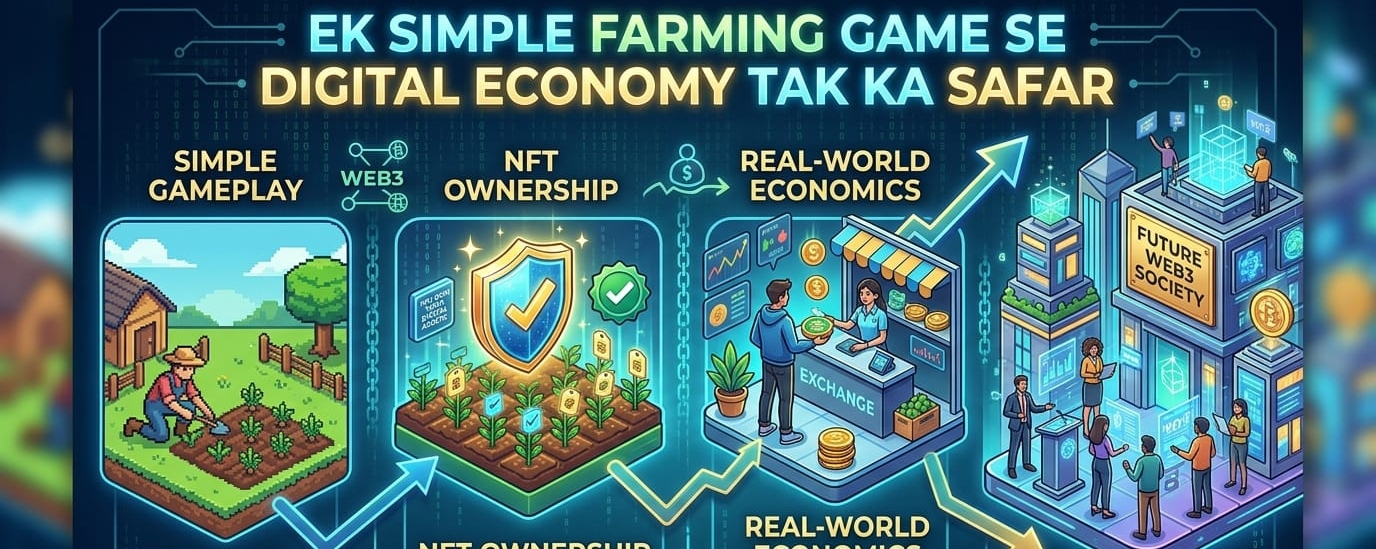
Pixels doesn’t try to impress you at first. You log in see a soft, pixelated world, plant a few crops, maybe wander around a bitand it all feels almost too simple. Like something you’ve seen before. But if you stay a little longer, you start noticing that things behave differently here. Your time matters in a strange way. Your choices stick. And slowly, the game stops feeling like a game and starts feeling like a small, living system.
That shift didn’t happen overnight. Early on, Pixels struggled with the same problem that hit most Web3 games—too much reward, too little balance. Players could earn endlessly, but the value behind those rewards kept slipping. It was the kind of system that looked exciting at the start but couldn’t hold itself together. Instead of ignoring that, the developers made a hard decision: rebuild the economy instead of patching it.
What came out of that rethink was something much more grounded. Instead of one currency doing everything, Pixels split the idea into two—one meant to hold value, the other meant to keep things moving. It sounds simple, but it changed how the entire world feels. You’re no longer just collecting rewards; you’re making decisions. Do you spend now or hold for later? Do you grind more or trade smarter? That quiet layer of decision-making adds a kind of weight most games never reach.
The move to the Ronin Network helped make all of this actually work in practice. Transactions became fast and cheap enough that you don’t even think about them. And that’s important, because the moment you have to stop and worry about fees or delays, the illusion breaks. Here, things just flow. You plant, craft, trade—and the system responds without getting in your way.
On the surface, the routine is still familiar. You farm, you gather, you build. But the longer you play, the more you realize these actions connect to something bigger. Skills improve, efficiency grows, and suddenly you’re not just playing alone—you’re part of a wider network of players who depend on each other in small but meaningful ways. Someone grows resources better than you. Someone else crafts faster. Trade becomes natural, not forced.
The newer updates have pushed this even further. What used to feel like simple loops now feels more like a chain of activity. Resources move through different hands, different roles, different places. Land ownership—limited and uneven—starts to matter more than you expect. If you own land, you’re not just playing; you’re hosting activity. Other players pass through, produce on it, and that activity creates value. It introduces a quiet hierarchy without ever announcing it.
And that’s where Pixels gets interesting in a deeper sense. It doesn’t just create a fair playground—it creates a structured one. Some players get ahead earlier. Some have better positions. New players have to figure out how to fit into that structure rather than start from zero. It mirrors real systems in a way that’s subtle but hard to ignore.
Another detail that often goes unnoticed is how the game starts recognizing behavior, not just progress. Over time, it tracks how active you are, how you engage, how you contribute. That builds a kind of reputation. It’s not loud or flashy, but it shapes your experience—what you can access, what advantages you get. In a space where anonymity is the norm, this adds a layer of identity that actually means something.
The scale of the player base is part of what makes all this feel real. When thousands—sometimes millions—of people are interacting in the same system, it stops feeling theoretical. Markets form naturally. Prices shift. Strategies emerge. And importantly, people keep playing even when the hype fades a bit. That’s usually the point where weaker systems fall apart, but Pixels has managed to keep its core intact so far.
Of course, the token tied to the game still moves up and down, sometimes sharply. That’s the nature of anything connected to crypto. There are moments when speculation takes over and everything feels driven by price rather than play. But what’s different here is that the game doesn’t completely depend on that. Even when the market cools, the internal systems still give players reasons to stay.
If you step back and look at it from a distance, Pixels feels like an early version of something we don’t fully have a name for yet. It’s not just a game, and it’s not just an economy. It sits somewhere in between—a space where playing, working, and interacting start to blend together.
And maybe that’s the most interesting part. When you spend time optimizing your farm, coordinating with others, or figuring out better ways to earn, it doesn’t feel like traditional “work,” but it also doesn’t feel entirely like play anymore. It sits in that middle space where effort turns into something persistent, something that carries forward.
What happens next will depend on how carefully it grows. If it keeps balancing its systems and avoids leaning too heavily into quick profit mechanics, it could become a model others follow. If it loses that balance, it could fall into the same traps earlier games did.
Right now, though, Pixels feels surprisingly grounded. It doesn’t try to overwhelm you with complexity all at once. It lets you ease into it, piece by piece. You start with a small patch of land, a few simple actions—and before you realize it, you’re part of something much larger, something still evolving in real time.
It’s quietalmost understated. But that’s exactly why