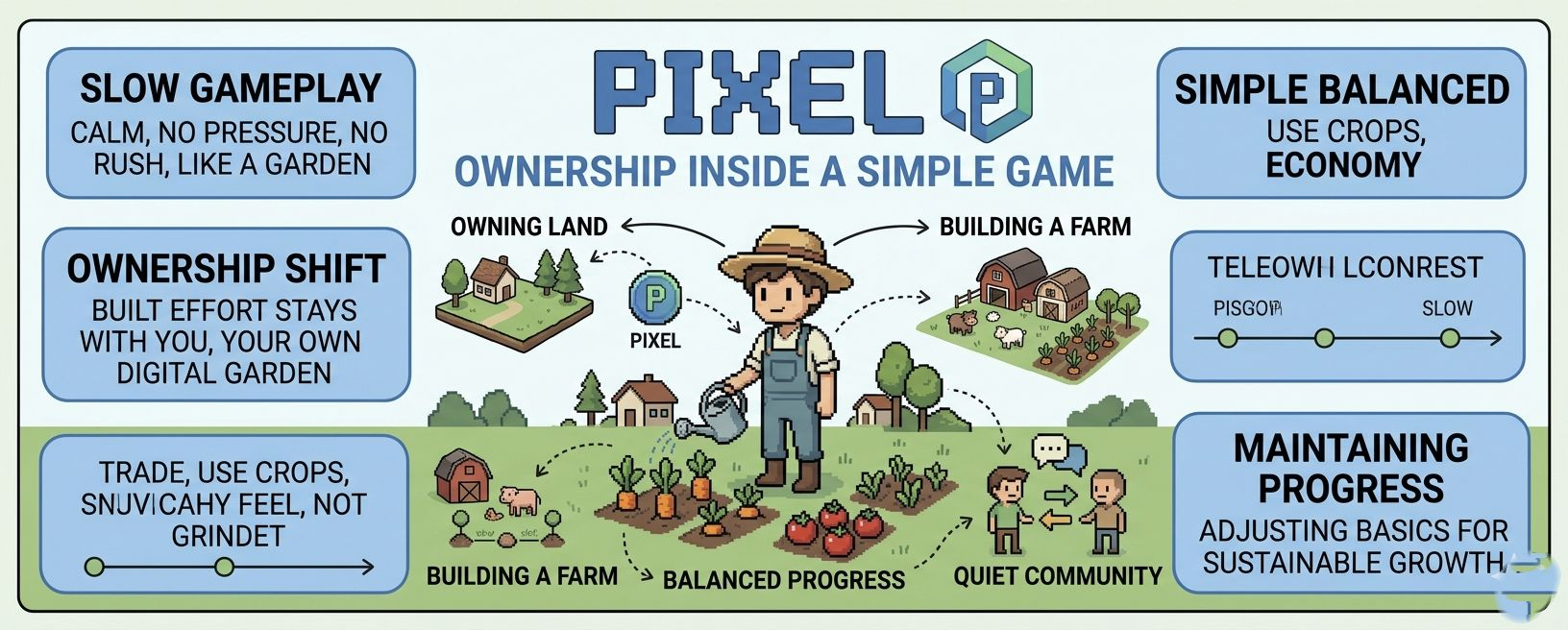

I didn’t approach Pixels like a typical game. At some point, I stopped playing it the usual way… and started observing it.
That shift happened slowly.
At first, it looked simple. Farming, movement, crafting. Familiar loops. Nothing unusual. But the longer I stayed, the more I felt there was something else happening beneath the surface—something quieter, more structural.
And I kept asking myself: what exactly is this trying to become?
The honest part is, I almost dropped it in the first week. It felt slow. Repetitive. Another farming loop that didn’t seem worth the time. I’ve seen enough of those to know how they usually end. For a moment, it genuinely felt like I was wasting my time.
But something didn’t sit right with that conclusion, so I stayed a little longer.
I spend a lot of time looking at systems, usually through charts, execution speeds, and how networks behave under pressure. Most projects try very hard to look complex. Pixels doesn’t. It almost hides behind simplicity. And that’s exactly why it takes time to notice what it’s actually doing.
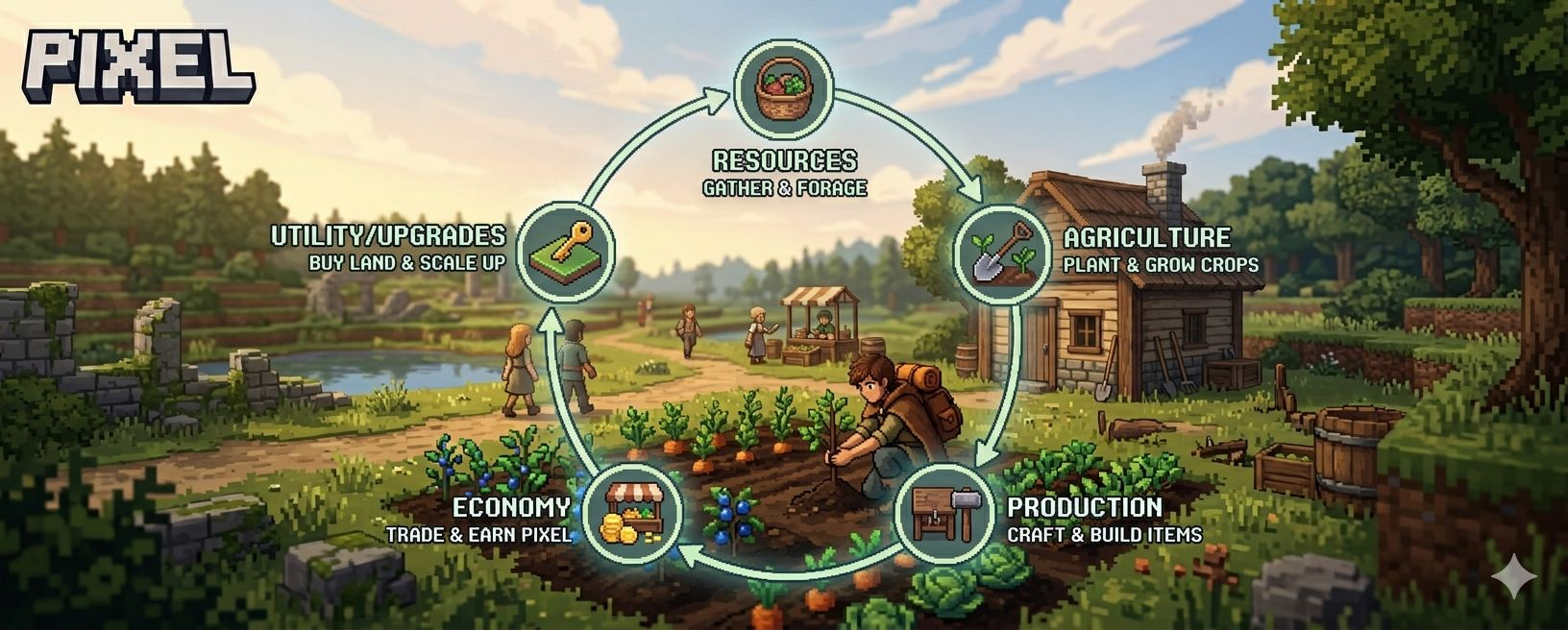
Resources aren’t just collected and forgotten. They move through stages. They get processed, reused, redistributed. There’s a loop forming underneath everything, and more importantly, that loop is consistent. It doesn’t depend on constant external input to keep going.
It’s not about the money. At least, not at first.
To really understand why this matters, you have to look at what came before it. We’ve all seen how earn-first systems played out. Entire ecosystems built around extraction, where rewards came before structure. For a while, it looked like growth. In reality, it was imbalance building up. Once participation slowed, everything else followed.
We’ve seen enough “next-gen” projects fail because they forgot that a system needs a foundation, not just a marketing budget.
The issue was never ownership itself. It was the absence of something strong enough to support it.
Pixels doesn’t start from that angle. It builds from activity. Farming, crafting, gathering these aren’t just features, they are inputs into a cycle. Every action feeds into something else. Resources don’t just sit in inventory, they move, they get transformed, and they re-enter the system.
You’re not pulling value out of it. You’re operating inside it.
There’s also a subtle decision that becomes clear only after spending time with it. Not everything is treated as something valuable. Basic gameplay exists in a layer where actions are simple and low pressure. Then there’s another layer where ownership, efficiency, and scarcity start to matter more.
That separation is doing a lot of work.
Because once everything becomes financial, behavior changes. Systems become fragile. Pixels avoids that by letting players exist without pressure, while still allowing deeper participation for those who move further in.
Ownership doesn’t feel like something being pushed. It feels like something that naturally emerges.
Land is a good example of that. At first, it doesn’t seem like a big deal. But once you start using it properly, you notice how it changes production. Certain bottlenecks just disappear. Movement becomes more efficient. Output becomes more consistent. It’s not something you fully understand from the outside, but once you experience it, the difference is obvious.
That kind of value isn’t announced. It’s discovered.
Another thing that stood out to me is how smooth the system feels at a technical level. Actions don’t hang. Transitions between tasks are quick enough that you stop thinking about what’s happening underneath. That might sound small, but it isn’t.
If execution had friction, the entire loop would break. Repetition would feel like a chore instead of a system. Here, it doesn’t. The flow stays intact, and because of that, the structure holds together.
Recent changes haven’t tried to turn the system into something else. Instead, they refine what already exists. Resource flow feels more balanced. Production makes more sense over time. Land usage feels more structured. These aren’t dramatic changes, but they make the system more stable.
It feels like adjustment, not expansion.
There’s also a growing reliance on others, even if it’s not obvious at first. You can try to do everything yourself, but it quickly becomes inefficient. Over time, it makes more sense to exchange, to rely on different roles, even if those roles aren’t formally defined.
Trade isn’t introduced as a feature. It becomes necessary because of limitation.
That’s when the system starts to feel less like a game and more like an environment.
None of this removes the risks. Systems like this depend on activity. If participation slows, the entire structure feels it. Balance is not something you achieve once and forget. It needs constant adjustment, and even small changes can shift outcomes.
Pixels doesn’t avoid these realities. It operates within them.
And maybe that’s the most interesting part.
It doesn’t try to prove itself loudly. It doesn’t rush to expand before stabilizing. It builds gradually, allowing behavior inside the system to shape what it becomes.
After spending enough time with it, I don’t really see Pixels as a game trying to become an economy.
It feels more like an economy that is still figuring out what kind of game it wants to be.