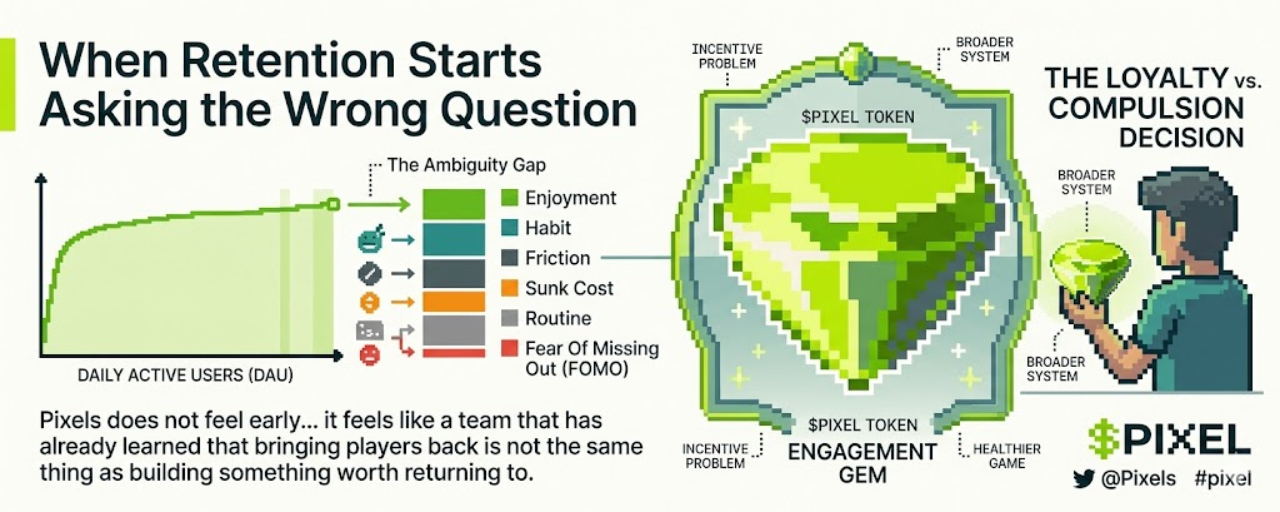
The more I think about game economies, the less I trust retention as a clean metric.
Not because retention is useless. But because it hides too much.
A player comes back every day. The dashboard sees consistency. The system sees success. The studio sees proof that something is working. But the metric itself cannot tell you why the player returned. Enjoyment, habit, friction, sunk cost, routine, fear of missing out. All of them can produce the same line on the chart.
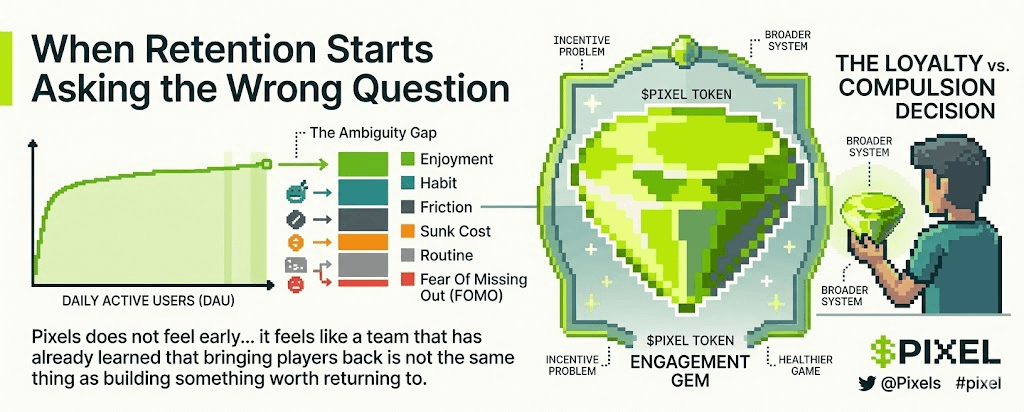
That ambiguity matters more than people admit.
What makes Pixels interesting is not simply that it has a rewards layer. It is that the project seems to sit much closer to this ambiguity than most teams do. Once you have operated at scale long enough, the question stops being how to drive more behavior. The question becomes whether the behavior you are reinforcing is actually the kind that makes the game healthier over time.
That is not a cosmetic distinction. It changes everything.
PIXEL becomes more compelling to me in that context. Not as a generic engagement token, but as part of a broader system trying to solve a harder incentive problem under real pressure. How do you reward participation without teaching the economy to depend on the wrong type of participant? How do you improve retention without collapsing the difference between loyalty and compulsion?
Most projects are still too early to ask that honestly.
Pixels does not feel early in that way. It feels like a team that has already learned that bringing players back is not the same thing as building something worth returning to.
That is why I keep paying attention.