
Pixels is one of those games that feels simple at first, almost suspiciously simple, and I do not mean that in a bad way. You walk into this bright little world and the first thing that hits you is not some massive story or deep combat system or complicated strategy layer. It is the mood. The game wants you to slow down. It wants you to plant crops, wander around, gather materials, talk to characters, and just exist in its world for a while. That part works better than I expected. There is something oddly satisfying about a game that does not act like it has to scream for your attention every second. You farm. You explore. You make things. You repeat the loop. And somehow that loop holds together.
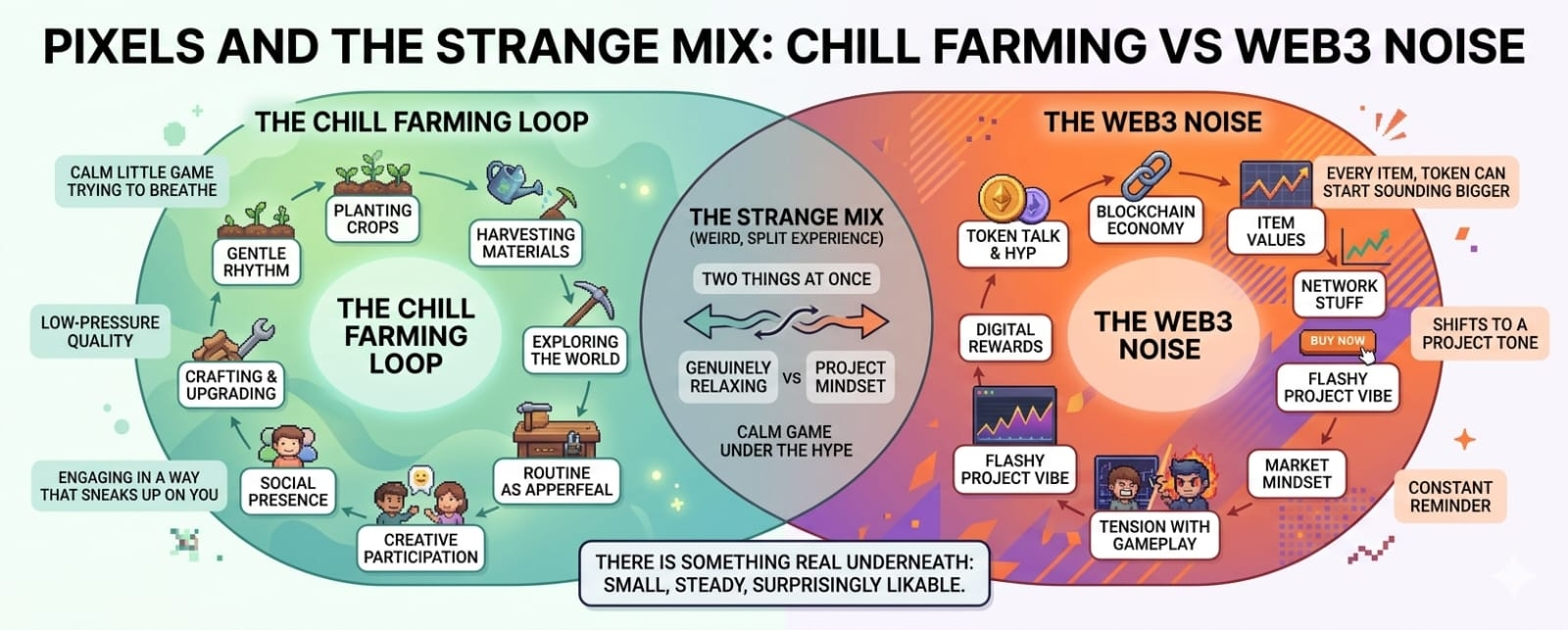
That is probably the real strength of Pixels. Under all the Web3 branding, under the token talk, under the network stuff and the usual cloud of hype that follows anything attached to crypto, there is actually a calm little game in here trying to breathe. That is what makes it interesting to me. If it was just another flashy blockchain project with no real gameplay, there would not be much to say. But Pixels is harder to dismiss because the core of it is recognizably human. It understands the appeal of routine. Planting, harvesting, crafting, upgrading, running around a friendly map looking for the next useful thing. These are not revolutionary ideas. They do not need to be. Games have been built on that kind of rhythm for years because people like it. People like feeling settled into a world, even a small one.
And Pixels really leans into that gentle rhythm. The farming is not trying to reinvent the genre. You grow crops, manage your space, collect what you need, and gradually figure out how to be more efficient. The exploration has that same easygoing style where you are not charging into danger every ten seconds. You are just moving through the environment, picking up tasks, checking locations, finding resources, getting a little deeper into the game’s systems without being thrown off a cliff. There is a kind of patience to it. The world is colorful without being exhausting. The design feels inviting. It knows the value of making people want to stay.
Still, the Web3 side is always there, and that is where the experience gets weird. Not ruined, exactly. Just split. Because on one side, Pixels feels like a cozy social game where the point is to build a routine and enjoy the process. On the other side, it is attached to this whole digital economy mindset where every item, token, and reward can start sounding bigger than it actually is. That tension never fully disappears. You can be having a decent time planting crops and then suddenly be reminded that this is also part of a blockchain ecosystem, and the tone shifts. It stops feeling like a game for a second and starts feeling like a project. That is not always a good thing.
Maybe that is the most frustrating part. Pixels does not need all that noise to be appealing. The farming loop is already solid enough to hold attention. The social side helps too. There is a soft community energy around the game, the sense that you are not alone in the world, that other players are building, trading, moving around, doing their own little routines beside you. It adds life without turning everything into chaos. That matters. A lot of games talk about community and end up feeling empty anyway. Pixels at least gives the impression that people are present in a real way, and for a game built around repetition and slow progress, that presence goes a long way.
The creative side deserves some credit too. Creation in Pixels is not framed like this huge artistic breakthrough, but it supports the feeling that you are participating in the world rather than just passing through it. You gather. You make. You improve. You shape your own progress bit by bit. That sounds basic, and it is basic, but basic does not mean shallow. Sometimes the best game systems are the ones that stay out of your way and let you enjoy the process of building up from almost nothing. Pixels understands that better than a lot of louder games do.
I keep coming back to the same thought, though. The game is at its best when it forgets to advertise itself. When it stops trying to be part of some bigger tech conversation and just lets itself be a farming and exploration game. That is when it feels most honest. Because the charm is real. The world is easy to like. The routine is easy to fall into. Even the repetition, which could have become dull, has that low-pressure quality that makes you think, alright, one more task, one more crop, one more trip around the map. Then a lot of time passes and you barely notice.
So Pixels ends up feeling like two things at once. It is a genuinely relaxing social game with a nice loop and a world that is pleasant to spend time in. And it is also a Web3 product carrying all the baggage that comes with that label. Sometimes those two sides fit together. Sometimes they clearly do not. But the reason people keep talking about Pixels is not hard to understand. It is not just hype, even if hype is definitely part of the package. There is something real underneath it. Something small, steady, and surprisingly likable. Not perfect. Not revolutionary. Just engaging in a way that sneaks up on you. And honestly, that might be enough.