
Pixels sits in a strange, almost uncomfortable position within the broader Web3 gaming space. On the surface, it looks familiar: pixel art, farming loops, light exploration, a token attached to it. If you’ve spent any time around blockchain games, you’ve seen this formula before, often repeated with minor variations. But the longer you spend inside Pixels, the harder it becomes to categorize it alongside the usual suspects. It doesn’t loudly announce its differences. Instead, those differences show up quietly in how it feels to play.
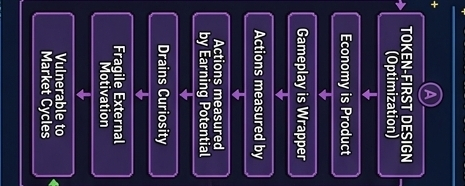
What stands out first is that Pixels doesn’t seem desperate to justify its own existence through its token. That alone separates it from a large portion of Web3 games, where the economy is the product and the gameplay is just a wrapper. In many of those cases, you can almost feel the design pulling you toward optimization from the very beginning. You’re not really playing; you’re calculating. Every action is subconsciously measured against its earning potential, and eventually that mindset drains any sense of curiosity.
Pixels takes a slower approach. It leans into being a world before it tries to be an economy. The farming, crafting, and exploration loops aren’t groundbreaking on their own, but they’re not aggressively engineered to push you into a grind either. There’s space to wander, to experiment, to interact without constantly feeling like you’re falling behind if you’re not maximizing output. That shift in pressure is subtle, but it changes how you engage with the game.
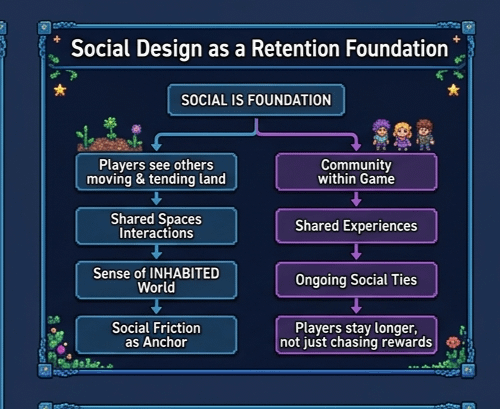
A big part of that comes from its social design, which feels less like an added feature and more like a foundation. In many Web3 games, “community” is something that exists outside the game itself, mostly on Discord or Twitter. Inside the game, players are often isolated, each running their own efficiency loop. Pixels flips that dynamic by making the presence of other players feel natural rather than forced.
You see people moving around, tending their land, interacting with shared spaces. It creates a sense that the world is inhabited, not just populated. That distinction matters. When a game feels alive, players tend to stay longer, not because they’re chasing rewards, but because they’re part of something that feels ongoing. Social friction, even in small amounts, can anchor players in ways that pure incentive systems cannot.
This is where Pixels starts to hint at a deeper understanding of retention. Most Web3 games rely heavily on external motivation. They bring players in with the promise of earning and try to sustain them with carefully balanced reward systems. The problem is that external motivation is fragile. The moment rewards drop or expectations shift, the entire structure starts to wobble.
Pixels doesn’t ignore incentives, but it doesn’t build everything around them either. It seems to recognize that long-term retention comes from a mix of internal and external motivation. Players need reasons to care that aren’t purely financial. Social ties, personal progression, and a sense of place all contribute to that. These are things traditional games have understood for years, but Web3 has often sidelined in favor of token mechanics.
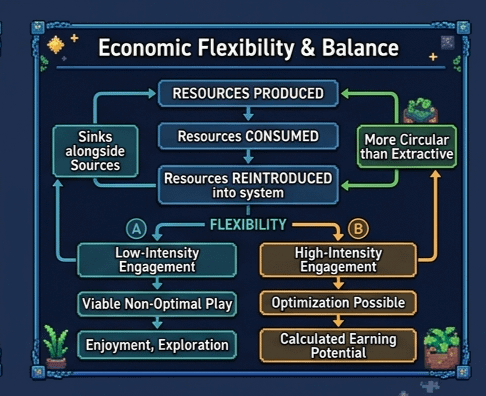
The economic structure of Pixels reflects this balance, though it’s not without its risks. At a glance, it appears more circular than extractive. Resources are produced, consumed, and reintroduced into the system in ways that at least attempt to avoid the typical boom-and-bust cycle. There’s an effort to create sinks alongside sources, which is essential for any economy that wants to last.
What’s interesting is that the economy doesn’t feel like it’s constantly pulling you into optimization mode. That doesn’t mean optimization isn’t possible—it absolutely is—but it’s not the only viable way to play. You can engage with the economy at different levels of intensity, which makes the system more flexible. That flexibility is often missing in Web3 games, where the optimal path quickly becomes the only path that makes sense.
Still, it would be naive to assume that this structure is immune to external pressure. Any game tied to a token will eventually face the realities of speculation, market cycles, and player behavior shifting toward profit-seeking. Pixels hasn’t solved that problem entirely. What it has done, though, is create a system that doesn’t immediately collapse under that pressure. Whether it can hold up over the long term is still an open question.
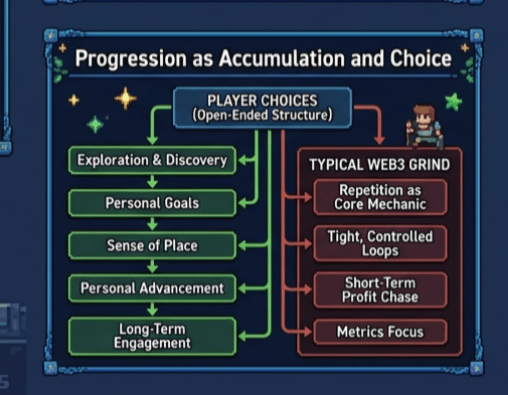
Progression is another area where Pixels quietly diverges from the norm. Instead of funneling players through tightly controlled loops designed to maximize engagement metrics, it leans into a more open-ended structure. You’re not constantly being pushed toward the next reward checkpoint. Instead, progression feels more like accumulation over time, shaped by your own choices rather than a predefined path.
This kind of design can be risky. Without clear direction, some players may feel lost or disengaged. But it also opens the door to a different kind of experience—one where progression isn’t just about efficiency, but about exploration and personal goals. In contrast, many Web3 games reduce progression to repetition. You perform the same actions over and over, not because they’re interesting, but because they’re profitable.
That difference ties back to a broader theme: player-first design versus token-first design. In a token-first system, everything revolves around sustaining the value of the token. Gameplay becomes a means to that end. In a player-first system, the goal is to create an experience that people actually want to engage with, regardless of the token. The token then becomes an extension of that experience, not its foundation.
Pixels leans closer to the player-first side, though it doesn’t fully escape the gravitational pull of its token. There are still moments where you can feel the tension between making the game enjoyable and maintaining economic balance. That tension is probably unavoidable in Web3, at least for now. The key difference is that Pixels doesn’t let the economy completely dictate the experience.
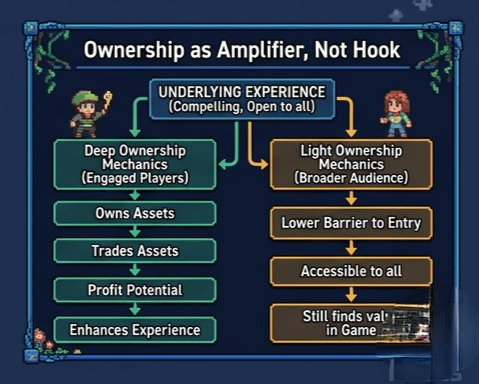
Ownership is another area where the game takes a more restrained approach. In many Web3 projects, ownership is treated as the core selling point. The assumption is that players will be drawn in by the ability to own assets, trade them, and potentially profit from them. But ownership on its own isn’t enough to sustain interest. If the underlying experience isn’t compelling, ownership just becomes a financial layer on top of a shallow game.
In Pixels, ownership feels more like an amplifier than a hook. It enhances the experience for those who choose to engage with it, but it’s not the main reason to play. You can still find value in the game without deeply interacting with its ownership mechanics. That’s an important distinction, because it lowers the barrier to entry and makes the game more accessible to a broader audience.
This also highlights the difference between real game economies and reward distribution models. A real economy involves meaningful interactions between players, resources, and systems. It has depth, friction, and unpredictability. A reward distribution model, on the other hand, is essentially a pipeline. Players perform actions and receive rewards in return, often with little variation.
Pixels moves closer to the former, though it’s still evolving. There are elements of a genuine economy, but they coexist with more traditional reward structures. The challenge will be gradually shifting the balance toward systems that feel organic rather than scripted. That’s not an easy transition, especially in a space where players are often conditioned to expect immediate returns.
Ultimately, what makes Pixels interesting isn’t that it has solved the problems of Web3 gaming. It hasn’t. The same underlying tensions still exist, and the long-term sustainability of its systems is far from guaranteed. What it has done is create a different starting point. Instead of building a game around a token and trying to make it fun afterward, it starts with a world that people might actually want to spend time in.
That difference might not be enough to carry it through every market cycle or behavioral shift. But it does give it a stronger foundation than most. In a space dominated by short-term hype and rapid decline, that alone is worth paying attention to. Pixels feels less like a finished solution and more like an ongoing experiment—one that’s trying to figure out what Web3 games could look like if they prioritized players before profits.
Whether that experiment succeeds will depend on how it evolves under pressure. If it can maintain its balance between social design, economic structure, and player experience, it has a chance to outlast the usual hype cycles. If not, it risks becoming just another example of a promising idea that couldn’t escape the gravitational pull of its own token.
For now, though, it offers something rare in this space: a reason to log in that isn’t purely transactional. And that, more than any specific feature or system, might be its most important achievement.
