

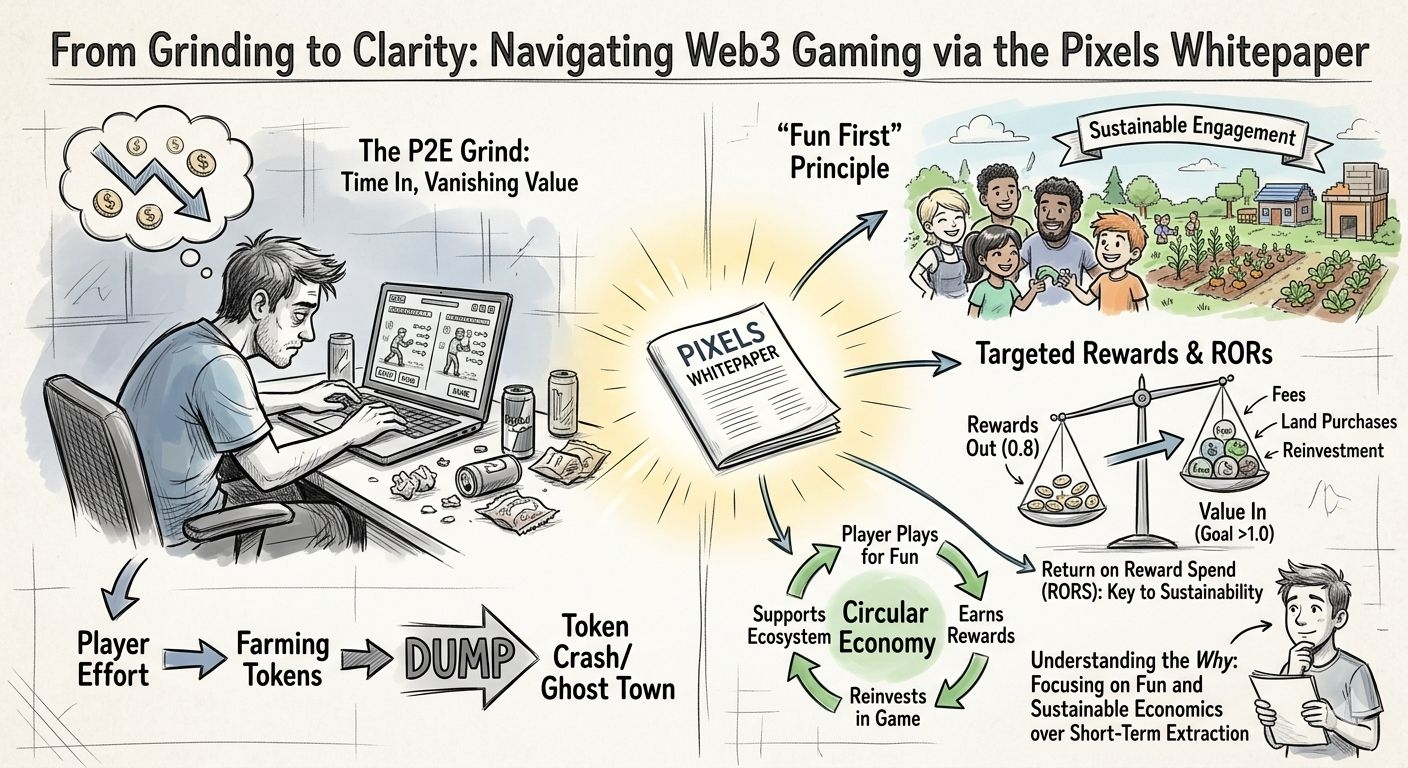
I still remember the exact moment I thought play-to-earn was going to change my life.
It was 2022. A friend of mine from university called me at midnight, genuinely excited, telling me he was making money just by playing a game on his laptop. I didn't sleep that night. By morning I had an account, a wallet, and a plan.
For a few weeks, it felt like the cheat code I'd always wanted. Wake up, grind, earn tokens, withdraw, repeat. I wasn't even enjoying the game. I was treating it like a second job — a boring one — but the money was coming in so I didn't care.
Then the token crashed. Then the players left. Then the game became a ghost town.
I lost most of what I'd earned and learned an expensive lesson that I'd go on to repeat in two more P2E games after that. The problem was never unique to one project. The whole model was broken. Everyone was extracting. Nobody was investing back. The moment the rewards slowed down, people disappeared — and the economy collapsed under its own weight.
That's exactly what Pixels admitted happened to them in 2024. They became the number one Web3 game by daily active users. They generated $20 million in revenue. By every surface-level metric, they were winning. But underneath, token inflation was eating them alive, rewards were going to the wrong players, and too many people were doing exactly what I used to do — taking value out without putting anything back in.
What impressed me about their whitepaper wasn't the technology. It was the honesty.
They identified the real problem: rewards weren't targeted. A player who genuinely loves the game and reinvests their earnings was getting the same treatment as someone who logs in, farms tokens, and immediately dumps them on the market. That's not a sustainable economy. That's a slow bleed.
Their solution is built around a metric called RORS — Return on Reward Spend. It works exactly like ROAS in digital marketing, comparing how much they give out in rewards versus how much comes back in fees. They're currently at 0.8. Their goal is to cross 1.0 — the point where the ecosystem becomes genuinely self-sustaining.
But the part that stuck with me the most was simpler than any metric. They wrote that the game needs to be fun first. No economic model saves a boring game. I think about every game I've played for years without earning a single rupee — and I played them because they were genuinely enjoyable. That's the standard Web3 gaming has never consistently met, and Pixels is finally saying it out loud.
The bigger vision is ambitious — building decentralized infrastructure for player acquisition across both Web3 and Web2 games. Essentially replacing the need to spend millions on Meta and Google ads by using real player data to identify who is actually worth rewarding.
I don't know if they'll fully pull it off. But they're asking the right questions. And after years of losing money on projects that never did — that alone feels like progress.