
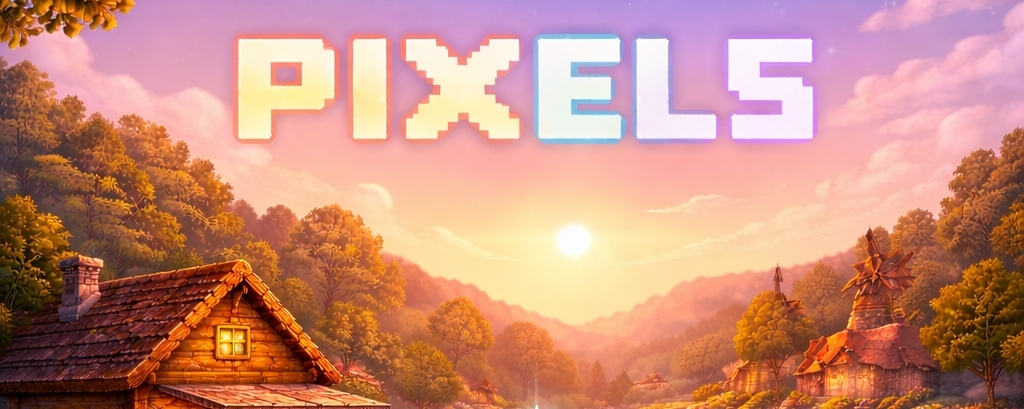
There’s a strange thing that can happen while playing Pixels (PIXEL).
At some point, often without noticing exactly when, you stop thinking about the fact that you’re playing a Web3 game.
You stop thinking about systems.
You stop thinking about progression.
You stop thinking about whether what you’re doing is “efficient.”
And you just start playing.
That shift feels small, but it says something important.
Because many games, especially in Web3, tend to make you constantly aware of their structure. You feel the mechanics. You feel the incentives. You feel the weight of the systems working in the background.
With Pixels (PIXEL), that awareness often softens.
And in some ways, that may be one of its strongest design choices.
The experience rarely begins with urgency. It begins with ordinary actions.
You plant something.
Harvest something.
Move through a shared world.
Maybe organize your land.
Maybe wander with no clear objective at all.
Nothing about those moments is trying to overwhelm you. There is no dramatic escalation demanding attention. No constant sense that you are falling behind if you move slowly.
Instead, there is rhythm.
And rhythm can be surprisingly powerful.
Because rhythm creates comfort.
And comfort creates return.
That may sound almost too simple, but simplicity is often underestimated.
Especially in a space where complexity has frequently been mistaken for depth.
Web3 gaming has often leaned toward systems-heavy thinking. Economic structures, layered mechanics, optimization loops, ownership models—all important in their own ways, but often introduced as if more moving parts automatically create stronger experiences.
But more systems do not always create more meaning.
Sometimes they create more friction.
And friction, over time, wears people down.
Pixels (PIXEL) often feels like a quiet argument against that.
Not through theory.
Through experience.
It suggests that depth can emerge through consistency.
That attachment can emerge through repetition.
That players do not always need more mechanics.
Sometimes they need more room.
That room is part of what makes the gameplay loops feel stronger than they appear on paper.
Farming is repetitive, yes.
But repetition can either feel empty or grounding, depending on how it is framed.
Here, it often feels grounding.
Checking crops.
Replanting.
Expanding something slowly over days or weeks.
Watching small progress accumulate.
These things create a sense of continuity that more dramatic gameplay often struggles to replicate.
You are not always chasing a peak moment.
You are participating in a steady one.
And steady experiences often age well.
That same feeling extends into exploration.
There is a looseness to moving through the world that feels important.
You are not constantly being pushed toward the next objective.
You can wander because wandering feels worthwhile.
That freedom gives curiosity space to exist.
And curiosity is often more sustaining than obligation.
Which brings up retention.
Because Pixels (PIXEL) seems to approach retention differently from many systems built around pressure.
There is a difference between keeping players active and giving them reasons to return.
Those are not the same thing.
Activity can be driven by urgency.
Return is often driven by attachment.
And attachment tends to form when a world feels easy to continue.
That may be why Pixels (PIXEL) often feels less like something people manage and more like something they revisit.
A place you check in on.
A place where small routines have meaning.
A place where absence does not feel like punishment.
That last part matters.
Because many systems create retention by making absence costly.
Miss something, lose something.
Fall behind.
Break the streak.
That can work for a while.
But it often creates fragile engagement.
People stay because they feel they must.
Until eventually they don’t.
Pixels (PIXEL) often seems more interested in another kind of loyalty.
The kind built when people return voluntarily.
Because they want to see their farm again.
Because they enjoy the rhythm.
Because the world feels familiar.
That is a softer kind of retention.
But perhaps a stronger one.
And it connects closely to the social side of the game.
There is something understated about how community often forms here.
It does not always arrive through structured events or heavily engineered social systems.
It often emerges through repeated shared presence.
You pass other players.
See what they are building.
Recognize names over time.
Exchange small interactions.
Sometimes collaborate.
Sometimes simply exist alongside each other.
But even simple coexistence has weight.
Because it makes the world feel inhabited.
And inhabited worlds tend to matter more.
People often stay in online spaces not only because of what they can do there—
but because others make those spaces feel alive.
That feeling is difficult to force.
But powerful when it emerges naturally.
And perhaps that is part of why Pixels (PIXEL) feels meaningful as more than a single game.
It hints at something broader about what sustainable Web3 gaming might require.
Not only functioning systems.
But livable worlds.
Worlds people want to spend time in, even when they are doing very ordinary things.
That may sound almost too modest compared to the larger promises often made around Web3.
But modest ideas sometimes hold up better than grand ones.
Because they tend to be rooted in behavior.
And behavior is what ecosystems are ultimately built on.
Do people keep showing up?
Do they keep participating?
Do they continue caring after novelty fades?
Those are the harder questions.
And often the more important ones.
Pixels (PIXEL) does not answer them through spectacle.
It answers them through steadiness.
Through making simple loops feel enough.
Through trusting that calm does not have to mean shallow.
Through allowing social life to grow through routine.
Through treating presence itself as valuable.
That may be a quieter vision of gaming.
But quiet does not mean weak.
Sometimes it means durable.
And durability may matter more than intensity in the long run.
Especially as Web3 gaming moves beyond experimentation and starts confronting the question of what actually lasts.
Maybe the future is not only in more elaborate systems.
Maybe it is also in worlds that feel lighter to inhabit.
More human.
More forgiving.
More grounded.
Worlds that do not constantly ask players to prove commitment—
but make commitment grow naturally.
That feels close to what Pixels (PIXEL) is exploring.
Not by trying to be the loudest project in the room.
But by showing that sometimes the strongest ecosystems begin with something much simpler.
A world that feels good to return to.
And sometimes, that may be enough to build something that lasts.