
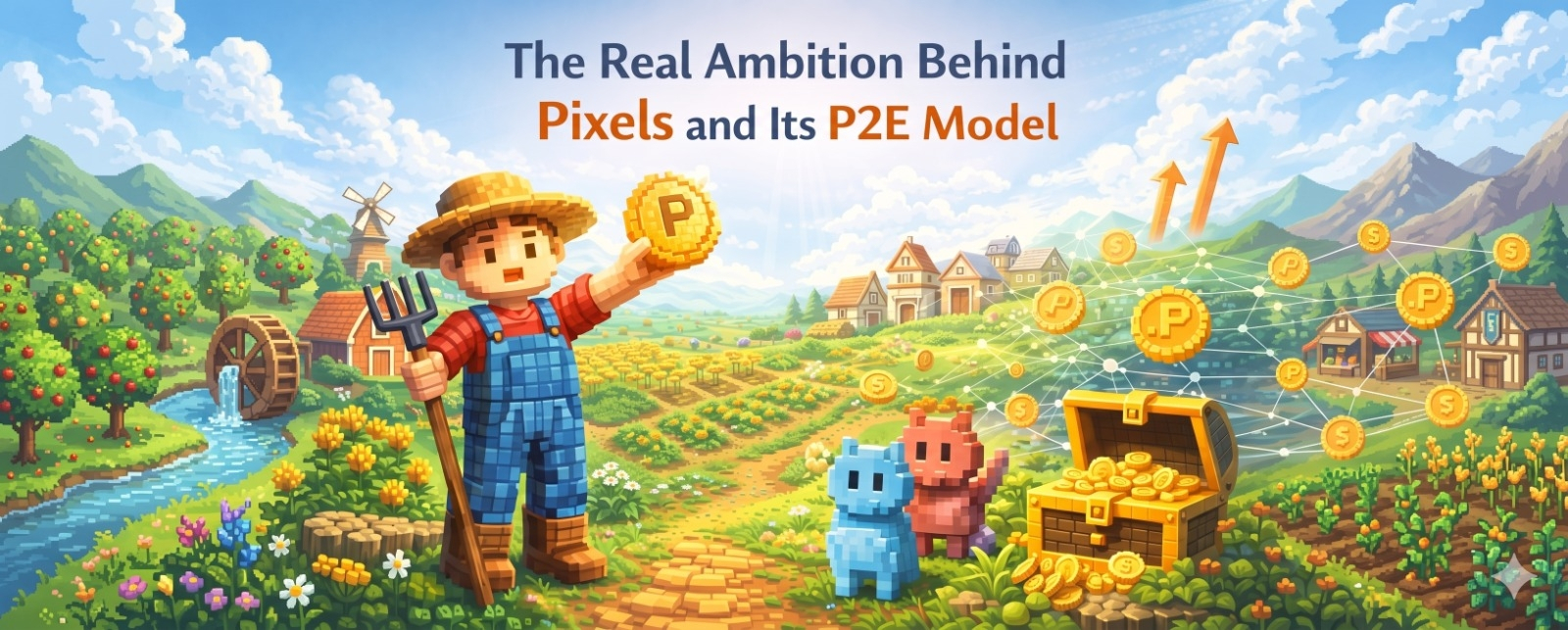
I keep coming back to Pixels with a very specific feeling, and it is not excitement in the usual sense, it is something quieter, something that builds slowly the more I sit with it. At first, it looks like a simple farming game living on the Ronin Network, something familiar and easy to understand, but the longer I think about it, the more I realize it is not trying to grab attention quickly. It is trying to hold it gently. And there is a difference between those two things that becomes clearer over time.
When I look at how Pixels is designed, it feels like the project is asking a different question than most Web3 games. It is not asking how to make players earn fast or react fast, it is asking what makes someone stay. That shift changes everything. The world is open, but not overwhelming. I can start small, planting crops, walking around, doing simple tasks that do not feel heavy or forced. Then slowly, almost without noticing, more layers begin to appear. I start unlocking recipes, understanding systems, finding little efficiencies in how I use my time. It becomes less about completing actions and more about watching something grow because I kept showing up.
The farming is where it begins, but it does not stay there. Exploration adds movement to the experience, quests bring small pieces of story, and crafting ties everything together in a way that feels natural. Nothing feels isolated. If I spend time in one part of the game, it quietly supports another. That is where the rhythm of Pixels starts to make sense. It is not trying to overwhelm me with features. It is letting me discover them at my own pace, and that makes the experience feel more personal, like I am building my own way through it instead of following a fixed path.
There is also something important in how the game treats ownership. Land exists, and it matters, but it does not stand in the way of playing. I can still participate, still grow, still progress without needing to own anything from the start. If I decide to go deeper, those options are there, but they do not define my experience. That balance makes the world feel more open. It does not divide players into those who can and those who cannot. It gives space for both, and that choice changes the tone of everything.
The same feeling carries into the token system. PIXEL is present, but it does not dominate the experience. It supports things like upgrades, cosmetics, and small boosts, but it does not replace the core of the game. If I ignore it for a while, the world still makes sense. I can still play, still progress, still enjoy what I am doing. That tells me something important. The game is not leaning on the token to feel valuable. It is trying to create value through the time I spend inside it.
When Pixels moved into the Ronin ecosystem, it felt like a natural fit rather than a forced shift. Everything becomes a little smoother, a little more connected, and it feels like the game is sitting in an environment that understands what it is trying to be. It is not just about technology. It is about being in a place where games are treated as the main focus, not just another use case.
What I find myself noticing the most is how the world changes without losing its shape. Updates come in, systems evolve, new features appear, but nothing feels like it resets the experience. It builds on what is already there. Systems like reputation, community interaction, and shared spaces begin to matter more over time. It is not just about what I do alone. It is about how I exist alongside others, how I contribute, how I stay consistent. The game starts to recognize that in small ways, and those small ways add up.
There is also a deeper layer that sits underneath everything. Pixels is not only building a game. It is building a structure that can support more worlds, more experiences, more creativity over time. That means it is not fixed. It is something that can grow without breaking itself. And that idea changes how I see it. It is not about reaching a final version. It is about continuing to become something more while still feeling familiar.
When I step back and look at it honestly, Pixels does not feel loud or urgent, and maybe that is exactly why it works. It does not try to pull me in with pressure. It gives me space to enter on my own terms. The progress feels steady, the systems feel connected, and the world feels like it has room for me to exist in it without needing to rush.
In the end, Pixels leaves me with a simple feeling that stays longer than I expect. It feels patient. It feels like a place where time matters, where small actions slowly turn into something meaningful, where showing up again and again quietly shapes the experience. It does not promise anything dramatic. It does something more difficult. It gives me a reason to stay, and over time, that reason starts to feel real.