Huh
I didn’t think much about it at first. It just felt like another loop. Log in, plant something, harvest, repeat. The kind of system you don’t question because it’s already familiar from a dozen other games.
But after a few days, something felt slightly off. Not in a broken way. More like… uneven. Two players putting in similar time weren’t ending up in the same place. And it wasn’t skill. It wasn’t luck either. It was something quieter, harder to point at.
That’s when I started paying attention to how time behaves inside Pixels, not how it’s spent.
We usually assume time is neutral in these systems. An hour is an hour. If rewards differ, we explain it through strategy or optimization. But here, it feels like the system is reading time differently depending on how it’s structured. Not all activity lands the same way.
Some patterns seem to stick.
You notice it slowly. Certain routines just flow better. Rewards don’t spike dramatically, but they stop feeling random. There’s less friction. Fewer interruptions. It’s subtle enough that most people probably call it progress and move on. I don’t think it’s that simple.
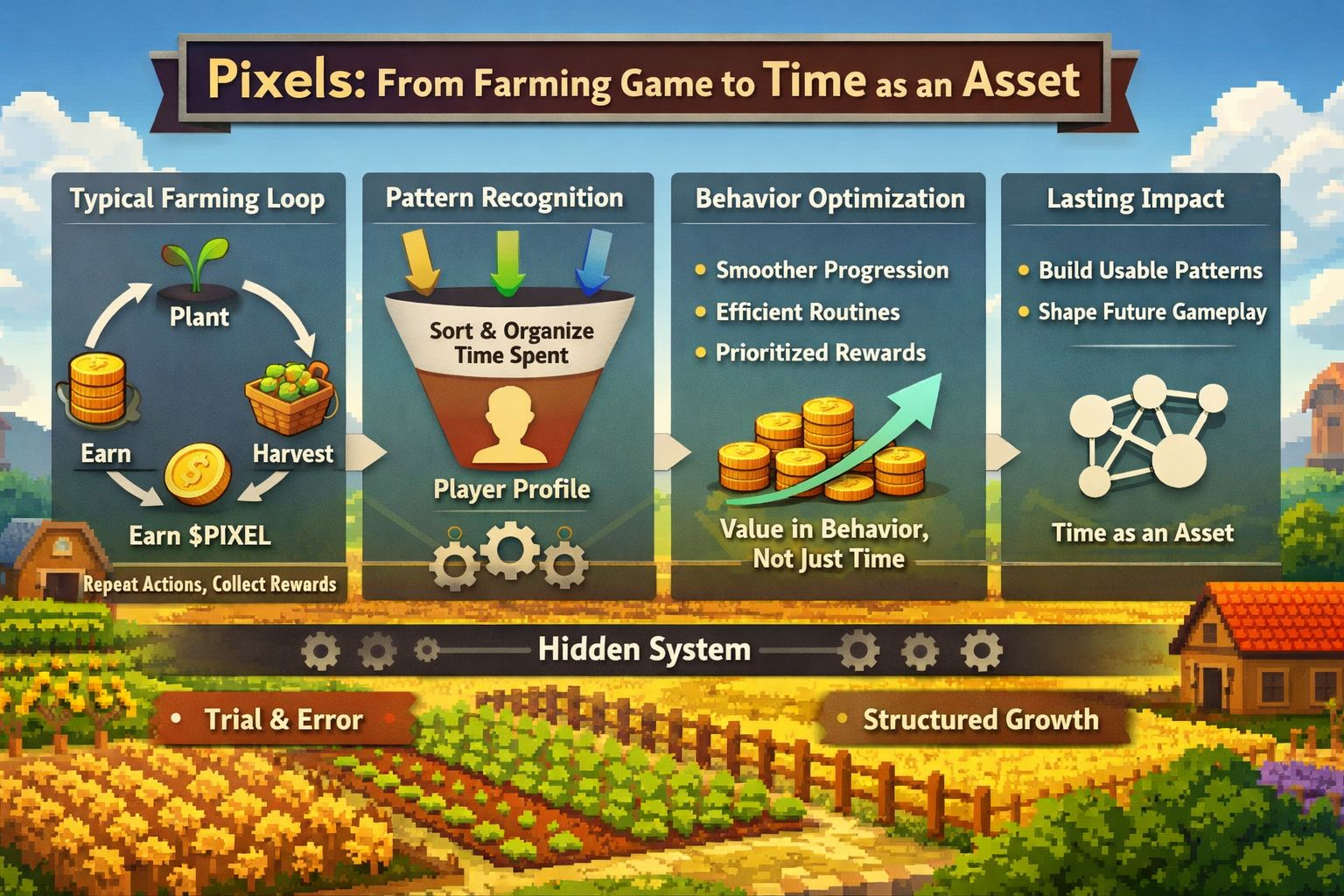
What looks like a farming loop might actually be closer to a sorting mechanism.
And that’s where $PIXEL starts behaving differently than it first appears. It’s easy to label it as a reward token. You do something, you get paid. Straightforward. But when the system begins to favor certain patterns of behavior, the token stops being neutral. It becomes part of how the system decides which time matters more.
Not in a moral sense. In a structural one.
I kept thinking about something outside crypto. Years ago, I watched how platforms started ranking sellers. Not just based on volume, but consistency. Delivery times. Repeat behavior. Small signals that compound. Over time, the platform doesn’t just reward effort. It rewards reliability. The predictable seller scales faster than the chaotic one, even if both are equally active.
Pixels gives me a similar feeling, just less explicit.
You can play randomly. Try different things. Explore. It works, but it doesn’t quite compound. Then you fall into a routine, maybe without realizing it, and suddenly things smooth out. Progress feels less like pushing and more like sliding forward. That shift is easy to ignore, but it matters.
Because once behavior becomes predictable, it becomes usable.
That’s the part most people aren’t really talking about. If a system can recognize patterns in how players act, it can start organizing those patterns. Not publicly, not with a leaderboard, but internally. Some behaviors get reinforced. Others fade into noise.
Time, in that sense, stops being just time. It becomes something closer to a profile.
Not identity in the usual sense. The system doesn’t need to know who you are. It only needs to understand how you behave. And once that behavior is stable enough, it can be reused. Maybe across sessions. Maybe across future games if the ecosystem expands the way it’s supposed to.
That’s where the asset idea starts to feel less abstract.
You’re not just accumulating tokens. You’re building a pattern that the system recognizes as valuable. $PIXEL sits somewhere in the middle of that process. It’s still a currency, sure. But it’s also part of how that recognition gets translated into outcomes. Faster progression. Better positioning. Smoother loops.
It doesn’t announce this. It just… happens.
And that creates a strange kind of tension. Because the more the system rewards predictable behavior, the more players start adjusting toward it. Not consciously at first. Then very consciously. You begin to optimize not for fun or exploration, but for what seems to work.
That’s efficient, but it’s also narrowing.
I’ve seen this in other systems. Once the reward structure becomes clear, behavior converges. Diversity drops. The system becomes easier to manage, but also less flexible. In a game context, that might show up as repetitive loops. In a broader ecosystem, it could affect how new mechanics get adopted or ignored.
There’s also the question of transparency. Right now, most of this sits below the surface. Players feel the difference, but they can’t fully explain it. That gap matters. When people can’t see how their time is being evaluated, they rely on trial and error. Or worse, they follow whatever patterns seem to work for others.
From a market perspective, this makes Pixels harder to read.
If demand were purely tied to player growth or spending, it would be more straightforward. But if the token is also involved in reinforcing certain behaviors, then its value is partially tied to how effectively the system can sort and reuse time. That’s not something you see on a chart. It builds quietly.
And it doesn’t scale the way people expect.
More players don’t automatically mean more value. More usable patterns might.
That’s a different kind of growth curve. Slower, maybe. Less obvious. But potentially more durable if it holds.
I’m not fully convinced yet. It’s still early, and a lot of this could just be emergent behavior rather than intentional design. Systems often look smarter than they actually are, especially when enough users interact with them.
Still, I can’t really unsee it now.
What looks like a simple farming loop might be doing something more selective underneath. Not just rewarding time, but organizing it. Deciding, quietly, which versions of player behavior are worth carrying forward.