

I didn’t expect to care much about a game like Pixels, at least not at first. On the surface, it looks like another soft, colorful farming world—the kind of place where you plant crops, wander around, maybe decorate a little plot of land and log off. But the more time I spent thinking about it, the more I realized it’s trying to be something slightly different… or maybe it’s the players who are turning it into something else entirely.
There’s something oddly calming about the loop of farming and exploration. It’s simple, almost deliberately so. You plant, you wait, you harvest, you repeat. Normally, that kind of gameplay would feel shallow after a while, but here it feels intentional—like the game isn’t rushing you toward anything. And that’s rare, especially in the Web3 space where everything often feels tied to urgency, value, or speculation.
That’s probably where my skepticism kicks in.
Because as much as Pixels presents itself as this cozy, social world, there’s still that underlying layer of blockchain mechanics. Ownership, tokens, economies—it’s all there, quietly sitting beneath the surface. And I keep wondering: does that change how people behave in the game? Are we really just playing, or are we constantly calculating, even subconsciously?
Sometimes it feels like both.
I’ve noticed that when a game introduces real value—even indirectly—it shifts the mood. The crops aren’t just crops anymore; they’re assets. Time spent isn’t just leisure; it becomes an investment. And while Pixels does a decent job of softening that feeling, it never fully disappears. At least not for me.
But then again, there are moments when it does.
Like when you’re just wandering around without a goal, bumping into other players, or discovering some small detail in the environment that clearly wasn’t designed for efficiency or profit. Those moments feel… genuine. Almost like the game is quietly asking you to ignore the “Web3” label and just exist in its world for a bit.
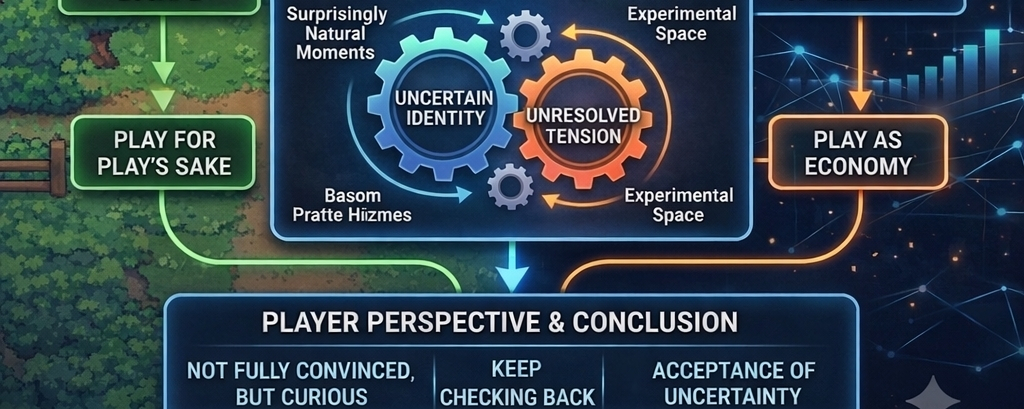
And I think that’s where Pixels becomes interesting—not as a blockchain project, but as an experiment in blending two very different mindsets. On one side, you have play for the sake of play. On the other, play that carries weight, ownership, maybe even consequence.
I’m not sure it fully resolves that tension.
Some days, it feels like a relaxing escape. Other days, it feels like a system you’re supposed to optimize. And maybe that inconsistency isn’t a flaw—maybe it’s just the reality of where games like this are headed.
What I keep coming back to is this: would I still play it if none of the Web3 elements existed?
I think I might. Not obsessively, not as a main game, but as something to return to when I want something slower, something quieter. And that says a lot, because it means there’s an actual game here, not just a framework built around tokens.
Still, I can’t shake the feeling that Pixels is in a kind of in-between state. It’s not purely a game, and it’s not purely an economy. It’s trying to be both, and sometimes it succeeds in ways that feel surprisingly natural… and other times it reminds you exactly how experimental this whole space still is.
Maybe that’s the point, though.
Maybe Pixels isn’t meant to feel completely resolved. Maybe it’s supposed to feel a little uncertain, a little unfinished in its identity—because that’s exactly where this entire idea of Web3 gaming still stands.
And I guess I’m okay with that. Not convinced, not fully invested, but curious enough to keep checking back and seeing what it becomes next.