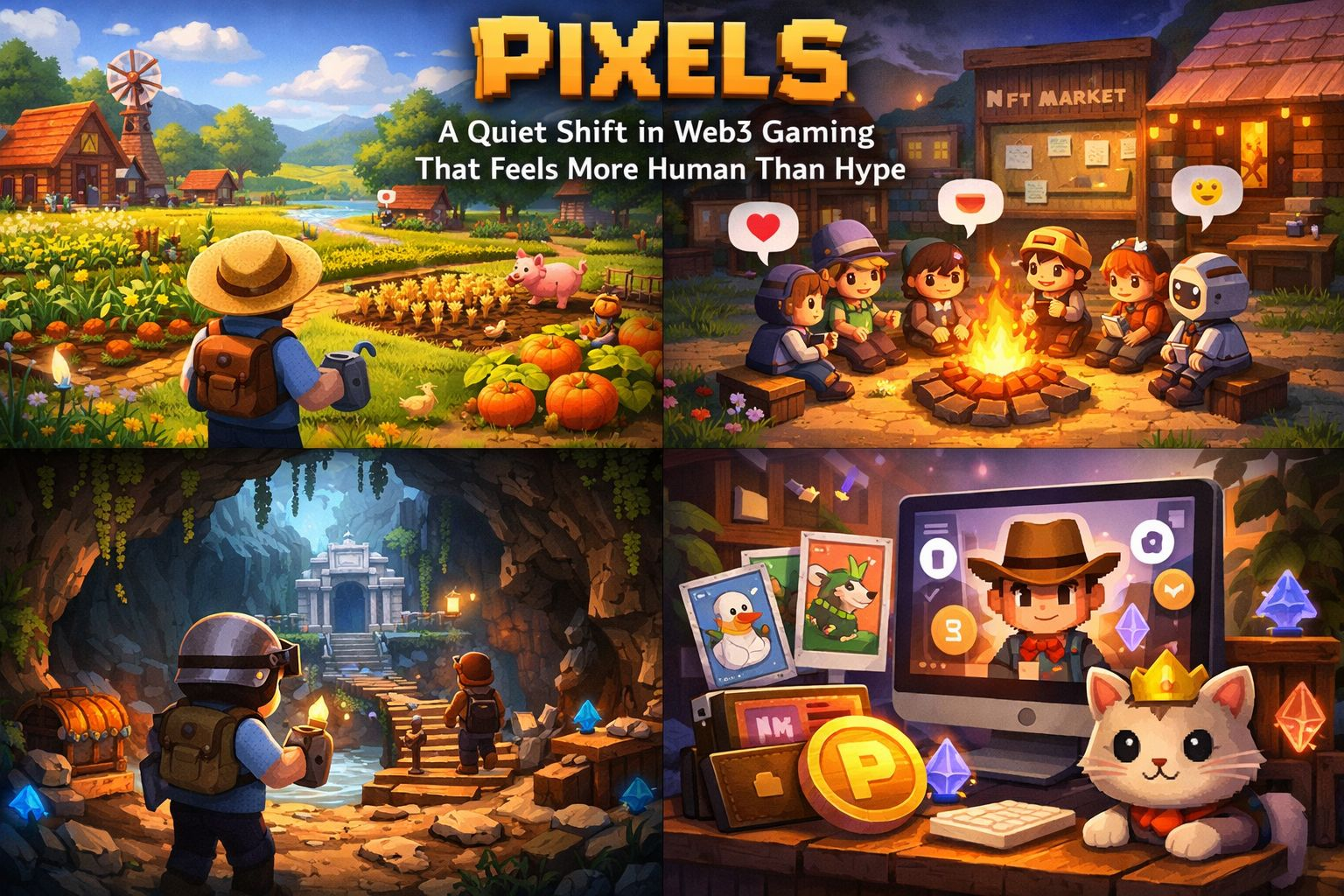
I’ll be honest—when I first came across Pixels, I didn’t feel that usual spark of excitement people often talk about in Web3. There was no flashy trailer pulling me in, no overwhelming promise of “next big thing” energy. It looked simple. Almost too simple. A pixel-style farming world, slow-paced, quiet, and familiar in a way that made me think I already understood it.
And maybe that’s exactly why I stayed.
Because the longer I spent looking at it, the more I realized Pixels wasn’t trying to impress me in the usual ways. It wasn’t shouting for attention. It was just there—steady, calm, and surprisingly inviting. And in a space where everything moves fast and burns out even faster, that kind of presence feels rare.
At its core, Pixels is built around farming, exploration, and creation. You plant crops, gather resources, move through a shared world, and slowly build your own routine. There’s no rush. No pressure pushing you to optimize every move. It feels closer to something you’d casually return to at the end of a long day rather than something demanding constant focus.
And that feeling—comfort, not urgency—is where Pixels quietly separates itself.
Technically, the game runs on the Ronin Network, a system designed specifically for gaming environments. But what matters isn’t the technical label—it’s how it feels. There’s no lag from transactions interrupting your flow, no constant reminders that you’re interacting with blockchain infrastructure. You’re not thinking about gas fees or confirmations. You’re just moving, planting, collecting, and exploring without friction.
That smoothness does something subtle. It lets you forget about the technology entirely.
And maybe that’s the point.
Because most players don’t log into a game thinking about blockchains or tokens. They log in because they want to enjoy themselves, even if just for a few minutes. Pixels seems to understand that better than most Web3 projects. It doesn’t try to educate you upfront. It lets you experience first, and understand later.
There’s also something interesting happening beneath the surface with how the economy is structured. Pixels doesn’t force everything onto the blockchain. Instead, it uses a mix—basic gameplay actions happen off-chain, while ownership and certain assets connect to the on-chain side through the PIXEL token.
That balance might sound like a technical choice, but it changes how the entire experience feels.
In many Web3 games, every action carries weight. You’re constantly aware that what you’re doing has financial implications. Over time, that awareness shifts your mindset. You stop playing freely and start calculating outcomes. You begin asking what’s “worth it” instead of what’s enjoyable.
Pixels doesn’t completely remove that dynamic, but it softens it.
You can play casually without ever thinking about tokens. Or you can engage with the economy if that’s something you enjoy. The game doesn’t force you into one path. It leaves space for both kinds of players—and that flexibility might be one of its strongest design choices.
I couldn’t help but think about Axie Infinity while exploring Pixels. Axie was a defining moment for Web3 gaming. It showed what was possible, but it also revealed what could go wrong. When a game becomes too focused on earning, it starts to lose something essential. Players don’t stay because they love the experience—they stay because they need the rewards to make sense.
And when those rewards weaken, everything else collapses with them.
Pixels feels like it’s trying to avoid that outcome. It shifts the focus back toward the experience itself. You’re not constantly reminded to maximize efficiency. Sometimes you’re just wandering, planting, interacting, and existing in the world without a clear objective.
And strangely, that lack of pressure makes the experience stronger.
There’s also a social layer that builds slowly over time. You begin to notice other players, shared spaces, and small interactions that make the world feel active. It’s not overwhelming or overly structured. It doesn’t push you into forced collaboration. It just exists quietly in the background, waiting for you to engage with it if you choose to.
And that made me think about something simple but important.
Maybe what Pixels is really building isn’t just a game or an economy—but a space.
A place where players can show up, do something small, and leave without feeling drained. A place that doesn’t demand constant attention or reward optimization. In a way, it feels closer to older online worlds, where the value came from being present rather than constantly progressing.
Of course, there are still uncertainties.
The PIXEL token is part of the system, and like any crypto asset, its future depends on how the ecosystem evolves. If the balance between gameplay and incentives shifts too far in one direction, it could change how players interact with the game. That’s always the risk in Web3—economics and experience are tightly connected.
And then there’s the question of growth.
Right now, Pixels feels controlled and comfortable. But what happens if it scales significantly? Can it maintain this calm, organic feel while expanding its player base and economy? Or will it face the same pressures that have affected other projects?
Those are open questions, and they don’t have easy answers.
But maybe what matters more is the direction Pixels is heading.
It feels like part of a broader shift happening in Web3 gaming—a move away from loud promises and short-term incentives, toward something more grounded. Less focus on extracting value, more focus on creating experiences people actually want to return to.
And that shift feels overdue.
I keep coming back to a simple thought: if you removed the blockchain layer completely, would Pixels still work as a game?
And the answer, at least for me, is yes.
That’s not something I can say about most Web3 titles. Many of them rely on their economic systems to stay relevant. Pixels feels like it could stand on its own, even without that layer. And that’s a strong foundation to build on.
Because once a game is genuinely enjoyable, everything else becomes optional.
Ownership becomes an added benefit, not the main reason to play. Tokens become tools, not the goal. And suddenly, the entire experience feels lighter, more natural, and more sustainable.
So where does Pixels go from here?
It could evolve into something bigger—expanding its economy, integrating with other platforms, becoming part of a wider digital ecosystem. Or it could remain focused, refining what it already does well and building a dedicated community around it.
Either path could work.
But the real question is whether it can hold onto this feeling—the sense that you’re playing because you want to, not because you have to.
Because if Pixels manages to protect that, it won’t just succeed as a Web3 game.
It might quietly redefine what a Web3 game is supposed to feel like.